

DC Customer Order Limits vs UP Order Limits Quantity Break
Two Shopify apps, side by side: detected stores, momentum, reviews, plans, listed features and who runs each. Store counts as of Nov 15, 2026.
The short answer
- UP Order Limits Quantity Break is detected on 2× as many Shopify stores as DC Customer Order Limits: 613 vs 310 as of Nov 15, 2026.
- On the Shopify App Store: DC Customer Order Limits 4.6 from 50 reviews and UP Order Limits Quantity Break 4.9 from 102 reviews.
- DC Customer Order Limits lists 13 features UP Order Limits Quantity Break’s listing doesn’t mention, including Availability date, Back orders, Coming soon.
Head to head


- United States
- United Kingdom
- Australia
- United States
- Germany
- United Kingdom
Momentum
New reviews each month
Review pace is the clearest public read on how fast an app is winning new merchants.
Basic
- · Back in stock demand analytics
- · Capped order limits
- · Free browser push restock alerts
- · Unlimited back in stock signups
- · Up to 10 monthly orders
Pro
- · Checkout rules for payment & shipping
- · Lifetime purchase tracking per customer
- · Unlimited back in stock email alerts
- · Unlimited monthly orders
- · Variant-level restock campaigns
Coverage counts what each App Store listing names. Every feature, checked off app by app, is in Shoplist.
See every featureSet order limits that remember your customers. Create customer lifetime purchase limits by quantity or spend, tracked across all orders, not just per cart. Add min/max cart limits, weight and mixed cart rules by product, variant or tag, with clear customer limit messages at checkout. Sold out? Add a Notify me form so shoppers join the waitlist, then send notify me alerts by email and browser push when you restock.
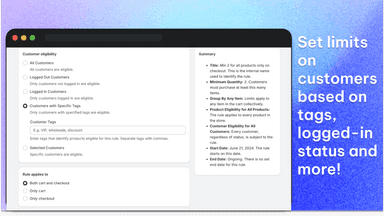
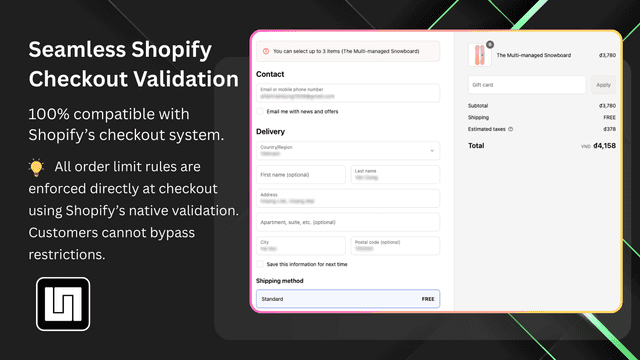
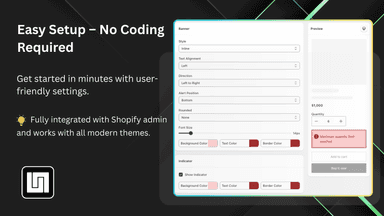
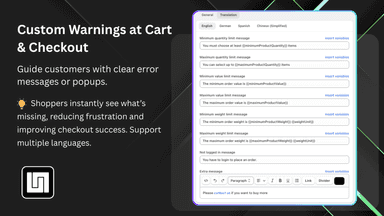
Easily create minimum and maximum order limits, quantity breaks for products, variants, collections, or entire carts. Control purchases by quantity, value, or weight with fully customizable rules. Show clear alerts on cart or checkout, Prevent fraud or bulk purchases, and streamline your store operations. No coding required – quick setup, theme-friendly, and optimized for sales and inventory management.
- Set cart limits on quantity and price to control order size and value
- Limit orders on entire cart, groups, products or specific product variants
- Set up pre-orders and B2B pre-sales to increase revenue and maximize sales
- Handle complex ordering scenarios, including different ship dates and variants
- Set order limit based on product quantity, total value or weight
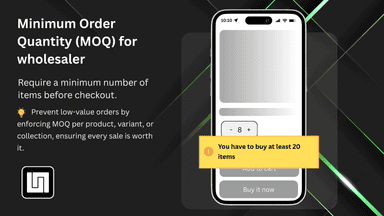
- Set MOQ limit quantity for product, variant or collection
- Set limit for wholesaler with customer tags, allow to contact for quotation
- Set limits based on each customer's purchase frequency. Integrate checkout rules





All the numbers
Every figure, side by side
A green dot marks the app ahead on a measured figure. Estimates, gaps and apps that leave no storefront trace never take the lead.
Adoption
| Measure |  DC Customer Order Limits |  UP Order Limits Quantity Break |
|---|---|---|
| Detected stores | 310 | 613(ahead) |
| Net store change, 28 days | −1 | +22 |
| Stores added, 28 days | 4 | 35(ahead) |
| Big-brand share | 13% | 10% |
| Top store categories | Apparel & Accessories, Health & Beauty, Home & Garden | Food, Beverages & Tobacco, Health & Beauty, Apparel & Accessories |
| Top store countries | United States, United Kingdom, Australia | United States, Germany, United Kingdom |
Reviews
| Measure | DC Customer Order Limits | UP Order Limits Quantity Break |
|---|---|---|
| App Store rating | 4.6 ★ | 4.9 ★(ahead) |
| App Store reviews | 50 | 102(ahead) |
| New reviews, 28 days | 0 | Not enough data |
| Reviewers a year or more in | Not enough data | 0% |
Pricing
| Measure | DC Customer Order Limits | UP Order Limits Quantity Break |
|---|---|---|
| Free plan | Not listed | Not listed |
| Lowest paid monthly plan | $14/month | No monthly plan listed |
| Longest free trial | 3 days | Not listed |
| Plans listed | 2 | Not published |
Listing
| Measure | DC Customer Order Limits | UP Order Limits Quantity Break |
|---|---|---|
| Shopify category rank | #18 | #8(ahead) |
| Shopify App Charts | Not on this week’s charts | #11 in Order limits |
| Built for Shopify | No | Yes |
| Launched | Jan 1, 2020 | Sep 12, 2025 |
| Languages | 1 | 15 |
| Developer | Dash Checkout | Uppush |
FAQ
DC Customer Order Limits and UP Order Limits Quantity Break: common questions
- Which is more popular, DC Customer Order Limits or UP Order Limits Quantity Break?
- UP Order Limits Quantity Break is detected on 2× as many Shopify stores as DC Customer Order Limits: 613 vs 310 as of Nov 15, 2026.
- Which has better reviews, DC Customer Order Limits or UP Order Limits Quantity Break?
- On the Shopify App Store: DC Customer Order Limits 4.6 from 50 reviews and UP Order Limits Quantity Break 4.9 from 102 reviews.
- What features does each app list that the other doesn’t?
- DC Customer Order Limits lists 13 the others don’t mention, such as Availability date, Back orders, Coming soon, Geolocation. UP Order Limits Quantity Break lists 6 the others don’t mention, such as Customer groups, Customer tagging, Multi-currency, Net terms. A feature missing from a listing may still be supported; this compares what each App Store listing says.
- Where does this comparison’s data come from?
- Shoplist crawls Shopify storefronts to detect which apps each store runs, and reads each app’s Shopify App Store listing for reviews, pricing, features and integrations. Store counts are as of Nov 15, 2026; estimated figures are labeled.
Keep comparing
More matchups
- Preorder, Back in stock Duck vs DC Customer Order Limits
- Avada Order Limits Quantity vs UP Order Limits Quantity Break
- DC Customer Order Limits vs P: Order Limits Quantity
- UP Order Limits Quantity Break vs Melon Minimum Order Quantity
- DC Customer Order Limits vs Min&Max Limits by Limitsify
- UP Order Limits Quantity Break vs Yuko Minimum Order Quantity


How Shoplist compares apps
Store counts come from Shoplist’s crawl of Shopify storefronts, which detects the apps each store runs; they are as of Nov 15, 2026. Reviews, ratings, plans, features and integrations come from each app’s Shopify App Store listing. 28-day figures are labeled when estimated, and a figure that is missing or estimated never decides who leads. Read the methodology.