
StockPing vs StockPing: Back in Stock
Two Shopify apps, side by side: detected stores, momentum, reviews, plans, listed features and who runs each. Store counts as of Oct 13, 2026 for StockPing, Nov 18, 2026 for StockPing.
The short answer
- Only StockPing lists a free plan. Paid plans start at $4.99/month for StockPing and $9.99/month for StockPing.
- StockPing lists 5 features StockPing’s listing doesn’t mention, including Auto-alerts, Customer demand, Notification button.
Head to head

Basic
- · Back in stock notifications
- · Email notifications
- · Up to 500 subscribers
Pro
- · Back in stock notifications
- · Email notifications
- · Priority support
- · Unlimited subscribers
Free
- · 5 alerts to try it out
- · Branded back-in-stock emails
- · Online Store notify-me form
Starter
- · $0.40 per 100 extra alerts
- · 1,000 alerts a month
- · Email design and languages
- · Online Store + 1 Hydrogen storefront
Growth
- · $0.40 per 100 extra alerts
- · 5,000 alerts a month
- · Email design and languages
- · Online Store + 2 Hydrogen storefronts
Pro
- · $0.30 per 100 extra alerts
- · 20,000 alerts a month
- · Send from your own domain
- · Unlimited storefronts
Coverage counts what each App Store listing names. Every feature, checked off app by app, is in Shoplist.
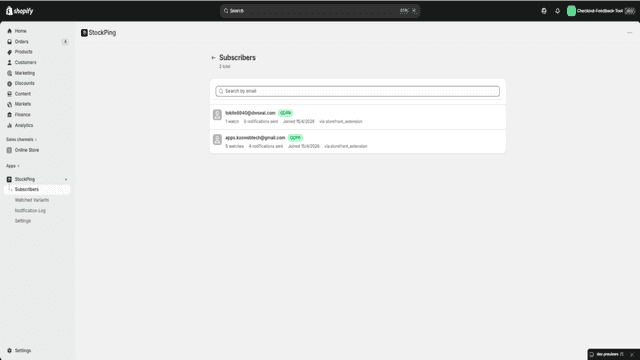
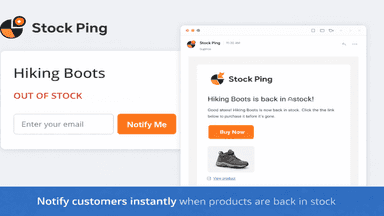
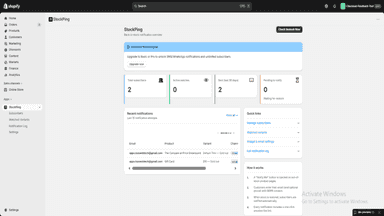
See every featureStock Ping helps merchants recover lost sales caused by out-of-stock products. Customers can subscribe using a “Notify Me” option on the product page, and once the product or selected variant is restocked, they receive an automatic email with a direct link. This ensures a smooth return-to-purchase experience. The app is simple, lightweight, and fully automated, reducing manual effort.
When a size or color sells out, StockPing puts a "Notify me" form on the product page. Shoppers leave their email, and once that exact variant is back and buyable, they get one email with a link straight to it. Built for headless too: add any number of Hydrogen storefronts, each with its own branding and email design.
- Automatic back-in-stock email alerts sent to subscribed customers
- Variant-specific alerts with direct links to the selected product
- “Notify Me” button displayed on out-of-stock product pages
- Works on Hydrogen too: a ready-made React form and its own email branding
- A Notify me form on sold-out variants, added from the theme editor
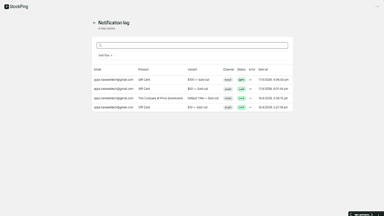
- One email per sign-up, sent only when that variant can really be bought
All the numbers
Every figure, side by side
A green dot marks the app ahead on a measured figure. Estimates, gaps and apps that leave no storefront trace never take the lead.
Adoption
| Measure |  StockPing | |
|---|---|---|
| Detected stores | Not published | Not published |
| Net store change, 28 days | 0 | 0 |
| Stores added, 28 days | Not enough data | Not enough data |
| Big-brand share | Not enough data | Not enough data |
| Top store categories | Not published | Not published |
| Top store countries | Not published | Not published |
Reviews
| Measure | StockPing | |
|---|---|---|
| App Store rating | Not published | Not published |
| App Store reviews | Not published | Not published |
| New reviews, 28 days | Not enough data | Not enough data |
| Reviewers a year or more in | Not enough data | Not enough data |
FAQ
StockPing and StockPing: common questions
- Is StockPing or StockPing cheaper?
- Only StockPing lists a free plan. Paid plans start at $4.99/month for StockPing and $9.99/month for StockPing. Shoplist compares base prices only between monthly plans in the same currency; usage charges and annual plans vary, so check each plan’s limits.
- What features does each app list that the other doesn’t?
- StockPing lists 3 the others don’t mention, such as Inventory tracking, Pop-ups, Stock counter. StockPing lists 5 the others don’t mention, such as Auto-alerts, Customer demand, Notification button, Notification templates. A feature missing from a listing may still be supported; this compares what each App Store listing says.
- Where does this comparison’s data come from?
- Shoplist crawls Shopify storefronts to detect which apps each store runs, and reads each app’s Shopify App Store listing for reviews, pricing, features and integrations. Store counts are as of Oct 13, 2026 for StockPing, Nov 18, 2026 for StockPing; estimated figures are labeled.
How Shoplist compares apps
Store counts come from Shoplist’s crawl of Shopify storefronts, which detects the apps each store runs; they are as of Oct 13, 2026 for StockPing, Nov 18, 2026 for StockPing. Reviews, ratings, plans, features and integrations come from each app’s Shopify App Store listing. 28-day figures are labeled when estimated, and a figure that is missing or estimated never decides who leads. Read the methodology.