

SolveDPP: DPP Product Passport vs Tracehub
Two Shopify apps, side by side: detected stores, momentum, reviews, plans, listed features and who runs each. Store counts as of Oct 13, 2026.
The short answer
- Both list a free plan. Paid plans start at $9.99/month for SolveDPP and $39/month for Tracehub.
- Tracehub lists 7 features SolveDPP’s listing doesn’t mention, including Bulk import and export, Data sync, JSON.
Head to head


Free
- · 5 DPPs
Pro
- · AI autofill
- · Removes 'by solveDPP' branding
- · Unlimited DPPs
Starter
- · 70 DPPs
- · AI autofill
Free
- · 10 AI operations/month
- · QR codes & product sync
- · Up to 10 products & DPPs
Starter
- · 100 AI operations/month
- · Analytics dashboard
- · Storefront integration
- · Up to 100 products & DPPs
Pro
- · 1,000 AI operations/month
- · Custom brand fonts
- · Multi-language support
- · PDF export & bulk operations
Enterprise
- · Advanced insights
- · Audit-ready reports
- · Custom categories & fields
- · Multi-store support
- · Optional variant-specific DPPs
- · Unlimited AI operations
Coverage counts what each App Store listing names. Every feature, checked off app by app, is in Shoplist.
See every featureThe EU Ecodesign Regulation (ESPR) will soon make Digital Product Passports mandatory for many product categories. This app simplifies the entire compliance process: create and manage Digital Product Passports (DPP) directly in your shop and share them with your customers via QR code. Capture material data, environmental impact, and traceability in one central place – no spreadsheets or external tools needed.
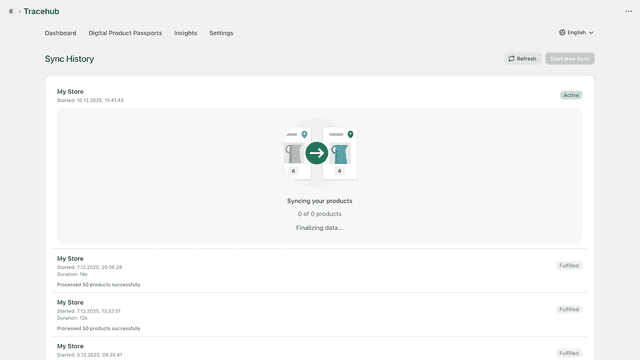
Prepare your store for EU ESPR compliance with Digital Product Passports. The EU Ecodesign for Sustainable Products Regulation (ESPR) requires Digital Product Passports (DPP) for products sold in the European market. Tracehub helps you create, manage, and display compliant product passports before the 2027 deadline. ESPR is EU legislation requiring detailed sustainability information for products.
- Erstelle konforme digitale Produktpässe für Dein Sortiment.
- Generiere scanbare QR-Codes für Deine physischen Produktetiketten.
- Integriere öffentliche Compliance-Seiten direkt in Deinen Shop.
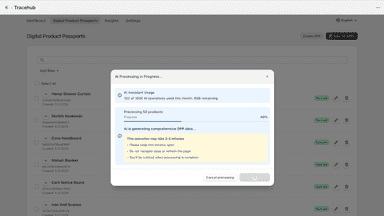
- AI-Powered Auto-Fill: Reduce manual data entry - complete DPPs in 2 min.
- Automatic Sync: Product import from Shopify - DPPs created automatically.
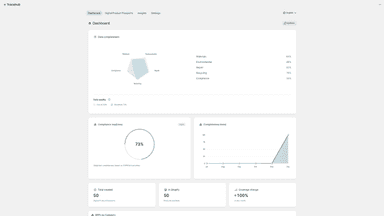
- Smart Insights: Identifies products with potential for higher perceived value.
- Storefront integration: Display DPPs with QR code, Sustainability Badge + more.


All the numbers
Every figure, side by side
A green dot marks the app ahead on a measured figure. Estimates, gaps and apps that leave no storefront trace never take the lead.
Adoption
| Measure |  SolveDPP |  Tracehub |
|---|---|---|
| Detected stores | Not published | Not published |
| Net store change, 28 days | 0 | 0 |
| Stores added, 28 days | Not enough data | Not enough data |
| Big-brand share | Not enough data | Not enough data |
| Top store categories | Not published | Not published |
| Top store countries | Not published | Not published |
Reviews
| Measure | SolveDPP | Tracehub |
|---|---|---|
| App Store rating | 5.0 ★ | Not published |
| App Store reviews | 1 | Not published |
| New reviews, 28 days | Not enough data | Not enough data |
| Reviewers a year or more in | Not enough data | Not enough data |
FAQ
SolveDPP and Tracehub: common questions
- Is SolveDPP or Tracehub cheaper?
- Both list a free plan. Paid plans start at $9.99/month for SolveDPP and $39/month for Tracehub. Shoplist compares base prices only between monthly plans in the same currency; usage charges and annual plans vary, so check each plan’s limits.
- What features does each app list that the other doesn’t?
- SolveDPP lists 1 the others don’t mention, such as Custom text. Tracehub lists 7 the others don’t mention, such as Bulk import and export, Data sync, JSON, Metafields editor. A feature missing from a listing may still be supported; this compares what each App Store listing says.
- Where does this comparison’s data come from?
- Shoplist crawls Shopify storefronts to detect which apps each store runs, and reads each app’s Shopify App Store listing for reviews, pricing, features and integrations. Store counts are as of Oct 13, 2026; estimated figures are labeled.
How Shoplist compares apps
Store counts come from Shoplist’s crawl of Shopify storefronts, which detects the apps each store runs; they are as of Oct 13, 2026. Reviews, ratings, plans, features and integrations come from each app’s Shopify App Store listing. 28-day figures are labeled when estimated, and a figure that is missing or estimated never decides who leads. Read the methodology.