

Smart Sorting Auto Collection vs Stockladder
Two Shopify apps, side by side: detected stores, momentum, reviews, plans, listed features and who runs each. Store counts as of Oct 26, 2026 for Smart Sorting Auto Collection, Oct 13, 2026 for Stockladder.
The short answer
- Both list a free plan. Paid plans start at $9/month for Smart Sorting Auto Collection and $9/month for Stockladder.
- Stockladder lists 4 features Smart Sorting Auto Collection’s listing doesn’t mention, including A/B testing, Analytics, Drag and drop.
Head to head


Momentum
New reviews each month
Review pace is the clearest public read on how fast an app is winning new merchants.
Free
- · 1 sorting rule per collection
- · Push out-of-stock items to the bottom
- · Sort up to 250 products per collection
- · Sort up to 5 collections
- · Updates every 24 hours
New Store
- · 3 sorting rules per collection
- · Push out-of-stock items to the bottom
- · Sort up to 250 products per collection
- · Sort up to unlimited collections
- · Updates every 6 hours
Growing Store
- · 6 sorting rules per collection
- · Push out-of-stock items to the bottom
- · Sort up to 1000 products per collection
- · Sort up to unlimited collections
- · Updates every 3 hours
Scale Mode
- · Push out-of-stock items to the bottom
- · Sort unlimited products per collection
- · Sort up to unlimited collections
- · Unlimited sorting rules per collection
- · Updates every 30 minutes
Free
- · Collection analytics
- · Hourly automated sort
- · Push out-of-stock to bottom
- · Up to 10 collections with advanced sort
- · Up to 2 per-collection rule overrides
- · Up to 500 orders/month for sales sort
Growth
- · Hide OOS & inventory webhooks
- · Rule stack, tag/vendor promote & demote
- · Sales-based sort & variant swatch sort
- · Up to 50 collections with advanced sort
Pro
- · A/B strategy compare
- · GA4 metrics import
- · Seasonal collections & smart mirrors
- · Up to 100 collections with advanced sort
Coverage counts what each App Store listing names. Every feature, checked off app by app, is in Shoplist.
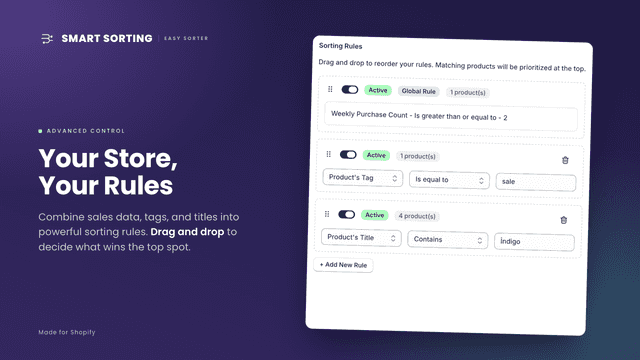
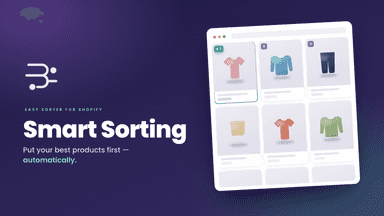
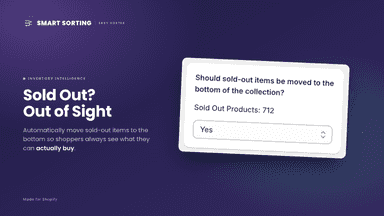
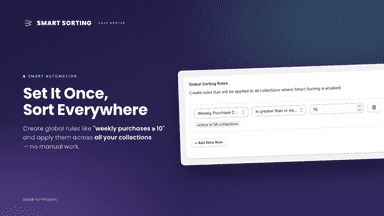
See every featureSmart Sorting keeps your collection pages organized without manual work. Create sorting rules that push sold-out products to the bottom, keep bestsellers and new arrivals visible, and reorder products automatically as your inventory and sales change. Apply different rules to different collections and let the app re-sort them on a schedule.
Stockladder keeps Shopify collections merchandised automatically by reordering products based on current inventory. Low-stock and out-of-stock items move down or out of view while sellable products stay prominent, so merchants don't have to manually reorder collections after every sale or restock.
- Create custom sorting rules for each collection
- Automatically push sold-out products to the bottom
- Keep bestsellers and new arrivals at the top
- Re-sort collections automatically on a schedule
- Reorders collection products automatically based on current inventory levels
- Moves out-of-stock and low-stock items down or out of collection view
- Preview every change before it goes live, with one-click revert
- Set custom rules per collection, including items or collections to skip


All the numbers
Every figure, side by side
A green dot marks the app ahead on a measured figure. Estimates, gaps and apps that leave no storefront trace never take the lead.
Adoption
| Measure |  Smart Sorting Auto Collection |  Stockladder |
|---|---|---|
| Detected stores | Not published | Not published |
| Net store change, 28 days | 0 | 0 |
| Stores added, 28 days | Not enough data | Not enough data |
| Big-brand share | Not enough data | Not enough data |
| Top store categories | Not published | Not published |
| Top store countries | Not published | Not published |
Reviews
| Measure | Smart Sorting Auto Collection | Stockladder |
|---|---|---|
| App Store rating | 5.0 ★ | Not published |
| App Store reviews | 7 | Not published |
| New reviews, 28 days | Not enough data | Not enough data |
| Reviewers a year or more in | Not enough data | Not enough data |
Pricing
| Measure | Smart Sorting Auto Collection | Stockladder |
|---|---|---|
| Free plan | Yes | Yes |
| Lowest paid monthly plan | $9/month | $9/month |
| Longest free trial | Not listed | 7 days |
| Plans listed | 4 | 3 |
Listing
| Measure | Smart Sorting Auto Collection | Stockladder |
|---|---|---|
| Shopify category rank | #20(ahead) | #86 |
| Shopify App Charts | Not on this week’s charts | Not on this week’s charts |
| Built for Shopify | No | No |
| Launched | Jul 30, 2026 | Jul 27, 2026 |
| Languages | 2 | 1 |
| Developer | Holly Palm | Pinion Labs Inc |
FAQ
Smart Sorting Auto Collection and Stockladder: common questions
- Is Smart Sorting Auto Collection or Stockladder cheaper?
- Both list a free plan. Paid plans start at $9/month for Smart Sorting Auto Collection and $9/month for Stockladder. Shoplist compares base prices only between monthly plans in the same currency; usage charges and annual plans vary, so check each plan’s limits.
- What features does each app list that the other doesn’t?
- Smart Sorting Auto Collection lists 3 the others don’t mention, such as Pin products, Redirect, Stock alerts. Stockladder lists 4 the others don’t mention, such as A/B testing, Analytics, Drag and drop, Filtering. A feature missing from a listing may still be supported; this compares what each App Store listing says.
- Where does this comparison’s data come from?
- Shoplist crawls Shopify storefronts to detect which apps each store runs, and reads each app’s Shopify App Store listing for reviews, pricing, features and integrations. Store counts are as of Oct 26, 2026 for Smart Sorting Auto Collection, Oct 13, 2026 for Stockladder; estimated figures are labeled.
How Shoplist compares apps
Store counts come from Shoplist’s crawl of Shopify storefronts, which detects the apps each store runs; they are as of Oct 26, 2026 for Smart Sorting Auto Collection, Oct 13, 2026 for Stockladder. Reviews, ratings, plans, features and integrations come from each app’s Shopify App Store listing. 28-day figures are labeled when estimated, and a figure that is missing or estimated never decides who leads. Read the methodology.