

SKUward: Purchase Orders vs Stockward
Two Shopify apps, side by side: detected stores, momentum, reviews, plans, listed features and who runs each. Store counts as of Oct 13, 2026.
The short answer
- Both list a free plan. Paid plans start at $9.99/month for SKUward and $19/month for Stockward.
- Stockward lists 7 features SKUward’s listing doesn’t mention, including Forecasting, Import and export, Inventory planning.
Head to head


Free
- · 2 suppliers
- · 5 purchase orders per month
- · CSV export on every plan
Starter
- · CSV import with column mapping
- · Keeps receipt history
- · Stocky CSV migration
- · Unlimited purchase orders
- · Up to 10 suppliers
Pro
- · Everything in Starter
- · Unlimited suppliers
Free
- · 5 purchase orders a month
- · Reorder point + qty for every SKU
- · Suppliers from your Shopify vendors
- · Unlimited SKUs
- · Variant-level forecast
Pro
- · Everything in Free
- · Reorder plan CSV export
- · Unlimited purchase orders
Growth
- · Everything in Pro
- · Per-supplier lead times
- · Priority support
Coverage counts what each App Store listing names. Every feature, checked off app by app, is in Shoplist.
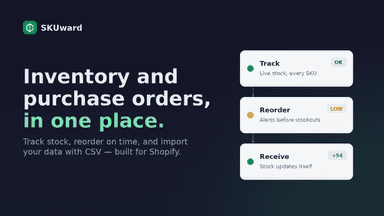
See every featureStocky closes on August 31, 2026. SKUward is built for that move. Upload the CSV you export from Stocky. SKUward maps the columns for you, including quantity received and received date, so your supplier cost history survives instead of resetting to zero. After the move it runs your purchasing: suppliers, purchase orders, reorder points and low stock alerts inside Shopify admin. Your data stays yours.
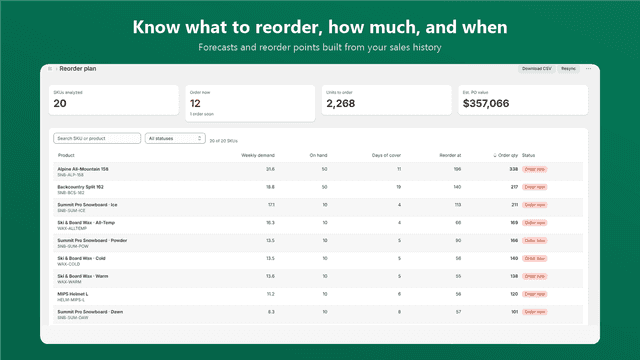
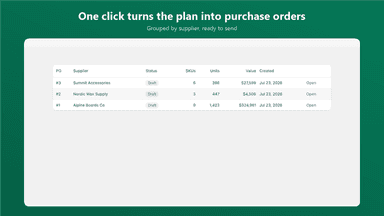
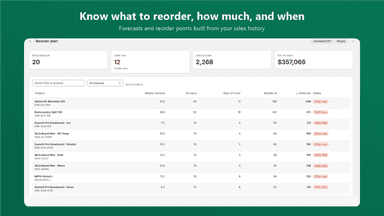
Stocky is shutting down on August 31, 2026. Stockward covers the same ground. It reads your sales history and stock levels, then shows what to reorder, how much, and when, for every SKU. Group suggestions into purchase orders by supplier, send them as CSV or print them, and mark them received when stock arrives. Bring your suppliers, costs and lead times in from a single CSV file.
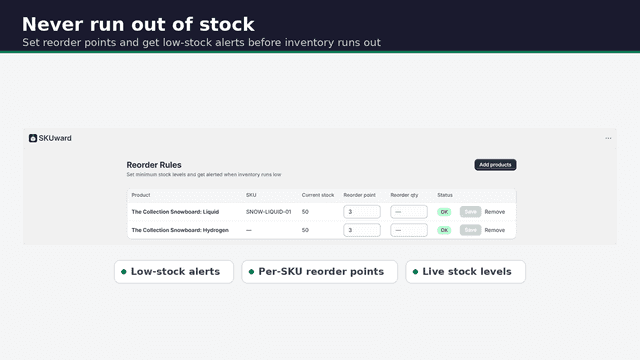
- Real-time inventory tracking across all products and locations
- Set custom reorder points and get low-stock alerts before you sell out
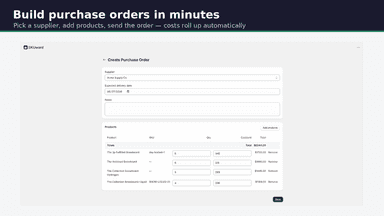
- Create and send purchase orders to suppliers in a few clicks
- Import products, suppliers, and purchase orders via CSV
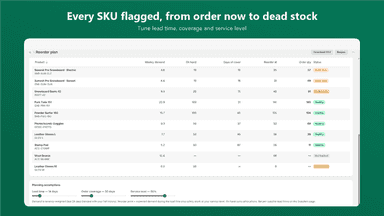
- Reorder suggestions per SKU: demand, days of cover, reorder point, quantity
- Purchase orders grouped by supplier, exportable as CSV or printable
- One-click import of your Stocky export: suppliers, costs, lead times
- Adjustable lead time, coverage and service level, recalculated live

All the numbers
Every figure, side by side
A green dot marks the app ahead on a measured figure. Estimates, gaps and apps that leave no storefront trace never take the lead.
Adoption
| Measure |  SKUward |  Stockward |
|---|---|---|
| Detected stores | Not published | Not published |
| Net store change, 28 days | 0 | 0 |
| Stores added, 28 days | Not enough data | Not enough data |
| Big-brand share | Not enough data | Not enough data |
| Top store categories | Not published | Not published |
| Top store countries | Not published | Not published |
Reviews
| Measure | SKUward | Stockward |
|---|---|---|
| App Store rating | Not published | Not published |
| App Store reviews | Not published | Not published |
| New reviews, 28 days | Not enough data | Not enough data |
| Reviewers a year or more in | Not enough data | Not enough data |
FAQ
SKUward and Stockward: common questions
- Is SKUward or Stockward cheaper?
- Both list a free plan. Paid plans start at $9.99/month for SKUward and $19/month for Stockward. Shoplist compares base prices only between monthly plans in the same currency; usage charges and annual plans vary, so check each plan’s limits.
- What features does each app list that the other doesn’t?
- SKUward lists 2 the others don’t mention, such as Auto-restock, Inventory tracking. Stockward lists 7 the others don’t mention, such as Forecasting, Import and export, Inventory planning, Low stock alerts. A feature missing from a listing may still be supported; this compares what each App Store listing says.
- Where does this comparison’s data come from?
- Shoplist crawls Shopify storefronts to detect which apps each store runs, and reads each app’s Shopify App Store listing for reviews, pricing, features and integrations. Store counts are as of Oct 13, 2026; estimated figures are labeled.
How Shoplist compares apps
Store counts come from Shoplist’s crawl of Shopify storefronts, which detects the apps each store runs; they are as of Oct 13, 2026. Reviews, ratings, plans, features and integrations come from each app’s Shopify App Store listing. 28-day figures are labeled when estimated, and a figure that is missing or estimated never decides who leads. Read the methodology.