

SEOMelon ‑ AI SEO + AEO vs SEOMint
Two Shopify apps, side by side: detected stores, momentum, reviews, plans, listed features and who runs each. Store counts as of Oct 13, 2026.
The short answer
- Both list a free plan. Paid plans start at $19/month for SEOMelon and $5/month for SEOMint.
- SEOMelon lists 7 features SEOMint’s listing doesn’t mention, including ALT text, Analytics, Audits.
Head to head


Free Seedling
- · 16 achievement badges
- · 20 AI credits per month
- · Product scans and audits
- · SEO scoring and SERP preview
Starter
- · 500 AI credits per month
- · 7-day free trial
- · SEO titles and descriptions
- · SERP previews and product scans
Growth
- · 3,000 AI credits per month
- · Collection SEO workflows
- · Scheduled scans and reports
- · Schema and AEO generation
Pro
- · 10,000 AI credits per month
- · Auto-approve eligible SEO updates
- · Reports and scheduled scans
- · Schema, FAQ, and AEO generation
Free
- · SEO & readability score
- · SEO editor + Google preview
- · Up to 20 products
Pro
- · 301 redirect manager
- · AI title & meta generation
- · Bulk editor with CSV
- · Internal links & orphans
- · JSON-LD structured data
- · Technical SEO controls
Coverage counts what each App Store listing names. Every feature, checked off app by app, is in Shoplist.
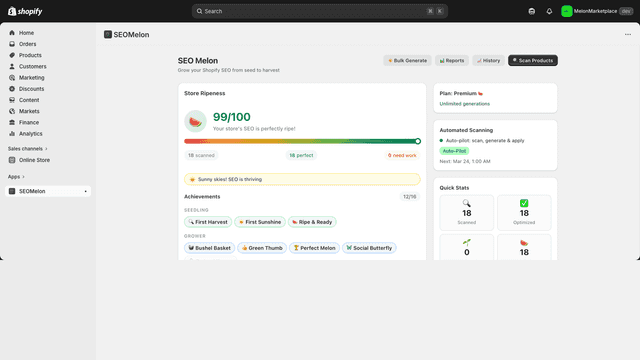
See every featureSEOMelon scans Shopify products, scores clarity gaps, and generates SEO titles, descriptions, image alt text, FAQ/AEO content, and JSON-LD schema. TinyFish research adds competitor context. Search Console adds real performance signals and Google index-health checks for crawl blocks, canonical mismatches, sitemap discovery, and rich-result errors in Google's indexed copy.
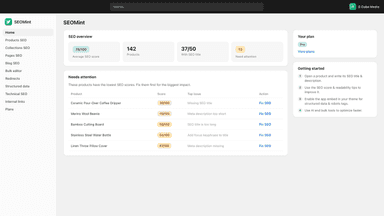
SEOMint gives your store a complete, easy-to-use SEO toolkit. Edit SEO titles and meta descriptions with a live Google preview, and get real-time SEO and readability scores that tell you exactly what to fix. Generate optimized meta content with AI, add JSON-LD structured data for rich results without touching theme code, bulk-edit your whole catalog, and turn 404s into 301 redirects.
- AI insights for product gaps, seasonality, and promotion opportunities
- Generate SEO titles, descriptions, social tags, schema, and FAQ content
- Live SERP preview and inline editing before one-click publishing
- Collection SEO and bulk workflows for catalog optimization
- AI-generated SEO titles and meta descriptions for products and pages
- Real-time SEO and readability scores that show exactly what to improve
- JSON-LD structured data for Google rich results, no theme code needed
- 301 redirect manager to fix broken links and 404 errors



All the numbers
Every figure, side by side
A green dot marks the app ahead on a measured figure. Estimates, gaps and apps that leave no storefront trace never take the lead.
Adoption
| Measure |  SEOMelon |  SEOMint |
|---|---|---|
| Detected stores | Not published | Not published |
| Net store change, 28 days | 0 | 0 |
| Stores added, 28 days | Not enough data | Not enough data |
| Big-brand share | Not enough data | Not enough data |
| Top store categories | Not published | Not published |
| Top store countries | Not published | Not published |
Reviews
| Measure | SEOMelon | SEOMint |
|---|---|---|
| App Store rating | Not published | Not published |
| App Store reviews | Not published | Not published |
| New reviews, 28 days | Not enough data | Not enough data |
| Reviewers a year or more in | Not enough data | Not enough data |
FAQ
SEOMelon and SEOMint: common questions
- Is SEOMelon or SEOMint cheaper?
- Both list a free plan. Paid plans start at $19/month for SEOMelon and $5/month for SEOMint. Shoplist compares base prices only between monthly plans in the same currency; usage charges and annual plans vary, so check each plan’s limits.
- What features does each app list that the other doesn’t?
- SEOMelon lists 7 the others don’t mention, such as ALT text, Analytics, Audits, Bulk editing. SEOMint lists 5 the others don’t mention, such as File naming, Redirects, Rich snippets, Schemas. A feature missing from a listing may still be supported; this compares what each App Store listing says.
- Where does this comparison’s data come from?
- Shoplist crawls Shopify storefronts to detect which apps each store runs, and reads each app’s Shopify App Store listing for reviews, pricing, features and integrations. Store counts are as of Oct 13, 2026; estimated figures are labeled.
How Shoplist compares apps
Store counts come from Shoplist’s crawl of Shopify storefronts, which detects the apps each store runs; they are as of Oct 13, 2026. Reviews, ratings, plans, features and integrations come from each app’s Shopify App Store listing. 28-day figures are labeled when estimated, and a figure that is missing or estimated never decides who leads. Read the methodology.