
SegmentIQ: Discount Analytics vs SegmentOS ‑ Customer Segments
Two Shopify apps, side by side: detected stores, momentum, reviews, plans, listed features and who runs each. Store counts as of Oct 13, 2026.
The short answer
- Both list a free plan. Paid plans start at $29/month for SegmentIQ and $5.90/month for SegmentOS.
- SegmentOS lists 7 features SegmentIQ’s listing doesn’t mention, including AI insights, Cohort analysis, Custom reports.
Head to head


Segment Scanner
- · Answers in Shopify Sidekick over 90 days
- · Biggest discount code verdict, 90 days
- · Date filter: 7–90 days or custom range
- · Discount rate and cost per segment
- · Flags for discount-dependent segments
- · Revenue concentration view
Pro
- · Answers in Shopify Sidekick
- · CSV export
- · Discount training by segment
- · Every code and segment, 180 days
- · Possible leak flags per code
- · Sale before/after vs prior 8 weeks
Free
- · Up to 1,000 customers
Starter
- · 1,000 AI segment analyses per month
- · AI-powered segmentation included
- · Up to 5,000 customers
Advanced
- · 5,000 AI segment analyses per month
- · AI-powered segmentation included
- · Up to 15,000 customers
Pro
- · 10,000 AI segment analyses per month
- · 50,000 customers
- · AI-powered segmentation included
Coverage counts what each App Store listing names. Every feature, checked off app by app, is in Shoplist.
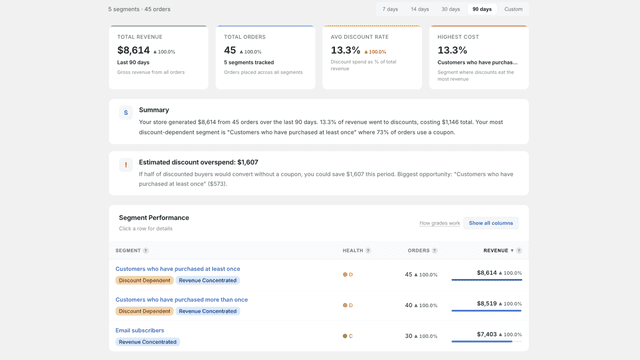
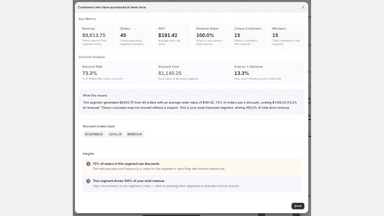
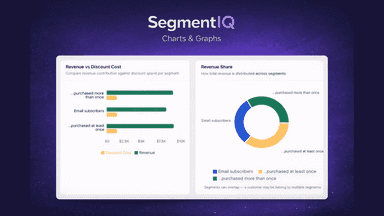
See every featureFind out where your discount spend really goes. SegmentIQ reads your orders, discount codes and customer segments, and shows how much of each code went to customers who had recently paid full price, how much reached first-time buyers, and which segments keep waiting for a discount. Compare any sale with the weeks before it to see what changed. Get suggestions you can paste into Shopify Sidekick.
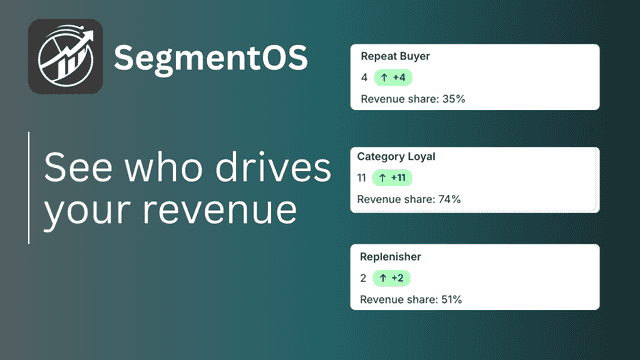
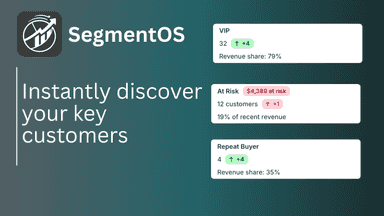
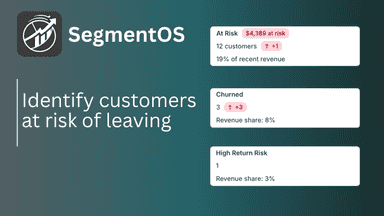
SegmentOS analyzes your store’s order history to automatically identify customer segments such as VIP, At Risk, Churned, Repeat Buyer and Deal Seeker. These segments help merchants understand customer behavior, identify valuable customers, and detect retention risks.
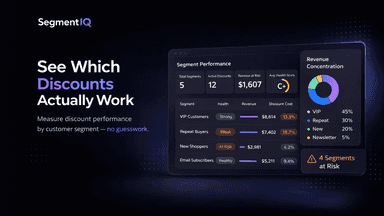
- Discount performance breakdown by customer segment with automated insights
- Revenue concentration analysis to spot risky segment dependencies
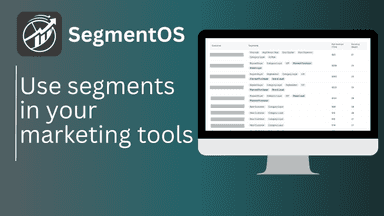
- Works with any discount source — Shopify native, Discount Ninja, and more
- Identify VIP, repeat buyers, churned and at-risk customers automatically
- See which customers drive revenue and which are at risk of leaving
- Spot declining customers early and take action to win them back
- Segments update automatically as customers place new orders
All the numbers
Every figure, side by side
A green dot marks the app ahead on a measured figure. Estimates, gaps and apps that leave no storefront trace never take the lead.
Adoption
| Measure |  SegmentIQ |  SegmentOS |
|---|---|---|
| Detected stores | Not published | Not published |
| Net store change, 28 days | 0 | 0 |
| Stores added, 28 days | Not enough data | Not enough data |
| Big-brand share | Not enough data | Not enough data |
| Top store categories | Not published | Not published |
| Top store countries | Not published | Not published |
Reviews
| Measure | SegmentIQ | SegmentOS |
|---|---|---|
| App Store rating | Not published | Not published |
| App Store reviews | Not published | Not published |
| New reviews, 28 days | Not enough data | Not enough data |
| Reviewers a year or more in | Not enough data | Not enough data |
FAQ
SegmentIQ and SegmentOS: common questions
- Is SegmentIQ or SegmentOS cheaper?
- Both list a free plan. Paid plans start at $29/month for SegmentIQ and $5.90/month for SegmentOS. Shoplist compares base prices only between monthly plans in the same currency; usage charges and annual plans vary, so check each plan’s limits.
- What features does each app list that the other doesn’t?
- SegmentIQ lists 1 the others don’t mention, such as Custom dashboards. SegmentOS lists 7 the others don’t mention, such as AI insights, Cohort analysis, Custom reports, Data export. A feature missing from a listing may still be supported; this compares what each App Store listing says.
- Where does this comparison’s data come from?
- Shoplist crawls Shopify storefronts to detect which apps each store runs, and reads each app’s Shopify App Store listing for reviews, pricing, features and integrations. Store counts are as of Oct 13, 2026; estimated figures are labeled.
How Shoplist compares apps
Store counts come from Shoplist’s crawl of Shopify storefronts, which detects the apps each store runs; they are as of Oct 13, 2026. Reviews, ratings, plans, features and integrations come from each app’s Shopify App Store listing. 28-day figures are labeled when estimated, and a figure that is missing or estimated never decides who leads. Read the methodology.