
RunSheet vs Shopfloor: Staff Task Board
Two Shopify apps, side by side: detected stores, momentum, reviews, plans, listed features and who runs each. Store counts as of Oct 13, 2026.
The short answer
- Both list a free plan. Paid plans start at $14/month for RunSheet and $29/month for Shopfloor.
Head to head


Free
- · Auto-detected properties
- · Default run sheet
- · Default system statuses
- · Line-item dashboard
- · No additonal staff
Studio
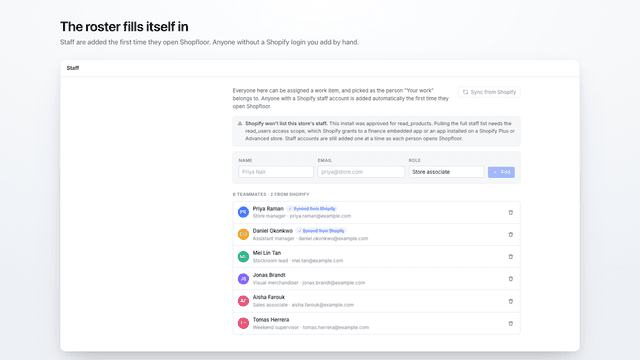
- · 3 Staff
- · All from Free +
- · Custom grouping
- · Custom system statuses
- · Lead-time rule, character warnings and d
- · Persistent assignable batches
Workshop
- · All from Studio +
- · Unlimited staff
Free
Team
Store
Coverage counts what each App Store listing names. Every feature, checked off app by app, is in Shoplist.
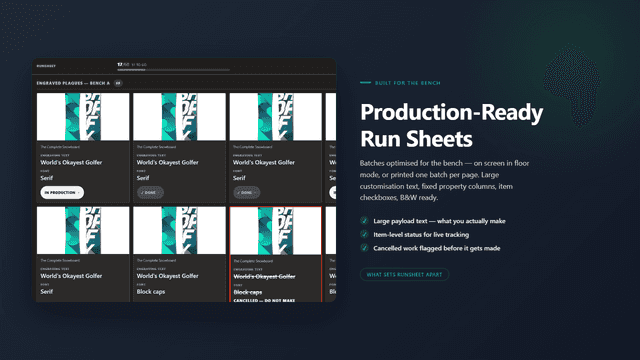
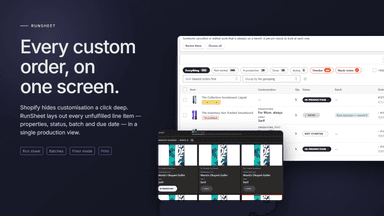
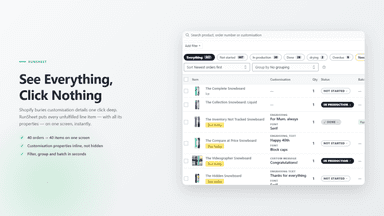
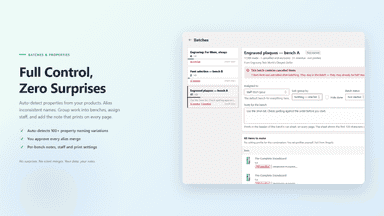
See every featureShopify's order list hides customization details one click deep, so a merchant with forty orders clicks eighty times to find out what to make. RunSheet puts every unfulfilled line item on one screen with its properties inline. Identical work is grouped so it can be made together, and production status is tracked separately from Shopify fulfilment, so marking a piece made never touches an order.
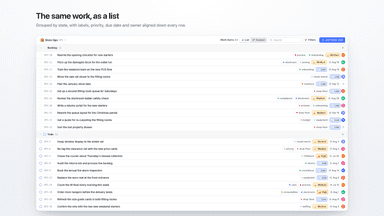
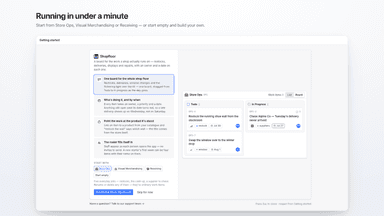
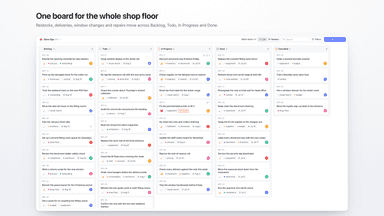
Shopfloor puts a task board in your Shopify admin, so the work that keeps a shop running has somewhere to live. Work groups into projects like Store Ops or Merch. A work item carries an owner, priority, labels and a due date, and moves across Backlog, Todo, In Progress and Done on a kanban board or a grouped list. An item can point at a product in your catalogue. Staff comment on the item instead of a group chat.
- Every unfulfilled line item on one screen with its customization shown inline
- Group identical work across orders into batches and hand them to named staff
- Track production separately from Shopify fulfilment, with your own stages
- Print run sheets sized to be read at a bench, with cancelled items flagged
- Kanban board and list view across Backlog, Todo, In Progress, Done, Cancelled
- Assign an owner and set priority, labels and a due date on any work item
- Comment on a work item so the discussion sits with the job, not in chat
- Link a work item to a product in your catalogue
All the numbers
Every figure, side by side
A green dot marks the app ahead on a measured figure. Estimates, gaps and apps that leave no storefront trace never take the lead.
Adoption
| Measure |  RunSheet |  Shopfloor |
|---|---|---|
| Detected stores | Not published | Not published |
| Net store change, 28 days | 0 | 0 |
| Stores added, 28 days | Not enough data | Not enough data |
| Big-brand share | Not enough data | Not enough data |
| Top store categories | Not published | Not published |
| Top store countries | Not published | Not published |
Reviews
| Measure | RunSheet | Shopfloor |
|---|---|---|
| App Store rating | Not published | Not published |
| App Store reviews | Not published | Not published |
| New reviews, 28 days | Not enough data | Not enough data |
| Reviewers a year or more in | Not enough data | Not enough data |
FAQ
RunSheet and Shopfloor: common questions
- Is RunSheet or Shopfloor cheaper?
- Both list a free plan. Paid plans start at $14/month for RunSheet and $29/month for Shopfloor. Shoplist compares base prices only between monthly plans in the same currency; usage charges and annual plans vary, so check each plan’s limits.
- Where does this comparison’s data come from?
- Shoplist crawls Shopify storefronts to detect which apps each store runs, and reads each app’s Shopify App Store listing for reviews, pricing, features and integrations. Store counts are as of Oct 13, 2026; estimated figures are labeled.
How Shoplist compares apps
Store counts come from Shoplist’s crawl of Shopify storefronts, which detects the apps each store runs; they are as of Oct 13, 2026. Reviews, ratings, plans, features and integrations come from each app’s Shopify App Store listing. 28-day figures are labeled when estimated, and a figure that is missing or estimated never decides who leads. Read the methodology.