

Revertly vs Velora: SaleSmith
Two Shopify apps, side by side: detected stores, momentum, reviews, plans, listed features and who runs each. Store counts as of Oct 13, 2026.
The short answer
- Only Revertly lists a free plan. Paid plans start at $19/month for Revertly and $9.90/month for Velora.
- Revertly lists 16 features Velora’s listing doesn’t mention, including BOGO, Cart discounts, Checkout discounts.
Head to head


Free
- · 1 scheduled sale at a time
- · Guaranteed automatic revert
- · Up to 50 products per sale
Pro
- · Guaranteed automatic revert
- · Unlimited concurrent sales
- · Unlimited products per sale
Basic
- · Basic support
- · Unlimited campaigns
- · Up to 100 products
Pro
- · Priority support
- · Unlimited campaigns
- · Up to 500 products
Enterprise
- · Dedicated support
- · Unlimited campaigns
- · Unlimited products
Coverage counts what each App Store listing names. Every feature, checked off app by app, is in Shoplist.
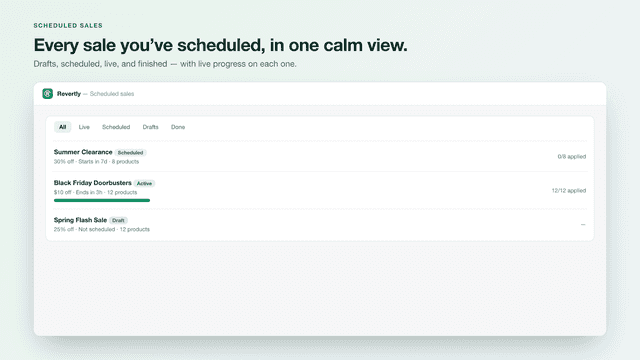
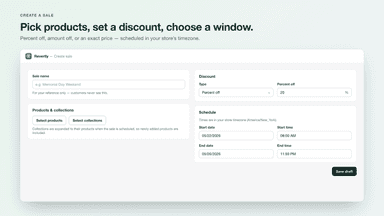
See every featureRevertly schedules bulk sale prices across your catalog — flash sales, storewide sales, and seasonal promos — with real compare-at strikethroughs. Pick products or collections, set start and end times, and every original price is restored automatically when the sale ends. Revertly snapshots each price first, so the revert is exact.
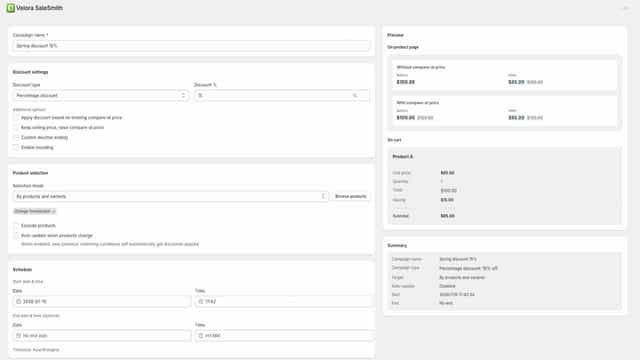
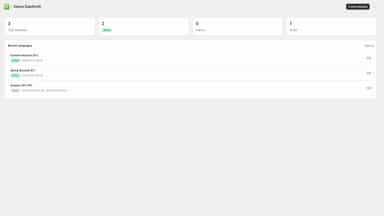
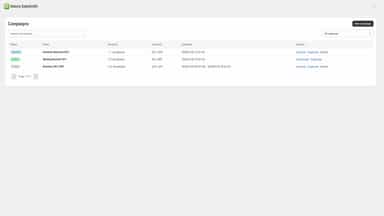
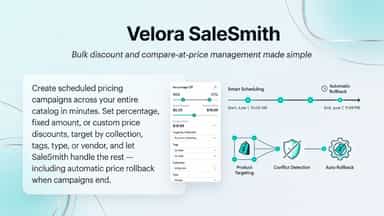
Velora SaleSmith helps Shopify merchants run bulk pricing campaigns without manual product-by-product editing. Whether it's a seasonal sale, clearance event, or flash discount, SaleSmith applies pricing changes instantly across hundreds or thousands of variants while preserving original prices for automatic rollback.
- Automatic revert — every original price restored exactly when the sale ends.
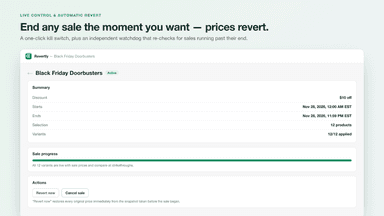
- Watchdog auto-reverts any sale that runs past its end — never stuck on sale.
- Dry-run preview, never-overwrite protection, and a one-click kill switch.
- 1. Bulk apply % off, fixed amount, or new prices across your catalog
- 2. Schedule campaigns with auto-activation and automatic price rollback
- 3. Target by collection, tags, type, vendor — exclude specific variants
All the numbers
Every figure, side by side
A green dot marks the app ahead on a measured figure. Estimates, gaps and apps that leave no storefront trace never take the lead.
Adoption
| Measure |  Revertly |  Velora |
|---|---|---|
| Detected stores | Not published | Not published |
| Net store change, 28 days | 0 | 0 |
| Stores added, 28 days | Not enough data | Not enough data |
| Big-brand share | Not enough data | Not enough data |
| Top store categories | Not published | Not published |
| Top store countries | Not published | Not published |
Reviews
| Measure | Revertly | Velora |
|---|---|---|
| App Store rating | Not published | Not published |
| App Store reviews | Not published | Not published |
| New reviews, 28 days | Not enough data | Not enough data |
| Reviewers a year or more in | Not enough data | Not enough data |
FAQ
Revertly and Velora: common questions
- Is Revertly or Velora cheaper?
- Only Revertly lists a free plan. Paid plans start at $19/month for Revertly and $9.90/month for Velora. Shoplist compares base prices only between monthly plans in the same currency; usage charges and annual plans vary, so check each plan’s limits.
- What features does each app list that the other doesn’t?
- Revertly lists 16 the others don’t mention, such as BOGO, Cart discounts, Checkout discounts, Cross-sell discounts. Velora lists 2 the others don’t mention, such as APIs and webhooks, Campaigns. A feature missing from a listing may still be supported; this compares what each App Store listing says.
- Where does this comparison’s data come from?
- Shoplist crawls Shopify storefronts to detect which apps each store runs, and reads each app’s Shopify App Store listing for reviews, pricing, features and integrations. Store counts are as of Oct 13, 2026; estimated figures are labeled.
How Shoplist compares apps
Store counts come from Shoplist’s crawl of Shopify storefronts, which detects the apps each store runs; they are as of Oct 13, 2026. Reviews, ratings, plans, features and integrations come from each app’s Shopify App Store listing. 28-day figures are labeled when estimated, and a figure that is missing or estimated never decides who leads. Read the methodology.