

Revenome vs roasWhale
Two Shopify apps, side by side: detected stores, momentum, reviews, plans, listed features and who runs each. Store counts as of Oct 13, 2026.
The short answer
- Paid plans start at $49/month for Revenome and $19/month for roasWhale.
- roasWhale lists 17 features Revenome’s listing doesn’t mention, including Activity tracking, AI insights, Benchmarking.
Head to head


Solo
starter
- · 1 store
- · 500 orders per month
- · Inventory and purchase orders
- · Live profit dashboard and P&L report
- · Product analytics and ad attribution
growth
- · 2,000 orders per month
- · 3 stores
- · Automatic ad platform spend sync
- · Everything in Starter
- · Unlimited AI questions
scale
- · 6,000 orders per month
- · Everything in Growth
- · Priority support
- · Unlimited stores
Coverage counts what each App Store listing names. Every feature, checked off app by app, is in Shoplist.
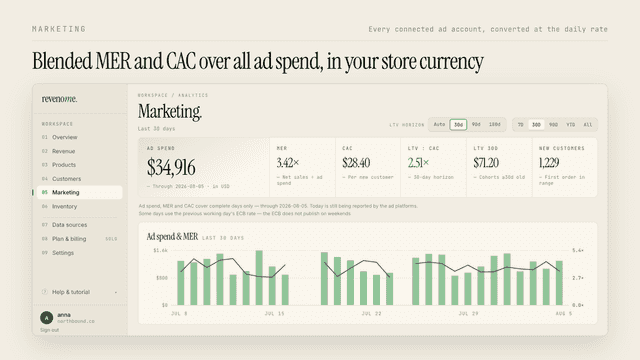
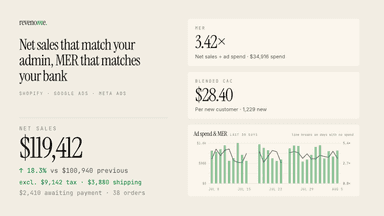
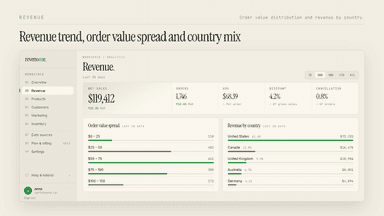
See every featureThree questions, answered from your own orders and ad spend. Did we sell more? Net sales the way your admin counts them, with tax and shipping stated under the figure, so it adds up to your own reports. Unpaid orders shown separately. Can we spend more? Blended MER and CAC across all Google and Meta spend, in your store currency. Platform ROAS kept separate. Will they come back?
Revenue tells you nothing about what you actually keep. RoasWhale attaches every cost to every order the second it lands: COGS, transaction fees, shipping, refunds, taxes and ad spend, then rolls it all into a live P&L, product-level profit and a four-level ad attribution report built on your own order data, not platform-reported numbers. Set your costs once.
- Net sales that match the totals in your admin — tax and shipping stated
- Blended MER and CAC across Google and Meta, in your store currency
- Cohort retention, LTV at 30 / 90 / 180 days, and LTV-to-CAC on one cohort
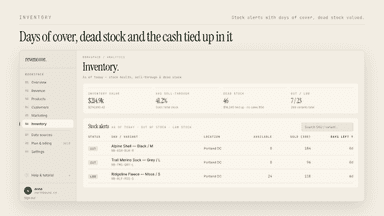
- Dead stock, sell-through and days-of-cover alerts with tied-up value
- Live P&L: every order lands with COGS, fees, shipping and refunds attached
- Attribution across campaigns, ad sets and ads, matched to your real orders
- One-click pixel captures first and last touch. No theme code required
- Inventory, purchase orders and days of stock beside your profit numbers


All the numbers
Every figure, side by side
A green dot marks the app ahead on a measured figure. Estimates, gaps and apps that leave no storefront trace never take the lead.
Adoption
| Measure |  Revenome |  roasWhale |
|---|---|---|
| Detected stores | Not published | Not published |
| Net store change, 28 days | 0 | 0 |
| Stores added, 28 days | Not enough data | Not enough data |
| Big-brand share | Not enough data | Not enough data |
| Top store categories | Not published | Not published |
| Top store countries | Not published | Not published |
Reviews
| Measure | Revenome | roasWhale |
|---|---|---|
| App Store rating | Not published | Not published |
| App Store reviews | Not published | Not published |
| New reviews, 28 days | Not enough data | Not enough data |
| Reviewers a year or more in | Not enough data | Not enough data |
FAQ
Revenome and roasWhale: common questions
- Is Revenome or roasWhale cheaper?
- Paid plans start at $49/month for Revenome and $19/month for roasWhale. Shoplist compares base prices only between monthly plans in the same currency; usage charges and annual plans vary, so check each plan’s limits.
- What features does each app list that the other doesn’t?
- roasWhale lists 17 the others don’t mention, such as Activity tracking, AI insights, Benchmarking, Checkout analytics. A feature missing from a listing may still be supported; this compares what each App Store listing says.
- Where does this comparison’s data come from?
- Shoplist crawls Shopify storefronts to detect which apps each store runs, and reads each app’s Shopify App Store listing for reviews, pricing, features and integrations. Store counts are as of Oct 13, 2026; estimated figures are labeled.
How Shoplist compares apps
Store counts come from Shoplist’s crawl of Shopify storefronts, which detects the apps each store runs; they are as of Oct 13, 2026. Reviews, ratings, plans, features and integrations come from each app’s Shopify App Store listing. 28-day figures are labeled when estimated, and a figure that is missing or estimated never decides who leads. Read the methodology.