

Restory vs Shopwatch: Store Change Log
Two Shopify apps, side by side: detected stores, momentum, reviews, plans, listed features and who runs each. Store counts as of Oct 13, 2026 for Restory, Nov 8, 2026 for Shopwatch.
The short answer
- Paid plans start at $9/month for Restory and $49/month for Shopwatch.
Head to head


- United States
Core
- · 90 days of change history
- · Deleted product/collection recovery
- · One-click revert and restore
Plus
- · 365 days of change history
- · Everything in Core
- · Watched products + email/Slack alerts
Basic
- · Includes Metaobjects and Metafields
- · Log changes to your store
- · Look back over 2 years of logs
- · Search and filter log entries
- · Unlimited users
- · View diffs showing what's changed
Agentic
- · Includes Metaobjects and Metafields
- · Log changes to your store
- · Look back over 2 years of logs
- · MCP server access for your agent
- · Search and filter log entries
- · Unlimited users
Coverage counts what each App Store listing names. Every feature, checked off app by app, is in Shoplist.
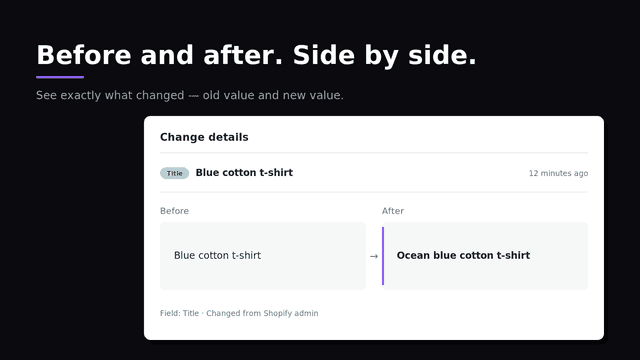
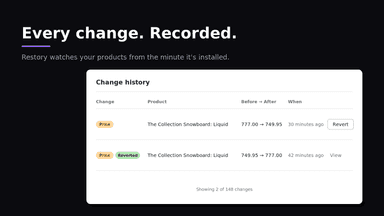
See every featureAn edit goes wrong: a description, a variant, a metafield, an import, and Shopify has no undo. Restory records every product and collection change automatically from the minute it's installed, with your whole catalog backed up as a baseline. See old and new values side by side and put anything back in one click, revert in bulk, or bring back deleted products and collections.
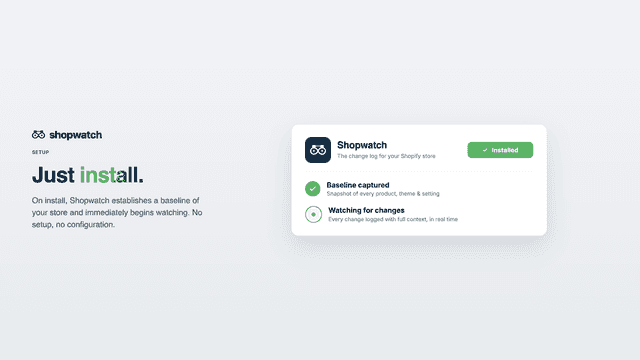
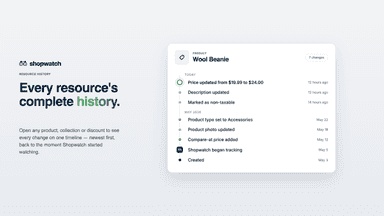
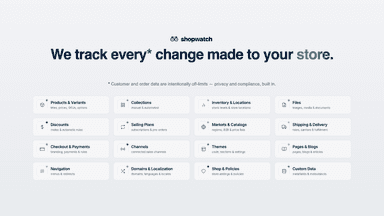
Your Shopify store changes constantly. Your team edits products, apps update prices in the background, and now AI agents make changes too. Most of it happens with no record of what was done. Shopwatch keeps that record. It logs 33 resource types: not just products, but themes, discounts, markets, metaobjects and navigation. You get what changed, when, and the exact values before and after.
- Automatic change tracking for every product field, variant, and image
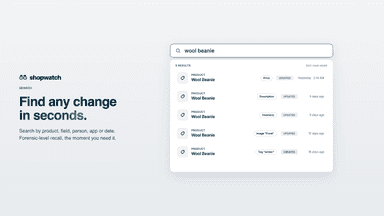
- Searchable timeline with product, collection, field, and date filters
- One-click revert and point-in-time product restore
- Deleted-product recovery with variants and images
- Tracks products, collections, discounts, pages, themes, markets, and more
- Search and filter the full log right inside your Shopify admin
- See a full timeline of every change to any part of your store
- Connect your AI agent, including Claude and OpenAI, to ask what changed


All the numbers
Every figure, side by side
A green dot marks the app ahead on a measured figure. Estimates, gaps and apps that leave no storefront trace never take the lead.
Adoption
| Measure |  Restory |  Shopwatch |
|---|---|---|
| Detected stores | Not published | 1 |
| Net store change, 28 days | 0 | 0 |
| Stores added, 28 days | Not enough data | Not enough data |
| Big-brand share | Not enough data | Not enough data |
| Top store categories | Not published | Home & Garden |
| Top store countries | Not published | United States |
Reviews
| Measure | Restory | Shopwatch |
|---|---|---|
| App Store rating | Not published | 5.0 ★ |
| App Store reviews | Not published | 1 |
| New reviews, 28 days | Not enough data | Not enough data |
| Reviewers a year or more in | Not enough data | Not enough data |
FAQ
Restory and Shopwatch: common questions
- Is Restory or Shopwatch cheaper?
- Paid plans start at $9/month for Restory and $49/month for Shopwatch. Shoplist compares base prices only between monthly plans in the same currency; usage charges and annual plans vary, so check each plan’s limits.
- Where does this comparison’s data come from?
- Shoplist crawls Shopify storefronts to detect which apps each store runs, and reads each app’s Shopify App Store listing for reviews, pricing, features and integrations. Store counts are as of Oct 13, 2026 for Restory, Nov 8, 2026 for Shopwatch; estimated figures are labeled.
How Shoplist compares apps
Store counts come from Shoplist’s crawl of Shopify storefronts, which detects the apps each store runs; they are as of Oct 13, 2026 for Restory, Nov 8, 2026 for Shopwatch. Reviews, ratings, plans, features and integrations come from each app’s Shopify App Store listing. 28-day figures are labeled when estimated, and a figure that is missing or estimated never decides who leads. Read the methodology.