

lcCode: RestockRadar vs Stockler
Two Shopify apps, side by side: detected stores, momentum, reviews, plans, listed features and who runs each. Store counts as of Oct 20, 2026 for lcCode, Oct 14, 2026 for Stockler.
The short answer
- Only lcCode lists a free plan. Paid plans start at $9/month for lcCode and $2.99/month for Stockler.
- Stockler lists 8 features lcCode’s listing doesn’t mention, including Analytics, Email notifications, Inventory planning.
Head to head


Free
- · Daily inventory and sales sync
- · Manual reorder minimums
- · Reorder action buckets
- · Track up to 50 SKUs
Starter
- · Email and Slack low-stock alerts
- · Hourly sync
- · Suggested reorder quantities
- · Track up to 500 SKUs
Pro
- · CSV purchase-order export
- · Everything in Starter
- · PO drafts grouped by supplier
- · Supplier management
- · Unlimited SKUs
- · Velocity-spike detection
Monthly Plan
Coverage counts what each App Store listing names. Every feature, checked off app by app, is in Shoplist.
See every featureReview low-stock items and suggested reorder quantities based on recent sales, lead time, safety days and order cover. Account for on-hand and incoming stock; set manual minimums for products with limited history. Paid plans add email and Slack alerts. On Pro, assign suppliers, prepare supplier-grouped purchase-order drafts and export CSV files.
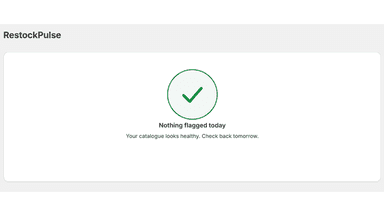
Most restock tools just watch a fixed number and alert when you cross it — a slow week gets treated the same as a real emergency, or a genuine stockout slips through because the number never technically hit zero.
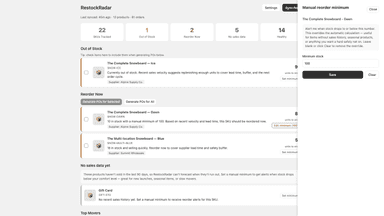
- Reorder dashboard with out-of-stock and reorder-now SKU buckets
- Suggested reorder quantities based on velocity and lead time
- Manual reorder minimums for launches and slow-moving products
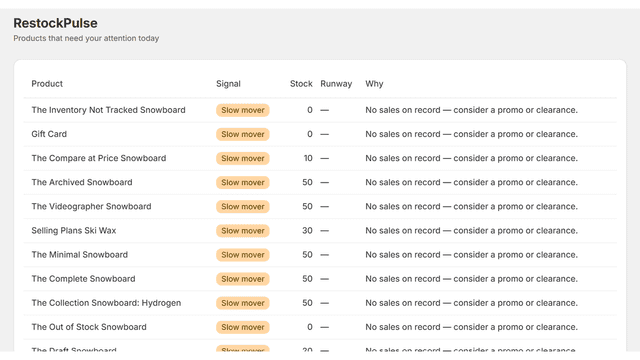
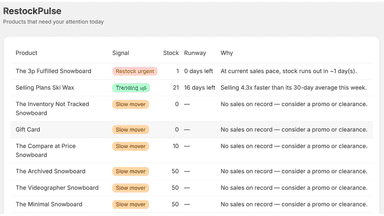
- Restock urgency alerts — Know what sells out this week, before it happens
- Trending product detection — Spot products suddenly selling faster than usual
- Daily email digest — A morning summary, sent only when something needs attention
- Zero-setup dashboard — One screen, refreshed daily — no configuration needed


All the numbers
Every figure, side by side
A green dot marks the app ahead on a measured figure. Estimates, gaps and apps that leave no storefront trace never take the lead.
Adoption
| Measure |  lcCode |  Stockler |
|---|---|---|
| Detected stores | Not published | Not published |
| Net store change, 28 days | 0 | 0 |
| Stores added, 28 days | Not enough data | Not enough data |
| Big-brand share | Not enough data | Not enough data |
| Top store categories | Not published | Not published |
| Top store countries | Not published | Not published |
Reviews
| Measure | lcCode | Stockler |
|---|---|---|
| App Store rating | Not published | Not published |
| App Store reviews | Not published | Not published |
| New reviews, 28 days | Not enough data | Not enough data |
| Reviewers a year or more in | Not enough data | Not enough data |
FAQ
lcCode and Stockler: common questions
- Is lcCode or Stockler cheaper?
- Only lcCode lists a free plan. Paid plans start at $9/month for lcCode and $2.99/month for Stockler. Shoplist compares base prices only between monthly plans in the same currency; usage charges and annual plans vary, so check each plan’s limits.
- What features does each app list that the other doesn’t?
- Stockler lists 8 the others don’t mention, such as Analytics, Email notifications, Inventory planning, Inventory sync. A feature missing from a listing may still be supported; this compares what each App Store listing says.
- Where does this comparison’s data come from?
- Shoplist crawls Shopify storefronts to detect which apps each store runs, and reads each app’s Shopify App Store listing for reviews, pricing, features and integrations. Store counts are as of Oct 20, 2026 for lcCode, Oct 14, 2026 for Stockler; estimated figures are labeled.
How Shoplist compares apps
Store counts come from Shoplist’s crawl of Shopify storefronts, which detects the apps each store runs; they are as of Oct 20, 2026 for lcCode, Oct 14, 2026 for Stockler. Reviews, ratings, plans, features and integrations come from each app’s Shopify App Store listing. 28-day figures are labeled when estimated, and a figure that is missing or estimated never decides who leads. Read the methodology.