

Restock vs TrueVelocity: Stop Stockouts
Two Shopify apps, side by side: detected stores, momentum, reviews, plans, listed features and who runs each. Store counts as of Oct 14, 2026.
The short answer
- Paid plans start at $19/month for Restock and $19/month for TrueVelocity.
- TrueVelocity lists 15 features Restock’s listing doesn’t mention, including Alert settings, Auto-alerts, Custom reports.
Head to head


Starter
Growth
Pro
monthly sub
- · 13 months historical data
- · CSV restock purchase order export
- · Daily email & Telegram alerts
- · L3 algorith(OOS + outlier + seasonality)
- · Revenue Saved by SKU breakdown
- · Supplier share links
Coverage counts what each App Store listing names. Every feature, checked off app by app, is in Shoplist.
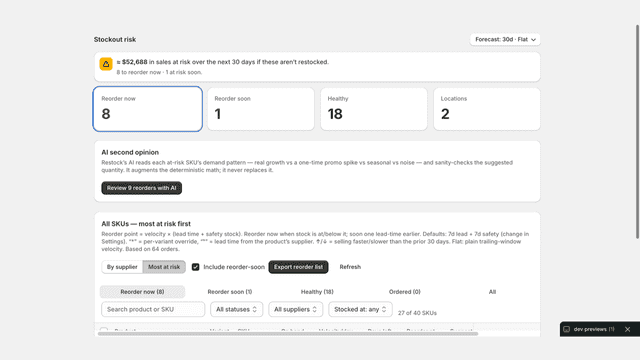
See every featureShopify shows your inventory levels — what you have. Restock tells you what to do about it: which products are running low, how many units to order, and when — ranked by urgency, with the projected revenue at risk if you wait. It's not another dashboard to interpret — Restock does the math the way you would on paper, so every recommendation is one you can verify.
When a product goes out of stock, most inventory tools still count those zero-sale days in their averages. That means your next reorder is based on deflated numbers — so you under-order, stock out again, and the cycle repeats. TrueVelocity breaks that cycle. Our engine strips out stockout days and outlier orders to calculate your real sales velocity.
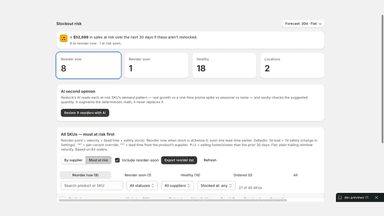
- See the revenue at risk if you don't restock in time
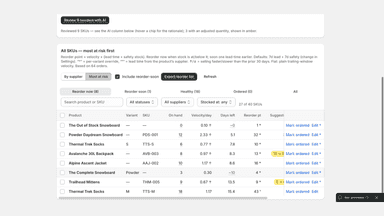
- Every SKU ranked by stockout risk, with a clear reorder-now flag
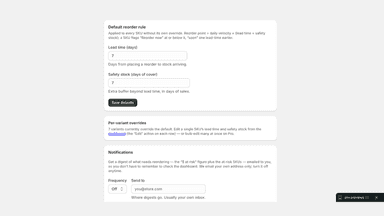
- Suggested reorder quantity that fits your lead time and safety stock
- Reorder-alert emails: a daily or weekly digest of what to reorder
- Filters out stockout days and outlier orders to calculate real sales velocity.
- Revenue at Risk dashboard shows exactly how much you're losing to low stock.
- Generate reorder lists and share them with your supplier via a single link.
- Get daily restock alerts via email or Telegram — with exact reorder quantities.


All the numbers
Every figure, side by side
A green dot marks the app ahead on a measured figure. Estimates, gaps and apps that leave no storefront trace never take the lead.
Adoption
| Measure |  Restock |  TrueVelocity |
|---|---|---|
| Detected stores | Not published | Not published |
| Net store change, 28 days | 0 | 0 |
| Stores added, 28 days | Not enough data | Not enough data |
| Big-brand share | Not enough data | Not enough data |
| Top store categories | Not published | Not published |
| Top store countries | Not published | Not published |
Reviews
| Measure | Restock | TrueVelocity |
|---|---|---|
| App Store rating | Not published | Not published |
| App Store reviews | Not published | Not published |
| New reviews, 28 days | Not enough data | Not enough data |
| Reviewers a year or more in | Not enough data | Not enough data |
Pricing
| Measure | Restock | TrueVelocity |
|---|---|---|
| Free plan | Not listed | Not listed |
| Lowest paid monthly plan | $19/month | $19/month |
| Longest free trial | 14 days | 14 days |
| Plans listed | 3 | 1 |
Listing
| Measure | Restock | TrueVelocity |
|---|---|---|
| Shopify category rank | #624 | #390(ahead) |
| Shopify App Charts | Not on this week’s charts | Not on this week’s charts |
| Built for Shopify | No | No |
| Launched | Jun 9, 2026 | May 27, 2026 |
| Languages | 1 | 2 |
| Developer | MASM Studios | TaiChu Software |
FAQ
Restock and TrueVelocity: common questions
- Is Restock or TrueVelocity cheaper?
- Paid plans start at $19/month for Restock and $19/month for TrueVelocity. Shoplist compares base prices only between monthly plans in the same currency; usage charges and annual plans vary, so check each plan’s limits.
- What features does each app list that the other doesn’t?
- Restock lists 3 the others don’t mention, such as Forecasting, Replenishment reminders, Stock replenishment. TrueVelocity lists 15 the others don’t mention, such as Alert settings, Auto-alerts, Custom reports, Email. A feature missing from a listing may still be supported; this compares what each App Store listing says.
- Where does this comparison’s data come from?
- Shoplist crawls Shopify storefronts to detect which apps each store runs, and reads each app’s Shopify App Store listing for reviews, pricing, features and integrations. Store counts are as of Oct 14, 2026; estimated figures are labeled.
How Shoplist compares apps
Store counts come from Shoplist’s crawl of Shopify storefronts, which detects the apps each store runs; they are as of Oct 14, 2026. Reviews, ratings, plans, features and integrations come from each app’s Shopify App Store listing. 28-day figures are labeled when estimated, and a figure that is missing or estimated never decides who leads. Read the methodology.