

Replenish: Inventory Forecast vs Restock
Two Shopify apps, side by side: detected stores, momentum, reviews, plans, listed features and who runs each. Store counts as of Oct 14, 2026.
The short answer
- Paid plans start at $10/month for Replenish and $19/month for Restock.
- Replenish lists 8 features Restock’s listing doesn’t mention, including Auto-restock, Email notifications, Insights.
Head to head


Starter
- · 500 SKUs
- · CSV import (Stocky migration)
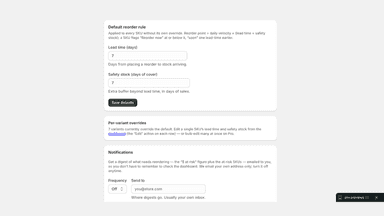
- · Configurable lead time & safety stocks
- · Daily email digest
- · Dead stock detection
- · Explainable recommendations
Growth
- · 1000 SKUs
- · ABC/XYZ analysis
- · Bundles / BOM
- · Everything in Starter
- · Multi-location forecasting
- · Purch Orders: tax, multi-currency, cases
Pro
- · API access
- · Cash flow projection
- · Everything in Growth
- · Outbound webhooks
- · Price benchmarks
- · Revenue forecasting
Starter
Growth
Pro
Coverage counts what each App Store listing names. Every feature, checked off app by app, is in Shoplist.
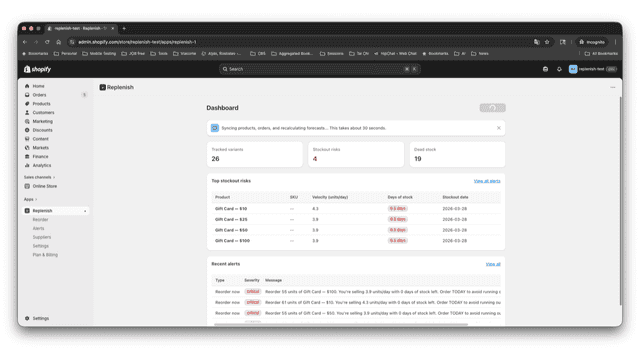
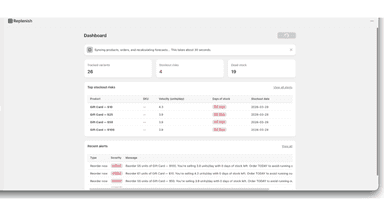
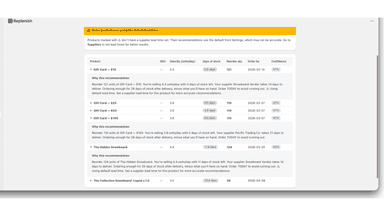
See every featureReplenish watches your inventory daily and tells you what needs attention. Every recommendation explains the math: "Reorder 200 — selling 8/day, 25 left, supplier takes 14 days, out in 3 days." No black-box AI. Stockout predictions ranked by urgency, dead stock detection, daily email digests, and configurable lead times.
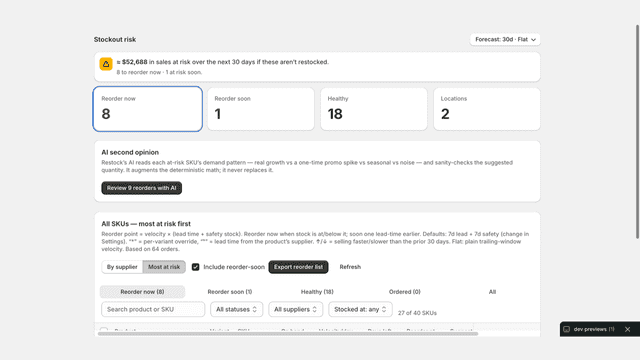
Shopify shows your inventory levels — what you have. Restock tells you what to do about it: which products are running low, how many units to order, and when — ranked by urgency, with the projected revenue at risk if you wait. It's not another dashboard to interpret — Restock does the math the way you would on paper, so every recommendation is one you can verify.
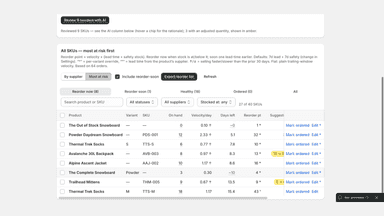
- Every suggestion shows the math: velocity, stock level, lead time, and dead line
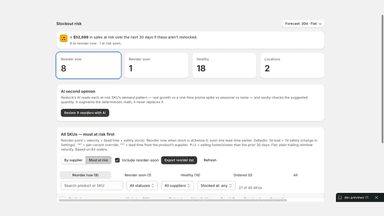
- See which products run out first Critical risks surface to the top automatically
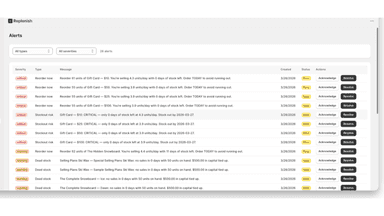
- Find products tying up capital that haven't sold. Know what to stop reordering
- See the revenue at risk if you don't restock in time
- Every SKU ranked by stockout risk, with a clear reorder-now flag
- Suggested reorder quantity that fits your lead time and safety stock
- Reorder-alert emails: a daily or weekly digest of what to reorder
All the numbers
Every figure, side by side
A green dot marks the app ahead on a measured figure. Estimates, gaps and apps that leave no storefront trace never take the lead.
Adoption
| Measure |  Replenish |  Restock |
|---|---|---|
| Detected stores | Not published | Not published |
| Net store change, 28 days | 0 | 0 |
| Stores added, 28 days | Not enough data | Not enough data |
| Big-brand share | Not enough data | Not enough data |
| Top store categories | Not published | Not published |
| Top store countries | Not published | Not published |
Reviews
| Measure | Replenish | Restock |
|---|---|---|
| App Store rating | Not published | Not published |
| App Store reviews | Not published | Not published |
| New reviews, 28 days | Not enough data | Not enough data |
| Reviewers a year or more in | Not enough data | Not enough data |
FAQ
Replenish and Restock: common questions
- Is Replenish or Restock cheaper?
- Paid plans start at $10/month for Replenish and $19/month for Restock. Shoplist compares base prices only between monthly plans in the same currency; usage charges and annual plans vary, so check each plan’s limits.
- What features does each app list that the other doesn’t?
- Replenish lists 8 the others don’t mention, such as Auto-restock, Email notifications, Insights, Inventory planning. Restock lists 2 the others don’t mention, such as Forecasting, Replenishment reminders. A feature missing from a listing may still be supported; this compares what each App Store listing says.
- Where does this comparison’s data come from?
- Shoplist crawls Shopify storefronts to detect which apps each store runs, and reads each app’s Shopify App Store listing for reviews, pricing, features and integrations. Store counts are as of Oct 14, 2026; estimated figures are labeled.
How Shoplist compares apps
Store counts come from Shoplist’s crawl of Shopify storefronts, which detects the apps each store runs; they are as of Oct 14, 2026. Reviews, ratings, plans, features and integrations come from each app’s Shopify App Store listing. 28-day figures are labeled when estimated, and a figure that is missing or estimated never decides who leads. Read the methodology.