

Relist vs Resello ‑ Product Resales
Two Shopify apps, side by side: detected stores, momentum, reviews, plans, listed features and who runs each. Store counts as of Nov 9, 2026 for Relist, Oct 13, 2026 for Resello.
The short answer
- Resello lists 10 features Relist’s listing doesn’t mention, including Automated approvals, Exchanges, In-store returns.
Head to head


- Italy
- United States
Explore
- · 3 Free Item Approvals
- · Condition pricing rules per set - 3
- · Custom return locations - 1
- · Fast human support
- · Open box products - 3
- · Products per set - 10
Starter
- · 3 Free Item Approvals
- · Condition pricing rules per set - 3
- · Custom return locations - 3
- · Fast human support
- · Open box products - 30
- · Products per set - 20
Scale
- · 3 Free Item Approvals
- · Condition pricing rules per set - 10
- · Custom return locations - 10
- · Fast human support
- · Open box products - unlimited
- · Products per set - 50
Coverage counts what each App Store listing names. Every feature, checked off app by app, is in Shoplist.
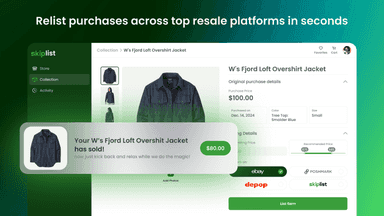
See every featureRelist enables brands to offer resale support with minimal effort. Customers can opt in to relist items in just a few clicks, while Relist manages listing, authentication, and fulfillment. This keeps brands connected to the post-purchase journey, reduces operational overhead, and provides insight into secondhand market activity.
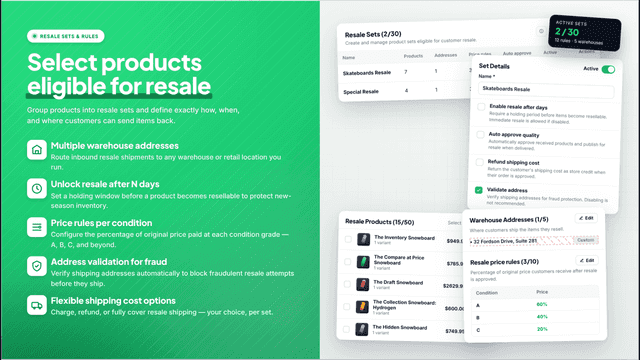
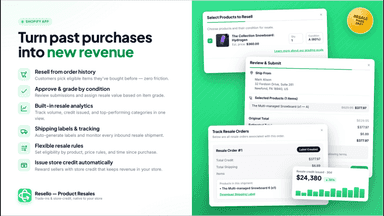
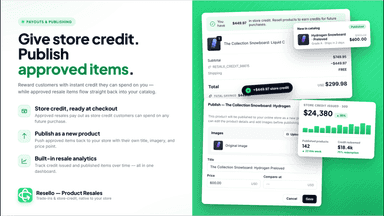
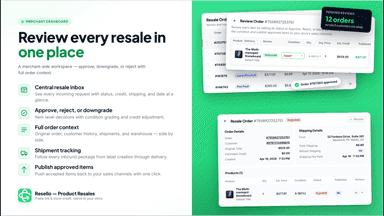
Resello turns one-time buyers into repeat customers by letting them trade in past purchases for store credit - directly from their account, with no third-party marketplace involved. Customers pick eligible items from their order history, ship them back with a pre-filled label, and receive store credit the moment you approve. Approved items become resale listings in your catalog with one click.
- Let customers relist past purchases in one click to top marketplaces
- SkipList handles listing, pricing, and shipping - no work required from you
- Relist handles listing, pricing, and shipping - no work required from you
- Help customers recover value from any past or ineligible purchase
- Enable customers to resell items from their order history
- Review items and assign value based on condition and publish approved ones
- Track resale performance with built-in analytics
- Generate shipping labels and track inbound resale shipments



All the numbers
Every figure, side by side
A green dot marks the app ahead on a measured figure. Estimates, gaps and apps that leave no storefront trace never take the lead.
Adoption
| Measure |  Relist |  Resello |
|---|---|---|
| Detected stores | 2 | Not published |
| Net store change, 28 days | 0 | 0 |
| Stores added, 28 days | Not enough data | Not enough data |
| Big-brand share | Not enough data | Not enough data |
| Top store categories | Apparel & Accessories, Luggage & Bags | Not published |
| Top store countries | Italy, United States | Not published |
Reviews
| Measure | Relist | Resello |
|---|---|---|
| App Store rating | Not published | Not published |
| App Store reviews | Not published | Not published |
| New reviews, 28 days | Not enough data | Not enough data |
| Reviewers a year or more in | Not enough data | Not enough data |
FAQ
Relist and Resello: common questions
- What features does each app list that the other doesn’t?
- Resello lists 10 the others don’t mention, such as Automated approvals, Exchanges, In-store returns, Manual refunds. A feature missing from a listing may still be supported; this compares what each App Store listing says.
- Where does this comparison’s data come from?
- Shoplist crawls Shopify storefronts to detect which apps each store runs, and reads each app’s Shopify App Store listing for reviews, pricing, features and integrations. Store counts are as of Nov 9, 2026 for Relist, Oct 13, 2026 for Resello; estimated figures are labeled.
How Shoplist compares apps
Store counts come from Shoplist’s crawl of Shopify storefronts, which detects the apps each store runs; they are as of Nov 9, 2026 for Relist, Oct 13, 2026 for Resello. Reviews, ratings, plans, features and integrations come from each app’s Shopify App Store listing. 28-day figures are labeled when estimated, and a figure that is missing or estimated never decides who leads. Read the methodology.