
Quaybound: Purchase Orders vs Shelfward: Purchase Orders
Two Shopify apps, side by side: detected stores, momentum, reviews, plans, listed features and who runs each. Store counts as of Oct 14, 2026 for Quaybound, Oct 18, 2026 for Shelfward.
The short answer
- Only Shelfward lists a free plan. Paid plans start at $49/month for Quaybound and $29/month for Shelfward.
- Quaybound lists 1 features Shelfward’s listing doesn’t mention, including Multi-location.
Head to head


Standard
Free
- · Invoice number, paid and due dates
- · Landed cost preview; no cost write-back
- · One inventory location
- · PO PDF and supplier email
- · Quantity-only partial receiving
- · Receipt PDF labels and reprints
Core
- · 14-day Shopify trial
- · Everything in Free
- · Late charges on Shelfward receipts
- · Min/max reorder drafts
- · One inventory location
- · Per-charge landed-cost allocation
Plus
- · 14-day Shopify trial
- · All inventory locations
- · Everything in Core
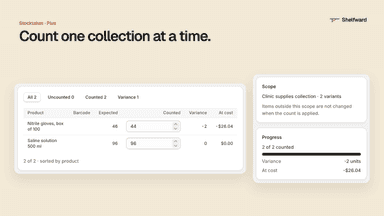
- · Scoped stocktakes and variance at cost
Coverage counts what each App Store listing names. Every feature, checked off app by app, is in Shoplist.
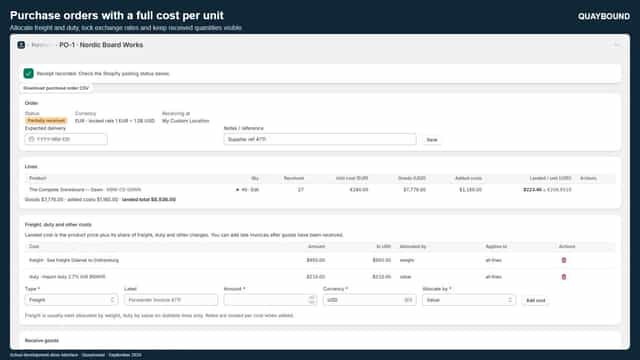
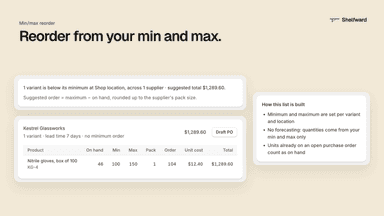
See every featureManage suppliers, purchase orders and receiving inside Shopify. Add freight, duty and fees to see landed cost per unit, with exchange rates locked on each order. Record partial deliveries and choose when to update inventory. Plan replenishment across your store using recent sales, supplier lead times, minimum quantities and pack sizes.
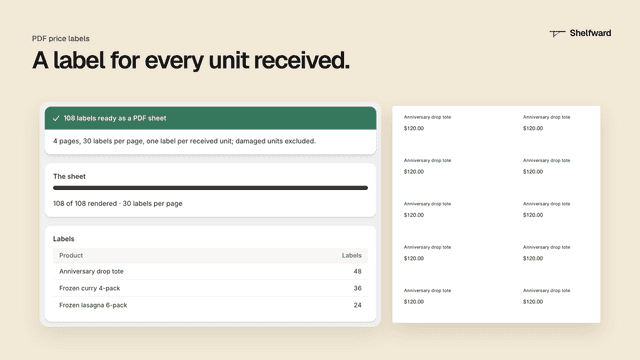
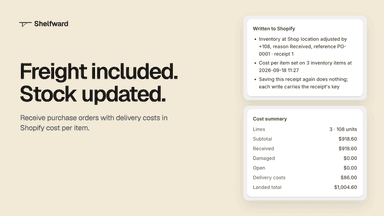
Create purchase orders and email suppliers a PDF. When stock arrives, split freight, duty and fees by quantity, value or weight, and cost per item in Shopify is updated with that landed cost. Received it with Shopify's own purchase orders? Add the freight to that shipment without receiving twice. Print PDF price labels. Free covers purchase orders, receiving and labels at one location; Core writes the landed cost.
- Landed cost per unit: freight, duty and fees allocated by value, weight or units
- Purchase orders in the supplier's currency with the rate locked on creation
- Suppliers with lead time, MOQ and case pack, several suppliers per product
- Receiving that posts one traceable stock adjustment, never a background sync
- Receive stock and update cost per item with freight, duty and fees included
- Create supplier purchase orders and email them with a PDF attached
- Print PDF price labels for received units on Letter or A4 sheets
- Count by collection or location on Plus, with variance valued at cost
All the numbers
Every figure, side by side
A green dot marks the app ahead on a measured figure. Estimates, gaps and apps that leave no storefront trace never take the lead.
Adoption
| Measure |  Quaybound |  Shelfward |
|---|---|---|
| Detected stores | Not published | Not published |
| Net store change, 28 days | 0 | 0 |
| Stores added, 28 days | Not enough data | Not enough data |
| Big-brand share | Not enough data | Not enough data |
| Top store categories | Not published | Not published |
| Top store countries | Not published | Not published |
Reviews
| Measure | Quaybound | Shelfward |
|---|---|---|
| App Store rating | Not published | Not published |
| App Store reviews | Not published | Not published |
| New reviews, 28 days | Not enough data | Not enough data |
| Reviewers a year or more in | Not enough data | Not enough data |
FAQ
Quaybound and Shelfward: common questions
- Is Quaybound or Shelfward cheaper?
- Only Shelfward lists a free plan. Paid plans start at $49/month for Quaybound and $29/month for Shelfward. Shoplist compares base prices only between monthly plans in the same currency; usage charges and annual plans vary, so check each plan’s limits.
- What features does each app list that the other doesn’t?
- Quaybound lists 1 the others don’t mention, such as Multi-location. Shelfward lists 1 the others don’t mention, such as Inventory tracking. A feature missing from a listing may still be supported; this compares what each App Store listing says.
- Where does this comparison’s data come from?
- Shoplist crawls Shopify storefronts to detect which apps each store runs, and reads each app’s Shopify App Store listing for reviews, pricing, features and integrations. Store counts are as of Oct 14, 2026 for Quaybound, Oct 18, 2026 for Shelfward; estimated figures are labeled.
How Shoplist compares apps
Store counts come from Shoplist’s crawl of Shopify storefronts, which detects the apps each store runs; they are as of Oct 14, 2026 for Quaybound, Oct 18, 2026 for Shelfward. Reviews, ratings, plans, features and integrations come from each app’s Shopify App Store listing. 28-day figures are labeled when estimated, and a figure that is missing or estimated never decides who leads. Read the methodology.