
PO Engine: PDF to Draft Order vs Pomelo: PO to Draft Order
Two Shopify apps, side by side: detected stores, momentum, reviews, plans, listed features and who runs each. Store counts as of Nov 7, 2026 for PO Engine, Nov 13, 2026 for Pomelo.
The short answer
- Both list a free plan. Paid plans start at $29/month for PO Engine and $29/month for Pomelo.
Head to head

Free
- · 15 orders every month
- · Renews monthly, not a trial
Starter
- · $0.19 an order
- · 150 orders a month
Growth
- · $0.13 an order
- · 600 orders a month
Free
- · 5 purchase orders per month
- · Every feature included
Starter
- · 100 purchase orders per month
- · Every feature included
Growth
- · 500 purchase orders per month
- · Every feature included
Pro
- · 2,000 purchase orders per month
- · Every feature included
Coverage counts what each App Store listing names. Every feature, checked off app by app, is in Shoplist.
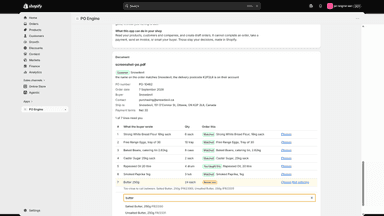
See every featureYour customers email purchase orders as PDFs, spreadsheets and CSVs. You retype them. PO Engine reads the order, matches every line to your products, and creates a Shopify draft order priced from your own catalogue and B2B price lists. Anything it is unsure about it asks you once, then remembers how that customer words things forever. It writes a draft order and stops.
Retyping wholesale purchase orders is slow and error-prone. Pomelo reads the PO your buyer sends, whether a PDF, scan, Excel file, CSV or pasted email, and matches every line to your products by SKU, barcode or description. You check the lines beside the original and create a draft order with the buyer's PO number, prices, payment terms, shipping charge, addresses and customer or B2B company attached.
- Reads purchase orders as PDF, Excel or CSV. No template for your buyers.
- Matches lines to your products, and asks you rather than guessing when unsure.
- Learns how each customer words things, so the same order never asks twice.
- Prices from your own catalogue and B2B price lists, never from the buyer's PDF.
- Reads PDFs, scans, Excel, CSV and email text, including case-pack quantities
- Matches lines by SKU, barcode or description and flags anything to check
- Carries the PO's payment terms, shipping charge and discount onto the draft
- Attaches the buyer as a customer or B2B company location on the draft order



All the numbers
Every figure, side by side
A green dot marks the app ahead on a measured figure. Estimates, gaps and apps that leave no storefront trace never take the lead.
Adoption
| Measure |  PO Engine | |
|---|---|---|
| Detected stores | Not published | Not published |
| Net store change, 28 days | 0 | 0 |
| Stores added, 28 days | Not enough data | Not enough data |
| Big-brand share | Not enough data | Not enough data |
| Top store categories | Not published | Not published |
| Top store countries | Not published | Not published |
Reviews
| Measure | PO Engine | |
|---|---|---|
| App Store rating | Not published | Not published |
| App Store reviews | Not published | Not published |
| New reviews, 28 days | Not enough data | Not enough data |
| Reviewers a year or more in | Not enough data | Not enough data |
FAQ
PO Engine and Pomelo: common questions
- Is PO Engine or Pomelo cheaper?
- Both list a free plan. Paid plans start at $29/month for PO Engine and $29/month for Pomelo. Shoplist compares base prices only between monthly plans in the same currency; usage charges and annual plans vary, so check each plan’s limits.
- Where does this comparison’s data come from?
- Shoplist crawls Shopify storefronts to detect which apps each store runs, and reads each app’s Shopify App Store listing for reviews, pricing, features and integrations. Store counts are as of Nov 7, 2026 for PO Engine, Nov 13, 2026 for Pomelo; estimated figures are labeled.
How Shoplist compares apps
Store counts come from Shoplist’s crawl of Shopify storefronts, which detects the apps each store runs; they are as of Nov 7, 2026 for PO Engine, Nov 13, 2026 for Pomelo. Reviews, ratings, plans, features and integrations come from each app’s Shopify App Store listing. 28-day figures are labeled when estimated, and a figure that is missing or estimated never decides who leads. Read the methodology.