
PixelTrim vs PixelUnik: Alt Text Generator
Two Shopify apps, side by side: detected stores, momentum, reviews, plans, listed features and who runs each. Store counts as of Nov 8, 2026 for PixelTrim, Oct 14, 2026 for PixelUnik.
The short answer
- Only PixelUnik lists a free plan. Paid plans start at $30/month for PixelTrim and $9.99/month for PixelUnik.
- PixelTrim lists 5 features PixelUnik’s listing doesn’t mention, including AI generation, Alt text, Compression.
Head to head


Basic
- · AI Alt Text Suggestions OpenAI + Claude
- · Automatic WebP Conversion
- · Before/After Metrics
- · Bulk Processing
- · Core Web Vitals (LCP, FID, CLS)
- · Page Speed Impact Analysis
Free
- · 30 free tokens, one time
- · AI alt text, one image at a time
- · SEO file names, one image at a time
- · SEO titles & meta, product by product
Starter
- · 100 tokens/month
- · AI alt text, one image at a time
- · Basic SEO report
- · Compression and WebP conversion
- · Email support
- · Originals preserved
Pro
- · 500 tokens/month
- · AI alt text, one image at a time
- · Full SEO report
- · Originals preserved
- · Priority email support
- · Priority processing
Growth
- · 1,500 tokens/month
- · Alt text for the whole catalogue
- · Auto alt text and WebP on new images
- · Bulk SEO file names
- · Chat and priority support
- · Early access to new features
Coverage counts what each App Store listing names. Every feature, checked off app by app, is in Shoplist.
See every featurePixelTrim helps you run a smooth store without sacrificing image quality. It compresses your product images and converts them to modern WebP format, reducing the large file sizes that slow down pages. You can optimize images in bulk or one product at a time, while keeping the original quality. PixelTrim also writes clear, descriptive alt text for your images using AI, improving accessibility and search visibility.
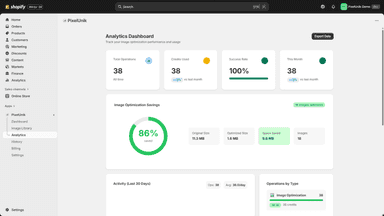
Google and screen readers can't see your product photos: they read the alt text. Writing it by hand for a whole catalog is slow work. PixelUnik looks at each image and describes what that photo shows, different for every angle, in one of seven languages. Review it, ask for another, or save it to Shopify.
- Automatic image compression and WebP conversion while preserving quality
- Bulk optimize all product images or fine-tune them one product at a time
- AI-generated alt text for images to support SEO and accessibility
- Compress product images significantly without quality loss
- Optimize images to modern WebP format for faster loading
- Batch optimize multiple images at once from your library
- Track optimization history and results in your dashboard


All the numbers
Every figure, side by side
A green dot marks the app ahead on a measured figure. Estimates, gaps and apps that leave no storefront trace never take the lead.
Adoption
| Measure |  PixelTrim |  PixelUnik |
|---|---|---|
| Detected stores | Not published | Not published |
| Net store change, 28 days | 0 | 0 |
| Stores added, 28 days | Not enough data | Not enough data |
| Big-brand share | Not enough data | Not enough data |
| Top store categories | Not published | Not published |
| Top store countries | Not published | Not published |
Reviews
| Measure | PixelTrim | PixelUnik |
|---|---|---|
| App Store rating | 5.0 ★ | Not published |
| App Store reviews | 2 | Not published |
| New reviews, 28 days | Not enough data | Not enough data |
| Reviewers a year or more in | Not enough data | Not enough data |
FAQ
PixelTrim and PixelUnik: common questions
- Is PixelTrim or PixelUnik cheaper?
- Only PixelUnik lists a free plan. Paid plans start at $30/month for PixelTrim and $9.99/month for PixelUnik. Shoplist compares base prices only between monthly plans in the same currency; usage charges and annual plans vary, so check each plan’s limits.
- What features does each app list that the other doesn’t?
- PixelTrim lists 5 the others don’t mention, such as AI generation, Alt text, Compression, Generative fill. PixelUnik lists 1 the others don’t mention, such as Auto-optimization. A feature missing from a listing may still be supported; this compares what each App Store listing says.
- Where does this comparison’s data come from?
- Shoplist crawls Shopify storefronts to detect which apps each store runs, and reads each app’s Shopify App Store listing for reviews, pricing, features and integrations. Store counts are as of Nov 8, 2026 for PixelTrim, Oct 14, 2026 for PixelUnik; estimated figures are labeled.
How Shoplist compares apps
Store counts come from Shoplist’s crawl of Shopify storefronts, which detects the apps each store runs; they are as of Nov 8, 2026 for PixelTrim, Oct 14, 2026 for PixelUnik. Reviews, ratings, plans, features and integrations come from each app’s Shopify App Store listing. 28-day figures are labeled when estimated, and a figure that is missing or estimated never decides who leads. Read the methodology.