

PaidUp: Wholesale Net Terms vs Quay: B2B Credit Limits
Two Shopify apps, side by side: detected stores, momentum, reviews, plans, listed features and who runs each. Store counts as of Oct 14, 2026 for PaidUp, Nov 5, 2026 for Quay.
The short answer
- Paid plans start at $19/month for PaidUp and $39/month for Quay.
- Quay lists 6 features PaidUp’s listing doesn’t mention, including Cash flow, Net terms, Order limits.
Head to head


Momentum
New reviews each month
Review pace is the clearest public read on how fast an app is winning new merchants.
Pro
Starter
- · Branded statements, any date, in bulk
- · Email & in-app chat support
- · Money forecast, aging reports in PDF/CSV
- · Over limit: pay on order or block
- · Overdue: net terms off, then a hold
- · Suggested limit & policy per company
Growth
- · Branded statements, any date, in bulk
- · Money forecast, aging reports in PDF/CSV
- · Over limit: pay on order or block
- · Overdue: net terms off, then a hold
- · Priority email & chat support
- · Suggested limit & policy per company
Scale
- · Branded statements, any date, in bulk
- · Money forecast, aging reports in PDF/CSV
- · Over limit: pay on order or block
- · Overdue: net terms off, then a hold
- · Priority email & chat + onboarding call
- · Suggested limit & policy per company
Coverage counts what each App Store listing names. Every feature, checked off app by app, is in Shoplist.
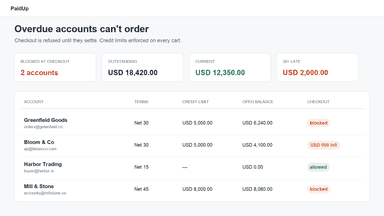
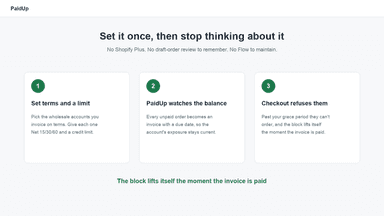
See every featureShopify gave every plan net terms, but nothing stops a stockist who already owes you for three invoices from placing a fourth. PaidUp is that missing piece. Set each wholesale account's terms and credit limit. Once an account is past your grace period, checkout refuses it until the invoices are settled, and unblocks the moment they pay.
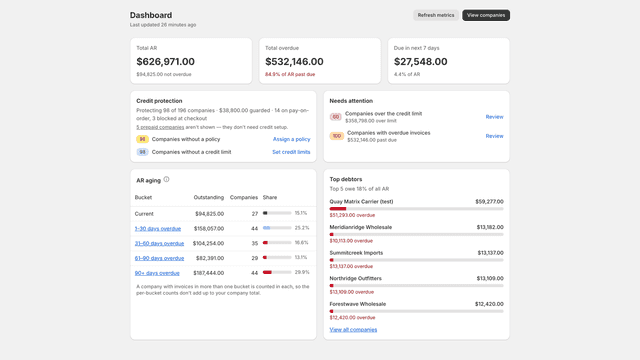
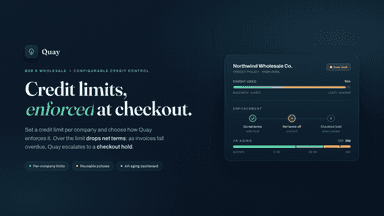
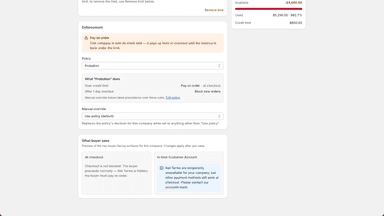
Quay is B2B credit control that keeps good buyers ordering. It suggests a limit and policy per company from your orders. Nothing changes until you apply, and you can undo it for 30 days. Over the limit, a buyer still orders without net terms, or is blocked if you choose. When invoices go overdue, Quay removes net terms on your schedule, then holds checkout.
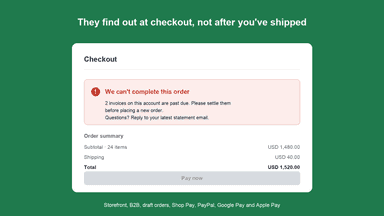
- Overdue accounts are blocked at checkout until their invoices are settled
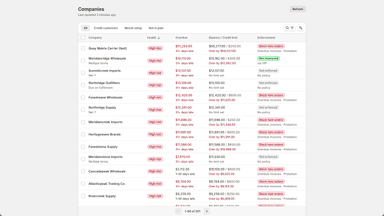
- Per-account credit limits enforced on every cart before you ship
- Works on the storefront, B2B, draft orders and accelerated checkouts
- Automatic reminder emails before and after each invoice due date
- Set a credit limit for each B2B or wholesale company
- Configure enforcement per company with reusable credit policies
- Over-limit buyers check out without net terms
- Overdue accounts can escalate to a checkout-blocking hold

All the numbers
Every figure, side by side
A green dot marks the app ahead on a measured figure. Estimates, gaps and apps that leave no storefront trace never take the lead.
Adoption
| Measure |  PaidUp |  Quay |
|---|---|---|
| Detected stores | Not published | Not published |
| Net store change, 28 days | 0 | 0 |
| Stores added, 28 days | Not enough data | Not enough data |
| Big-brand share | Not enough data | Not enough data |
| Top store categories | Not published | Not published |
| Top store countries | Not published | Not published |
Reviews
| Measure | PaidUp | Quay |
|---|---|---|
| App Store rating | Not published | 5.0 ★ |
| App Store reviews | Not published | 4 |
| New reviews, 28 days | Not enough data | Not enough data |
| Reviewers a year or more in | Not enough data | Not enough data |
FAQ
PaidUp and Quay: common questions
- Is PaidUp or Quay cheaper?
- Paid plans start at $19/month for PaidUp and $39/month for Quay. Shoplist compares base prices only between monthly plans in the same currency; usage charges and annual plans vary, so check each plan’s limits.
- What features does each app list that the other doesn’t?
- PaidUp lists 2 the others don’t mention, such as Billing and invoicing, Customers. Quay lists 6 the others don’t mention, such as Cash flow, Net terms, Order limits, Payment methods. A feature missing from a listing may still be supported; this compares what each App Store listing says.
- Where does this comparison’s data come from?
- Shoplist crawls Shopify storefronts to detect which apps each store runs, and reads each app’s Shopify App Store listing for reviews, pricing, features and integrations. Store counts are as of Oct 14, 2026 for PaidUp, Nov 5, 2026 for Quay; estimated figures are labeled.
How Shoplist compares apps
Store counts come from Shoplist’s crawl of Shopify storefronts, which detects the apps each store runs; they are as of Oct 14, 2026 for PaidUp, Nov 5, 2026 for Quay. Reviews, ratings, plans, features and integrations come from each app’s Shopify App Store listing. 28-day figures are labeled when estimated, and a figure that is missing or estimated never decides who leads. Read the methodology.