
Packfill: Bulk Product Weights vs UnitProof ‑ Grundpreis PAngV
Two Shopify apps, side by side: detected stores, momentum, reviews, plans, listed features and who runs each. Store counts as of Nov 16, 2026 for Packfill, Oct 17, 2026 for UnitProof.
The short answer
- Both list a free plan. Paid plans start at $9.99/month for Packfill and $12.99/month for UnitProof.
- Packfill lists 2 features UnitProof’s listing doesn’t mention, including CSV import and export, Rollback.
Head to head

Free
Pro
Free
- · Configure ten variants
- · Scan your whole catalog
- · See the proposed measurement for every v
Basic
- · Bulk set unit prices with a preview
- · Configure five hundred variants
- · Undo any run for thirty days
Pro
- · Everything in Basic
- · Rules that configure a category at once
Scale
- · Built for large catalogs
- · Everything in Pro
Coverage counts what each App Store listing names. Every feature, checked off app by app, is in Shoplist.
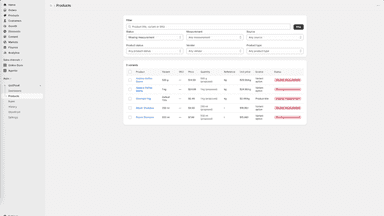
See every featureMissing weights make carrier-calculated and weight-based shipping rates wrong. Packfill scans your active products, shows which shippable variants have no weight and which product types are missing the most, and fills them for you. Write rules such as all T-shirts weigh 0.2 kg by product type, vendor, tag or collection, or import a CSV by SKU.
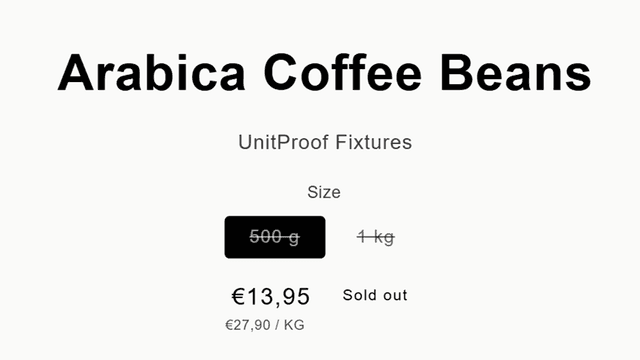
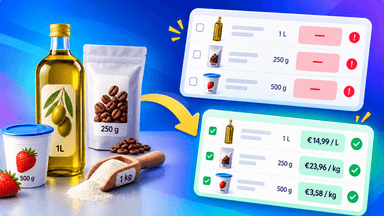
Themes show a price per kilo or litre only where the package size has been filled in, and filling it in one variant at a time is the part nobody does. UnitProof reads the size your catalog already states — a variant option, a title, a shipping weight — and says which clue it used. Nothing is written until you have seen it row by row, before and after. Every run is recorded and can be rolled back.
- See which shippable variants have no weight, grouped by product type
- Rules by product type, vendor, tag or collection, in g, kg, oz or lb
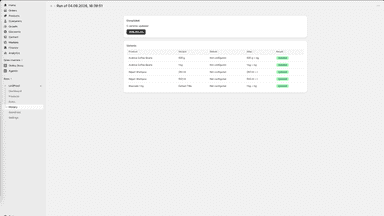
- Preview before applying, keep a history of every batch, undo the latest
- Scan the catalog and see a proposed measurement for every variant
- Preview each bulk change row by row, before and after, then apply
- Roll back any run, with the replaced values kept
All the numbers
Every figure, side by side
A green dot marks the app ahead on a measured figure. Estimates, gaps and apps that leave no storefront trace never take the lead.
Adoption
| Measure |  UnitProof | |
|---|---|---|
| Detected stores | Not published | Not published |
| Net store change, 28 days | 0 | 0 |
| Stores added, 28 days | Not enough data | Not enough data |
| Big-brand share | Not enough data | Not enough data |
| Top store categories | Not published | Not published |
| Top store countries | Not published | Not published |
Reviews
| Measure | UnitProof | |
|---|---|---|
| App Store rating | Not published | Not published |
| App Store reviews | Not published | Not published |
| New reviews, 28 days | Not enough data | Not enough data |
| Reviewers a year or more in | Not enough data | Not enough data |
FAQ
Packfill and UnitProof: common questions
- Is Packfill or UnitProof cheaper?
- Both list a free plan. Paid plans start at $9.99/month for Packfill and $12.99/month for UnitProof. Shoplist compares base prices only between monthly plans in the same currency; usage charges and annual plans vary, so check each plan’s limits.
- What features does each app list that the other doesn’t?
- Packfill lists 2 the others don’t mention, such as CSV import and export, Rollback. A feature missing from a listing may still be supported; this compares what each App Store listing says.
- Where does this comparison’s data come from?
- Shoplist crawls Shopify storefronts to detect which apps each store runs, and reads each app’s Shopify App Store listing for reviews, pricing, features and integrations. Store counts are as of Nov 16, 2026 for Packfill, Oct 17, 2026 for UnitProof; estimated figures are labeled.
How Shoplist compares apps
Store counts come from Shoplist’s crawl of Shopify storefronts, which detects the apps each store runs; they are as of Nov 16, 2026 for Packfill, Oct 17, 2026 for UnitProof. Reviews, ratings, plans, features and integrations come from each app’s Shopify App Store listing. 28-day figures are labeled when estimated, and a figure that is missing or estimated never decides who leads. Read the methodology.