
Packfill: Bulk Product Weights vs Reweigh
Two Shopify apps, side by side: detected stores, momentum, reviews, plans, listed features and who runs each. Store counts as of Nov 16, 2026 for Packfill, Oct 26, 2026 for Reweigh.
The short answer
- Both list a free plan. Paid plans start at $9.99/month for Packfill and $19/month for Reweigh.
- Packfill lists 1 features Reweigh’s listing doesn’t mention, including Rollback.
Head to head

Free
Pro
Free
- · AI weight suggestions with reasoning
- · Fix up to 5 products free
- · Full catalog scan + revenue-at-risk
Standard
- · For catalogs up to 500 products
- · Full change history + one-click undo
- · Guardian automatic scans
- · Unlimited weight fixes
Pro
- · Everything in Standard
- · Priority support
- · Unlimited catalog size
Coverage counts what each App Store listing names. Every feature, checked off app by app, is in Shoplist.
See every featureMissing weights make carrier-calculated and weight-based shipping rates wrong. Packfill scans your active products, shows which shippable variants have no weight and which product types are missing the most, and fills them for you. Write rules such as all T-shirts weigh 0.2 kg by product type, vendor, tag or collection, or import a CSV by SKU.
If your shipping rates look wrong at checkout, the most common cause isn't your rates - it's product weights. Every product with no weight gets shipped on a guess: customers see inflated rates and abandon carts, or you eat the difference when the carrier bills the real weight.
- See which shippable variants have no weight, grouped by product type
- Rules by product type, vendor, tag or collection, in g, kg, oz or lb
- Preview before applying, keep a history of every batch, undo the latest
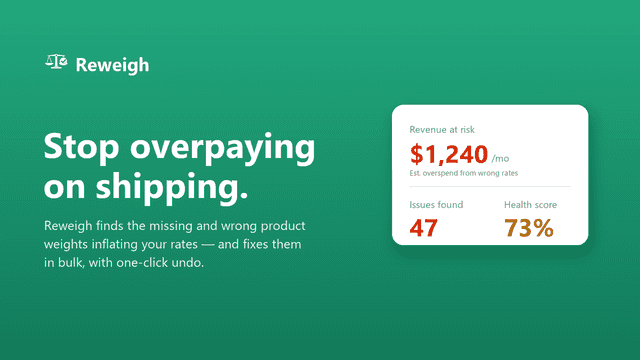
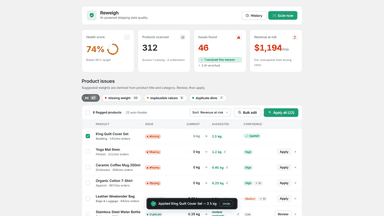
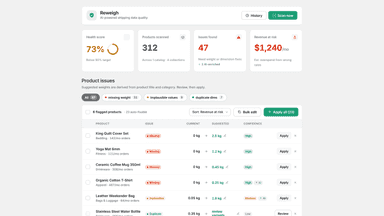
- One scan: shipping health score, every flagged product, and revenue at risk
- Weight suggestions from category data, keywords, and AI, with reasoning shown
- Bulk-apply fixes with a confirmation step and instant one-click undo
- Full change history: who changed which weight, and when

All the numbers
Every figure, side by side
A green dot marks the app ahead on a measured figure. Estimates, gaps and apps that leave no storefront trace never take the lead.
Adoption
| Measure |  Reweigh | |
|---|---|---|
| Detected stores | Not published | Not published |
| Net store change, 28 days | 0 | 0 |
| Stores added, 28 days | Not enough data | Not enough data |
| Big-brand share | Not enough data | Not enough data |
| Top store categories | Not published | Not published |
| Top store countries | Not published | Not published |
Reviews
| Measure | Reweigh | |
|---|---|---|
| App Store rating | Not published | Not published |
| App Store reviews | Not published | Not published |
| New reviews, 28 days | Not enough data | Not enough data |
| Reviewers a year or more in | Not enough data | Not enough data |
FAQ
Packfill and Reweigh: common questions
- Is Packfill or Reweigh cheaper?
- Both list a free plan. Paid plans start at $9.99/month for Packfill and $19/month for Reweigh. Shoplist compares base prices only between monthly plans in the same currency; usage charges and annual plans vary, so check each plan’s limits.
- What features does each app list that the other doesn’t?
- Packfill lists 1 the others don’t mention, such as Rollback. A feature missing from a listing may still be supported; this compares what each App Store listing says.
- Where does this comparison’s data come from?
- Shoplist crawls Shopify storefronts to detect which apps each store runs, and reads each app’s Shopify App Store listing for reviews, pricing, features and integrations. Store counts are as of Nov 16, 2026 for Packfill, Oct 26, 2026 for Reweigh; estimated figures are labeled.
How Shoplist compares apps
Store counts come from Shoplist’s crawl of Shopify storefronts, which detects the apps each store runs; they are as of Nov 16, 2026 for Packfill, Oct 26, 2026 for Reweigh. Reviews, ratings, plans, features and integrations come from each app’s Shopify App Store listing. 28-day figures are labeled when estimated, and a figure that is missing or estimated never decides who leads. Read the methodology.