

PacForm ‑ US EPR & CAA Reports vs Packlog: EPR Compliance
Two Shopify apps, side by side: detected stores, momentum, reviews, plans, listed features and who runs each. Store counts as of Oct 14, 2026.
The short answer
- Both list a free plan.
- PacForm and Packlog list the same 1 features.
Head to head


Data Setup
- · Add packaging profiles & weights
- · Continuous order tracking
- · Free forever plan tier
- · Maps materials to your products
Premium Export
- · Formatted for state regulations & PROs
- · Full data preservation status
- · Instant audit-ready CSV export
- · Run historical calculation engine
- · Unlimited annual report downloads
Free
- · Full data export, any time
- · Live tonnage for every scheme you ship
- · Mapping rules by tag, type or vendor
- · Obligation checker and packaging library
- · Up to 25 products mapped
Starter
- · 12 months of historical backfill
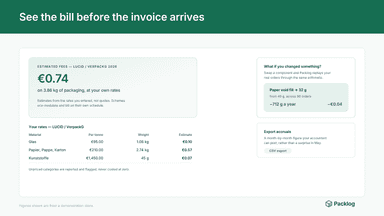
- · Deadline reminders and fee estimates
- · Registry files for up to 3 schemes
- · Up to 500 products mapped
Pro
- · 24 months of historical backfill
- · Deadline reminders and fee estimates
- · Registry files for every scheme
- · Up to 5,000 products mapped
Coverage counts what each App Store listing names. Every feature, checked off app by app, is in Shoplist.
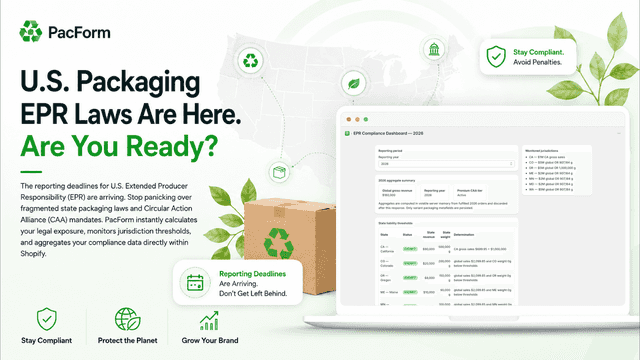
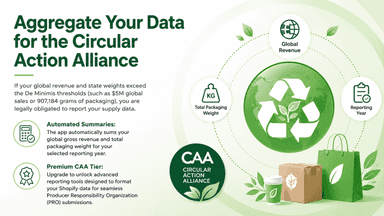
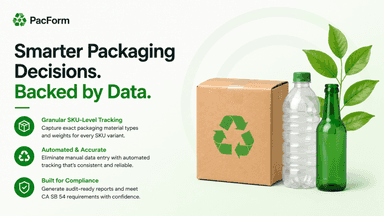
See every featureState laws require brands to report the weight of plastic, glass, and cardboard shipped. Doing this manually takes weeks and risks audit fines. This app completely automates your material footprint math. Assign default packaging weights to your orders, and our system scans your shipping history to calculate total material usage instantly.
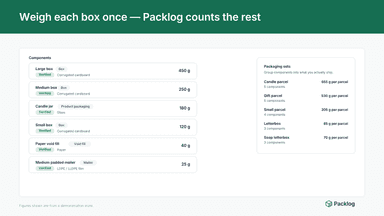
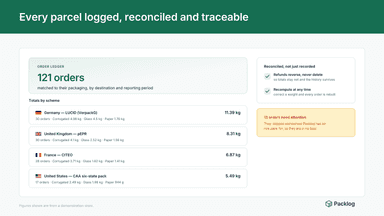
Packlog reads your fulfilled orders, works out the packaging that went with them, and produces the file each registry asks for. Weigh each box, mailer and insert once, then map packaging to products by tag, type or vendor. Every order is then logged by destination, with refunds reversed rather than deleted, so totals stay net.
- Automated Footprint Math: Multiplies packaging weights by total order volume.
- Audit-Ready Exports: Compliant CSVs formatted for state regulators and PROs.
- Historical Data Scanning: Analyzes past orders to calculate annual usage.
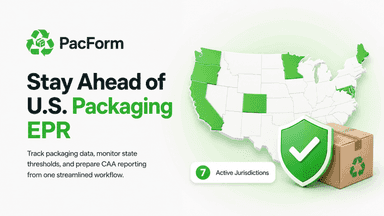
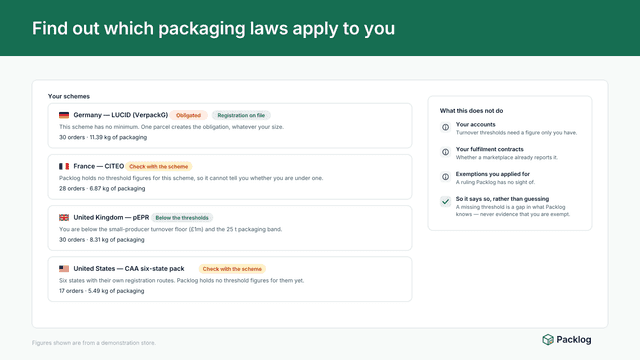
- See which packaging laws apply to you, and which do not
- Weigh packaging once, then map it to products by tag, type or vendor
- Every fulfilled order logged by destination, with refunds reversed
- Registry files for LUCID, CITEO, UK pEPR and US state EPR schemes
All the numbers
Every figure, side by side
A green dot marks the app ahead on a measured figure. Estimates, gaps and apps that leave no storefront trace never take the lead.
Adoption
| Measure |  PacForm |  Packlog |
|---|---|---|
| Detected stores | Not published | Not published |
| Net store change, 28 days | 0 | 0 |
| Stores added, 28 days | Not enough data | Not enough data |
| Big-brand share | Not enough data | Not enough data |
| Top store categories | Not published | Not published |
| Top store countries | Not published | Not published |
Reviews
| Measure | PacForm | Packlog |
|---|---|---|
| App Store rating | Not published | Not published |
| App Store reviews | Not published | Not published |
| New reviews, 28 days | Not enough data | Not enough data |
| Reviewers a year or more in | Not enough data | Not enough data |
FAQ
PacForm and Packlog: common questions
- Is PacForm or Packlog cheaper?
- Both list a free plan. Shoplist compares base prices only between monthly plans in the same currency; usage charges and annual plans vary, so check each plan’s limits.
- Where does this comparison’s data come from?
- Shoplist crawls Shopify storefronts to detect which apps each store runs, and reads each app’s Shopify App Store listing for reviews, pricing, features and integrations. Store counts are as of Oct 14, 2026; estimated figures are labeled.
How Shoplist compares apps
Store counts come from Shoplist’s crawl of Shopify storefronts, which detects the apps each store runs; they are as of Oct 14, 2026. Reviews, ratings, plans, features and integrations come from each app’s Shopify App Store listing. 28-day figures are labeled when estimated, and a figure that is missing or estimated never decides who leads. Read the methodology.