

Ovona vs PixelTrue: Facebook Pixel CAPI
Two Shopify apps, side by side: detected stores, momentum, reviews, plans, listed features and who runs each. Store counts as of Oct 13, 2026.
The short answer
- Only PixelTrue lists a free plan. Paid plans start at $59/month for Ovona and $29/month for PixelTrue.
- Ovona lists 3 features PixelTrue’s listing doesn’t mention, including Conversion tracking, Event-based, Pixel management.
Head to head


standard
PixelTrue - Free
- · 50 orders per month free forever
- · Full Meta Conversions API (CAPI)
- · Quota resets on the 1st of every month
- · Test Risk-Free. Upgrade when you scale
PixelTrue+
- · 2 min setup. no developer needed
- · 50 Orders Free monthly
- · Bypass iOS Ad Blockers
- · Full Meta Conversions API (CAPI)
- · Unlimited Orders Tracked
Coverage counts what each App Store listing names. Every feature, checked off app by app, is in Shoplist.
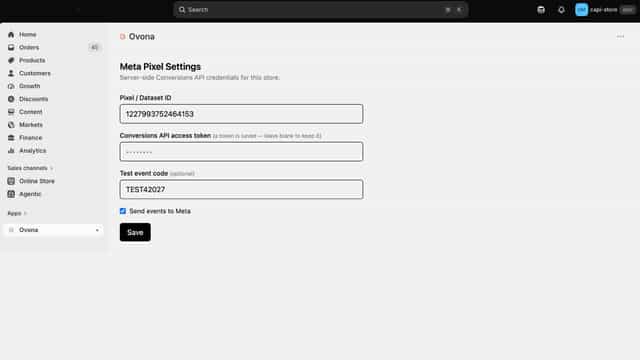
See every featureAd blockers, iOS tracking limits, and dropped connections stop browser pixels from reporting sales to Meta, so your ads optimize on incomplete data. Ovona sends your store's events to Meta from our servers instead of the shopper's browser. Purchases and checkouts are built from Shopify order data, so they arrive even when the browser pixel is blocked.
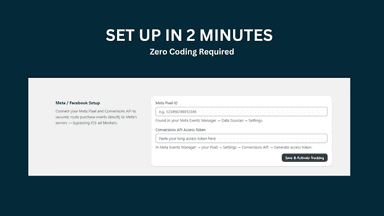
Meta's ad algorithm starves when iOS 14 and ad-blockers drop up to 35% of your purchase tracking. PixelTrue routes purchase events directly from Shopify's backend servers into Meta's Conversions API (CAPI) with 0ms speed impact. Why pay $150+/mo for Elevar or complex GTM containers? PixelTrue gives you 100% serverless tracking in a 2-minute zero-code setup with automatic deduplication.
- Purchases reach Meta even when ad blockers stop the browser pixel
- Tracks the full funnel: product views, add to carts, checkouts, and purchases
- Recognizes returning shoppers so more of your conversions are matched to ads
- Counts each conversion once, so your Meta reporting stays clean
- Server-side tracking bypasses iOS 14 ad blockers to fix broken Facebook Pixels.
- Securely hashes customer data to send complete Event Match Quality signals.
- Deduplicates events alongside your browser pixel to ensure perfect attribution.






All the numbers
Every figure, side by side
A green dot marks the app ahead on a measured figure. Estimates, gaps and apps that leave no storefront trace never take the lead.
Adoption
| Measure |  Ovona |  PixelTrue |
|---|---|---|
| Detected stores | Not published | Not published |
| Net store change, 28 days | 0 | 0 |
| Stores added, 28 days | Not enough data | Not enough data |
| Big-brand share | Not enough data | Not enough data |
| Top store categories | Not published | Not published |
| Top store countries | Not published | Not published |
Reviews
| Measure | Ovona | PixelTrue |
|---|---|---|
| App Store rating | Not published | Not published |
| App Store reviews | Not published | Not published |
| New reviews, 28 days | Not enough data | Not enough data |
| Reviewers a year or more in | Not enough data | Not enough data |
FAQ
Ovona and PixelTrue: common questions
- Is Ovona or PixelTrue cheaper?
- Only PixelTrue lists a free plan. Paid plans start at $59/month for Ovona and $29/month for PixelTrue. Shoplist compares base prices only between monthly plans in the same currency; usage charges and annual plans vary, so check each plan’s limits.
- What features does each app list that the other doesn’t?
- Ovona lists 3 the others don’t mention, such as Conversion tracking, Event-based, Pixel management. PixelTrue lists 3 the others don’t mention, such as Custom audiences, Performance tracking, UTM attribution. A feature missing from a listing may still be supported; this compares what each App Store listing says.
- Where does this comparison’s data come from?
- Shoplist crawls Shopify storefronts to detect which apps each store runs, and reads each app’s Shopify App Store listing for reviews, pricing, features and integrations. Store counts are as of Oct 13, 2026; estimated figures are labeled.
How Shoplist compares apps
Store counts come from Shoplist’s crawl of Shopify storefronts, which detects the apps each store runs; they are as of Oct 13, 2026. Reviews, ratings, plans, features and integrations come from each app’s Shopify App Store listing. 28-day figures are labeled when estimated, and a figure that is missing or estimated never decides who leads. Read the methodology.