
Ounce: MetalRate Sync vs Synq ‑ TCG Pricing & Inventory
Two Shopify apps, side by side: detected stores, momentum, reviews, plans, listed features and who runs each. Store counts as of Oct 25, 2026 for Ounce, Nov 1, 2026 for Synq.
The short answer
- Only Synq lists a free plan. Paid plans start at $30/month for Ounce and $29/month for Synq.
- Synq lists 13 features Ounce’s listing doesn’t mention, including Analytics, Auto-updates, Bulk editing.
Head to head


Momentum
New reviews each month
Review pace is the clearest public read on how fast an app is winning new merchants.
starter
- · Automatic sync twice a day
- · Bulk CSV import
- · Full audit-trail history
- · Stop-loss protection included
- · Up to 800 SKUs
pro
- · Automatic sync up to 5x/day
- · Everything in Starter
- · Priority support
- · Unlimited SKUs
Free
- · Daily TCGplayer prices
- · Every game and every feature
- · Price rules, import and POS
- · Up to 100 cards
Starter
- · Daily TCGplayer prices
- · Every game and every feature
- · Price rules, import and POS
- · Up to 2,000 cards
Pro
- · Daily TCGplayer prices
- · Every game and every feature
- · Price rules, import and POS
- · Up to 15,000 cards
Scale
- · Daily TCGplayer prices
- · Every game and every feature
- · Price rules, import and POS
- · Up to 50,000 cards
Coverage counts what each App Store listing names. Every feature, checked off app by app, is in Shoplist.
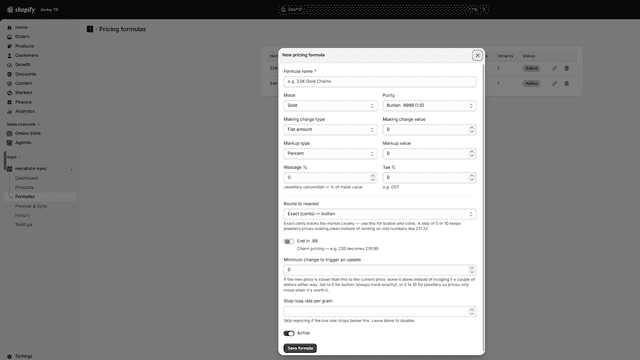
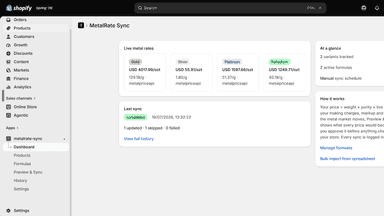
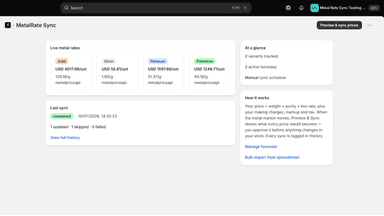
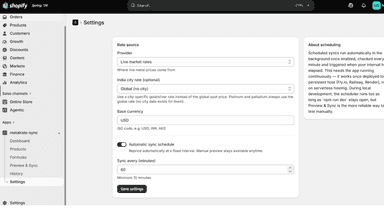
See every featureMetalRate Sync keeps your product prices in step with live gold, silver, platinum and palladium rates. Set a formula once (purity, making charge, wastage, markup, tax), preview every change, then apply it or let the app sync automatically. Every run is logged with the exact rate used. Set up a whole catalog from a spreadsheet, no SKUs needed.
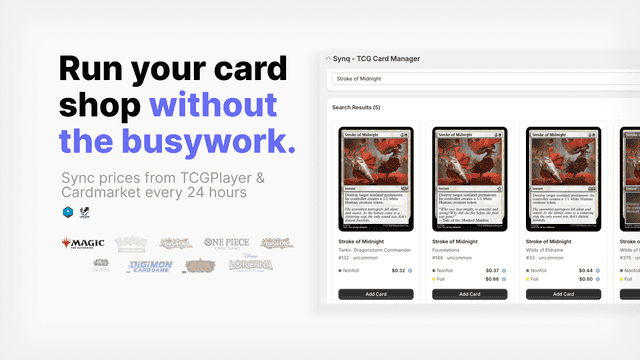
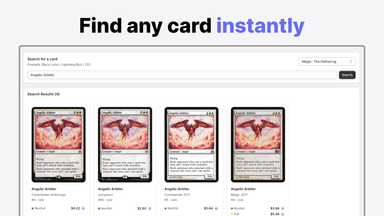
Synq is built for card shops. Search 19 games, including Magic, Pokémon, One Piece, Lorcana and Yu-Gi-Oh!, and add a card with its photo and condition. Each condition is a variant with its own price. Price rules follow the TCGplayer market on your schedule, by game, set, rarity or condition, with a minimum such as your cost. Import a TCGplayer export or a CSV, or link products you already sell.
- Reprice automatically from live gold, silver, platinum, and palladium rates
- Preview every price change before anything is applied to your store
- Full audit trail of every sync, with the exact rate used for each price
- Bulk import weights and formulas from a spreadsheet, matched by SKU
- Automatic daily price synchronization with TCGPlayer market data
- One-click card addition with auto-generated images, titles, and descriptions
- Multi-condition variants with configurable pricing adjustments by card condition


All the numbers
Every figure, side by side
A green dot marks the app ahead on a measured figure. Estimates, gaps and apps that leave no storefront trace never take the lead.
Adoption
| Measure |  Ounce |  Synq |
|---|---|---|
| Detected stores | Not published | Not published |
| Net store change, 28 days | 0 | 0 |
| Stores added, 28 days | Not enough data | Not enough data |
| Big-brand share | Not enough data | Not enough data |
| Top store categories | Not published | Not published |
| Top store countries | Not published | Not published |
Reviews
| Measure | Ounce | Synq |
|---|---|---|
| App Store rating | Not published | 3.8 ★ |
| App Store reviews | Not published | 3 |
| New reviews, 28 days | Not enough data | Not enough data |
| Reviewers a year or more in | Not enough data | Not enough data |
FAQ
Ounce and Synq: common questions
- Is Ounce or Synq cheaper?
- Only Synq lists a free plan. Paid plans start at $30/month for Ounce and $29/month for Synq. Shoplist compares base prices only between monthly plans in the same currency; usage charges and annual plans vary, so check each plan’s limits.
- What features does each app list that the other doesn’t?
- Ounce lists 4 the others don’t mention, such as Auto-repricing, Dashboards, Reports, Scheduling. Synq lists 13 the others don’t mention, such as Analytics, Auto-updates, Bulk editing, Competitor tracking. A feature missing from a listing may still be supported; this compares what each App Store listing says.
- Where does this comparison’s data come from?
- Shoplist crawls Shopify storefronts to detect which apps each store runs, and reads each app’s Shopify App Store listing for reviews, pricing, features and integrations. Store counts are as of Oct 25, 2026 for Ounce, Nov 1, 2026 for Synq; estimated figures are labeled.
How Shoplist compares apps
Store counts come from Shoplist’s crawl of Shopify storefronts, which detects the apps each store runs; they are as of Oct 25, 2026 for Ounce, Nov 1, 2026 for Synq. Reviews, ratings, plans, features and integrations come from each app’s Shopify App Store listing. 28-day figures are labeled when estimated, and a figure that is missing or estimated never decides who leads. Read the methodology.