
Optifeed: Ad Intelligence vs PixelFeed
Two Shopify apps, side by side: detected stores, momentum, reviews, plans, listed features and who runs each. Store counts as of Oct 13, 2026 for Optifeed, Nov 9, 2026 for PixelFeed.
The short answer
- Optifeed lists 13 features PixelFeed’s listing doesn’t mention, including Attribute filtering, Attribute mapping, Custom formulas.
Head to head

Momentum
New reviews each month
Review pace is the clearest public read on how fast an app is winning new merchants.
Standard
- · Custom Field Mapping
- · Email Support
- · Hourly Sync (+5 USD)
- · Manual Sync Available, Auto Sync 24Hrs
- · Sold Count & Bestsellers (up to 60 days)
- · Supports up to 500 Products
Grow
- · Email Support
- · Everything in Standard
- · Plus CSV Export
- · Supports up to 1000 Products
Advance
- · Choose Feed Images
- · Everything in Grow
- · Free Hourly Sync
- · Priority Email Support
- · Supports up to 2000 Products
Advance Plus
- · Everything in Advance
- · Free Hourly Sync
- · Priority Email Support
Coverage counts what each App Store listing names. Every feature, checked off app by app, is in Shoplist.
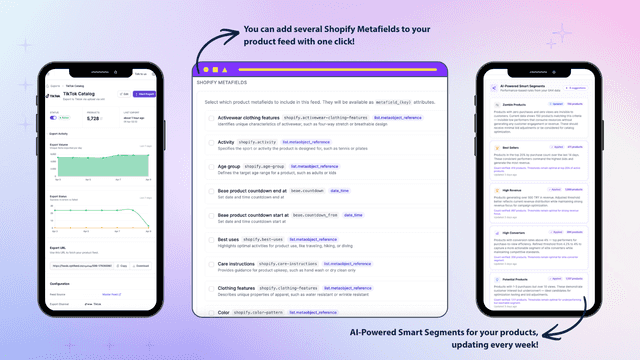
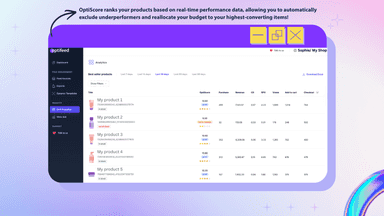
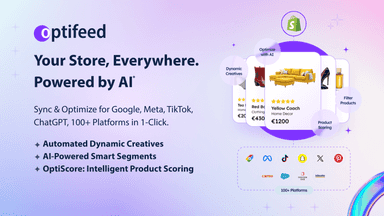
See every featureOptifeed is the marketing autopilot for ecommerce brands with large product catalogs. Optifeed enriches every product with AI and publishes it to 100+ channels where product data drives sales: ad platforms, price comparison sites, on-site marketing tools and AI assistants. It then creates, tests and optimizes product-level campaigns, shifting budget to winning products to drive higher ROAS.
PixelFeed turns your catalog into always-current product feeds. Every in-stock variant becomes a feed item with discount, color, size, material, and stock details, refreshed hourly or on demand. Map custom labels to sold quantity, bestseller rank, discount, or availability ratio.
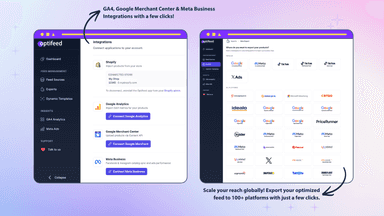
- Automatically generate feeds for 100+ platforms including Google, Meta & TikTok.
- Choose exactly which products, collections, or variants to include in your feed.
- Price or stock changes in Shopify? Optifeed syncs your product feed instantly.
- Feed Guard: Pre-validate data to fix Missing Attribute & Invalid Image errors.
- Hourly automatic feed updates, plus manual updates any time
- Custom labels from sold quantity, bestseller rank and availability ratio
- Promo image templates with badges, prices and frames, made per variant
- Only in-stock variants, with discount, color, size, and stock details
All the numbers
Every figure, side by side
A green dot marks the app ahead on a measured figure. Estimates, gaps and apps that leave no storefront trace never take the lead.
Adoption
| Measure |  Optifeed | |
|---|---|---|
| Detected stores | Not published | Not published |
| Net store change, 28 days | 0 | 0 |
| Stores added, 28 days | Not enough data | Not enough data |
| Big-brand share | Not enough data | Not enough data |
| Top store categories | Not published | Not published |
| Top store countries | Not published | Not published |
Reviews
| Measure | Optifeed | |
|---|---|---|
| App Store rating | 5.0 ★ | Not published |
| App Store reviews | 10 | Not published |
| New reviews, 28 days | Not enough data | Not enough data |
| Reviewers a year or more in | Not enough data | Not enough data |
FAQ
Optifeed and PixelFeed: common questions
- What features does each app list that the other doesn’t?
- Optifeed lists 13 the others don’t mention, such as Attribute filtering, Attribute mapping, Custom formulas, Custom labels. PixelFeed lists 9 the others don’t mention, such as Ad spend, Conversion tracking, Cost per acquisition, Performance tracking. A feature missing from a listing may still be supported; this compares what each App Store listing says.
- Where does this comparison’s data come from?
- Shoplist crawls Shopify storefronts to detect which apps each store runs, and reads each app’s Shopify App Store listing for reviews, pricing, features and integrations. Store counts are as of Oct 13, 2026 for Optifeed, Nov 9, 2026 for PixelFeed; estimated figures are labeled.
How Shoplist compares apps
Store counts come from Shoplist’s crawl of Shopify storefronts, which detects the apps each store runs; they are as of Oct 13, 2026 for Optifeed, Nov 9, 2026 for PixelFeed. Reviews, ratings, plans, features and integrations come from each app’s Shopify App Store listing. 28-day figures are labeled when estimated, and a figure that is missing or estimated never decides who leads. Read the methodology.