
OpsPilot: Tasks & Workflows vs PilotCOO: AI Store Agents
Two Shopify apps, side by side: detected stores, momentum, reviews, plans, listed features and who runs each. Store counts as of Jun 5, 2026 for OpsPilot, Nov 13, 2026 for PilotCOO.
The short answer
- OpsPilot lists 12 features PilotCOO’s listing doesn’t mention, including APIs, Conditional logic, Custom triggers.
Head to head

Starter
- · 3 team seats
- · All eight AI agents
- · Daily AI chat about your store
- · Unlimited insights, alerts and reports
Growth
- · 10 team seats
- · About 3x more AI chat each day
- · Everything in Starter
Coverage counts what each App Store listing names. Every feature, checked off app by app, is in Shoplist.
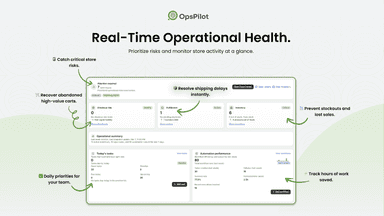
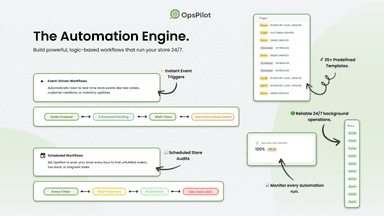
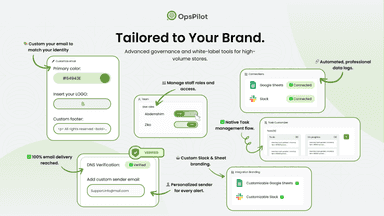
See every featureOpsPilot is a Shopify operations workspace for follow-up work. Turn orders, inventory, abandoned checkouts, customers, and product changes into assigned tasks, Slack or email alerts, and Google Sheets logs. Use templates or custom rules to route work to the right person, add comments and files, track workflow runs, and keep a clear history of what happened after each store event.
PilotCOO is an AI chief operating officer that works inside your Shopify admin. It reads your products, orders, refunds and customers, and every day its agents prepare the work that keeps a store healthy: purchase orders sized to your stock runway and cash, win-back emails for lapsed customers, product changes backed by margin and demand, fixes for products that keep coming back, and product pages AI shopping…
- Build workflows for orders, inventory, customers, and checkouts.
- Schedule checks for low stock, orders, and team follow-ups.
- Send Slack or email alerts when store conditions match.
- Send store and workflow data to Google Sheets.
- Smart reorder: purchase orders timed to stock runway and to your cash
- Win-back emails with one-time codes for customers who went quiet
- Promo guard and margin tuning, based on demand trend and real profit
- Returns detective: finds why products come back and drafts the fix

All the numbers
Every figure, side by side
A green dot marks the app ahead on a measured figure. Estimates, gaps and apps that leave no storefront trace never take the lead.
Adoption
| Measure |  OpsPilot | |
|---|---|---|
| Detected stores | Not published | Not published |
| Net store change, 28 days | 0 | Not enough data |
| Stores added, 28 days | Not enough data | Not enough data |
| Big-brand share | Not enough data | Not enough data |
| Top store categories | Not published | Not published |
| Top store countries | Not published | Not published |
Reviews
| Measure | OpsPilot | |
|---|---|---|
| App Store rating | Not published | Not published |
| App Store reviews | Not published | Not published |
| New reviews, 28 days | Not enough data | Not enough data |
| Reviewers a year or more in | Not enough data | Not enough data |
FAQ
OpsPilot and PilotCOO: common questions
- What features does each app list that the other doesn’t?
- OpsPilot lists 12 the others don’t mention, such as APIs, Conditional logic, Custom triggers, Custom workflows. PilotCOO lists 2 the others don’t mention, such as Customer segments, Stock replenishment. A feature missing from a listing may still be supported; this compares what each App Store listing says.
- Where does this comparison’s data come from?
- Shoplist crawls Shopify storefronts to detect which apps each store runs, and reads each app’s Shopify App Store listing for reviews, pricing, features and integrations. Store counts are as of Jun 5, 2026 for OpsPilot, Nov 13, 2026 for PilotCOO; estimated figures are labeled.
How Shoplist compares apps
Store counts come from Shoplist’s crawl of Shopify storefronts, which detects the apps each store runs; they are as of Jun 5, 2026 for OpsPilot, Nov 13, 2026 for PilotCOO. Reviews, ratings, plans, features and integrations come from each app’s Shopify App Store listing. 28-day figures are labeled when estimated, and a figure that is missing or estimated never decides who leads. Read the methodology.