

Old Glory: Made in USA vs StoreHQ: Compliance Scanner
Two Shopify apps, side by side: detected stores, momentum, reviews, plans, listed features and who runs each. Store counts as of Oct 14, 2026 for Old Glory, Jul 30, 2026 for StoreHQ.
The short answer
- Only Old Glory lists a free plan.
- StoreHQ lists 4 features Old Glory’s listing doesn’t mention, including Accessibility, Data privacy, Policy management.
Head to head


Free
- · 3 full scans every 30 days
- · Compliance score trend history
- · Every flagged claim and its wording
- · FTC substantiation guide
- · Prioritized fix guidance
- · Read-only — no customer data
Pro
- · AI catches implied US-origin claims
- · Automatic weekly monitoring
- · Everything in the Free plan
- · Unlimited compliance scans
Coverage counts what each App Store listing names. Every feature, checked off app by app, is in Shoplist.
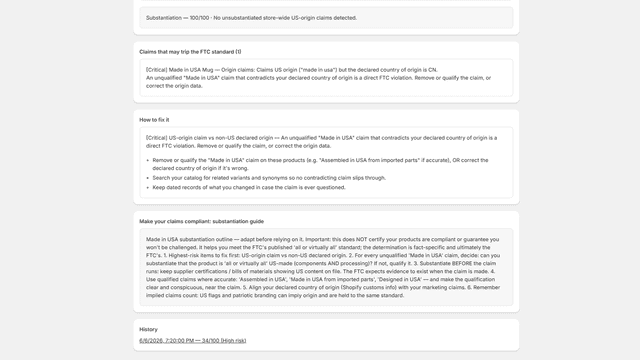
See every featureThe FTC enforces "Made in USA" claims under its "all or virtually all" standard, and unqualified US-origin claims must be substantiated by the merchant. Old Glory scans your products and store pages for US-origin claims, cross-checks each against the declared country of origin, scores the risk against the FTC standard, and gives the exact fix: substantiate or qualify each claim.
StoreHQ Compliance Scanner audits your storefront for common legal and platform compliance risks. It checks your store policies, cookie and privacy setup, advertising claims, SMS and email consent, auto-renewal and recurring-billing disclosures, and accessibility. The scan is read-only and never changes your store.
- Scan every product and your store copy for "Made in USA" / US-origin claims
- Cross-check each claim against the product's declared country of origin
- Risk-score vs the FTC "all or virtually all" standard, with the exact fix
- Recognizes compliant qualified claims like "Assembled in USA"
- Checks privacy, return/refund policy, terms, shipping, and cookie consent
- Flags deceptive advertising claims, fake urgency, and hidden fees
- Reviews SMS and email consent and required contact details
- Checks auto-renewal enrollment, cancellation, and renewal-term disclosure


All the numbers
Every figure, side by side
A green dot marks the app ahead on a measured figure. Estimates, gaps and apps that leave no storefront trace never take the lead.
Adoption
| Measure |  Old Glory |  StoreHQ |
|---|---|---|
| Detected stores | Not published | Not published |
| Net store change, 28 days | 0 | 0 |
| Stores added, 28 days | Not enough data | Not enough data |
| Big-brand share | Not enough data | Not enough data |
| Top store categories | Not published | Not published |
| Top store countries | Not published | Not published |
Reviews
| Measure | Old Glory | StoreHQ |
|---|---|---|
| App Store rating | Not published | Not published |
| App Store reviews | Not published | Not published |
| New reviews, 28 days | Not enough data | Not enough data |
| Reviewers a year or more in | Not enough data | Not enough data |
FAQ
Old Glory and StoreHQ: common questions
- Is Old Glory or StoreHQ cheaper?
- Only Old Glory lists a free plan. Shoplist compares base prices only between monthly plans in the same currency; usage charges and annual plans vary, so check each plan’s limits.
- What features does each app list that the other doesn’t?
- StoreHQ lists 4 the others don’t mention, such as Accessibility, Data privacy, Policy management, Terms and conditions. A feature missing from a listing may still be supported; this compares what each App Store listing says.
- Where does this comparison’s data come from?
- Shoplist crawls Shopify storefronts to detect which apps each store runs, and reads each app’s Shopify App Store listing for reviews, pricing, features and integrations. Store counts are as of Oct 14, 2026 for Old Glory, Jul 30, 2026 for StoreHQ; estimated figures are labeled.
How Shoplist compares apps
Store counts come from Shoplist’s crawl of Shopify storefronts, which detects the apps each store runs; they are as of Oct 14, 2026 for Old Glory, Jul 30, 2026 for StoreHQ. Reviews, ratings, plans, features and integrations come from each app’s Shopify App Store listing. 28-day figures are labeled when estimated, and a figure that is missing or estimated never decides who leads. Read the methodology.