

Multi Sync vs Store Porter
Two Shopify apps, side by side: detected stores, momentum, reviews, plans, listed features and who runs each. Store counts as of Oct 13, 2026.
The short answer
- Only Store Porter lists a free plan. Paid plans start at $9/month for Multi Sync and $4.99/month for Store Porter.
- Multi Sync lists 4 features Store Porter’s listing doesn’t mention, including Inventory, Inventory sync, Order sync.
Head to head


Starter
- · 2000 orders / month
- · 500 product syncs / month
- · Up to 3 connected stores
Growth
- · 20000 orders / month
- · 5000 product syncs / month
- · Up to 10 connected stores
Enterprise
- · Unlimited connected stores
- · Unlimited orders / month
- · Unlimited product syncs / month
Free
- · Upto 5 Collections
- · Upto 5 Pages
- · Upto 5 Products
Pro
- · Unlimited Blog, Article
- · Unlimited Collections
- · Unlimited Files
- · Unlimited Pages
- · Unlimited Products
Coverage counts what each App Store listing names. Every feature, checked off app by app, is in Shoplist.
See every featureStores working with multiple store often manage product catalogs and order routing through spreadsheets, emails, and manual edits, which leads to mismatched listings and slow fulfillment. This app replaces that with a structured connection: a store generates a one-time invite token, the other connects, and products and orders sync between the two stores.
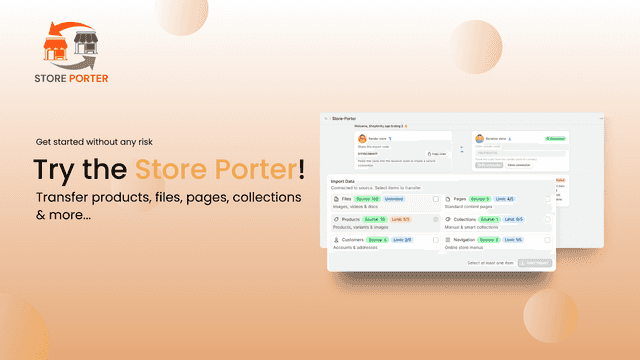
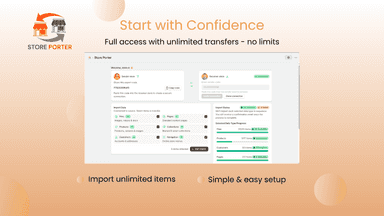
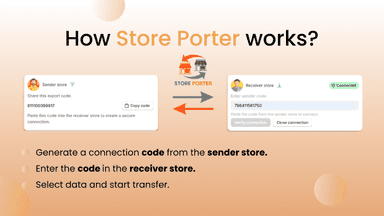
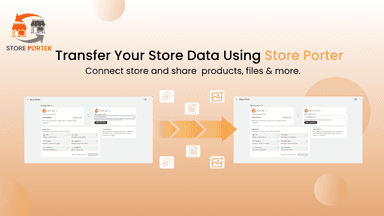
Moving data between Shopify stores often means exporting CSV files and reformatting them manually. Store Porter simplifies this. Install the app on both stores, share a secure code, and select what to transfer. Products, collections, customers, files, pages, and menus move automatically in the background. You get an email report when it finishes.
- Onboard partners with a single invite, no spreadsheets or manual setup
- Add any partner at any time, no support ticket needed
- Route orders to the correct partner store automatically
- Monitor every connected partner and sync activity from one dashboard
- Transfer products, collections, customers, files, pages, and menus
- Connect two stores securely using a simple shareable code
- Automatic duplicate detection skips already-imported items
- Background processing with email report on completion


All the numbers
Every figure, side by side
A green dot marks the app ahead on a measured figure. Estimates, gaps and apps that leave no storefront trace never take the lead.
Adoption
| Measure |  Multi Sync |  Store Porter |
|---|---|---|
| Detected stores | Not published | Not published |
| Net store change, 28 days | 0 | 0 |
| Stores added, 28 days | Not enough data | Not enough data |
| Big-brand share | Not enough data | Not enough data |
| Top store categories | Not published | Not published |
| Top store countries | Not published | Not published |
Reviews
| Measure | Multi Sync | Store Porter |
|---|---|---|
| App Store rating | Not published | Not published |
| App Store reviews | Not published | Not published |
| New reviews, 28 days | Not enough data | Not enough data |
| Reviewers a year or more in | Not enough data | Not enough data |
Pricing
| Measure | Multi Sync | Store Porter |
|---|---|---|
| Free plan | Not listed | Yes |
| Lowest paid monthly plan | $9/month | $4.99/month(ahead) |
| Longest free trial | 7 days | Not listed |
| Plans listed | 3 | 2 |
Listing
| Measure | Multi Sync | Store Porter |
|---|---|---|
| Shopify category rank | #434 | #142(ahead) |
| Shopify App Charts | Not on this week’s charts | Not on this week’s charts |
| Built for Shopify | No | No |
| Launched | Jun 24, 2026 | May 8, 2026 |
| Languages | 1 | 1 |
| Developer | Successive Digital | Cloudune |
FAQ
Multi Sync and Store Porter: common questions
- Is Multi Sync or Store Porter cheaper?
- Only Store Porter lists a free plan. Paid plans start at $9/month for Multi Sync and $4.99/month for Store Porter. Shoplist compares base prices only between monthly plans in the same currency; usage charges and annual plans vary, so check each plan’s limits.
- What features does each app list that the other doesn’t?
- Multi Sync lists 4 the others don’t mention, such as Inventory, Inventory sync, Order sync, Orders. Store Porter lists 4 the others don’t mention, such as Bulk export, Bulk import, Collections, Customers. A feature missing from a listing may still be supported; this compares what each App Store listing says.
- Where does this comparison’s data come from?
- Shoplist crawls Shopify storefronts to detect which apps each store runs, and reads each app’s Shopify App Store listing for reviews, pricing, features and integrations. Store counts are as of Oct 13, 2026; estimated figures are labeled.
How Shoplist compares apps
Store counts come from Shoplist’s crawl of Shopify storefronts, which detects the apps each store runs; they are as of Oct 13, 2026. Reviews, ratings, plans, features and integrations come from each app’s Shopify App Store listing. 28-day figures are labeled when estimated, and a figure that is missing or estimated never decides who leads. Read the methodology.