

MirrorSync ‑ Multi Store Sync vs Syntonic Multi Sync
Two Shopify apps, side by side: detected stores, momentum, reviews, plans, listed features and who runs each. Store counts as of Oct 13, 2026.
The short answer
- Only Syntonic Multi Sync lists a free plan. Paid plans start at $19/month for MirrorSync and $9/month for Syntonic Multi Sync.
- MirrorSync lists 2 features Syntonic Multi Sync’s listing doesn’t mention, including Multi-channel, Scheduled.
Head to head


Starter
- · Up to 250 synced SKUs
Growth
- · Up to 250 synced SKUs
Scale
- · Up to 2,500 synced SKUs
- · priority support
250 variants
- · Per-field sync control
- · Sync to unlimited stores
- · Tag and status filters
- · Two-way inventory sync
1000 variants
- · 14-day free trial
- · Per-field sync control
- · Sync to unlimited stores
- · Tag and status filters
- · Two-way inventory sync
2500 variants
- · 14-day free trial
- · Per-field sync control
- · Sync to unlimited stores
- · Tag and status filters
- · Two-way inventory sync
5000 variants
- · 14-day free trial
- · Per-field sync control
- · Sync to unlimited stores
- · Tag and status filters
- · Two-way inventory sync
10000 variants
- · 14-day free trial
- · Per-field sync control
- · Sync to unlimited stores
- · Tag and status filters
- · Two-way inventory sync
20000 variants
- · 14-day free trial
- · Per-field sync control
- · Sync to unlimited stores
- · Tag and status filters
- · Two-way inventory sync
Coverage counts what each App Store listing names. Every feature, checked off app by app, is in Shoplist.
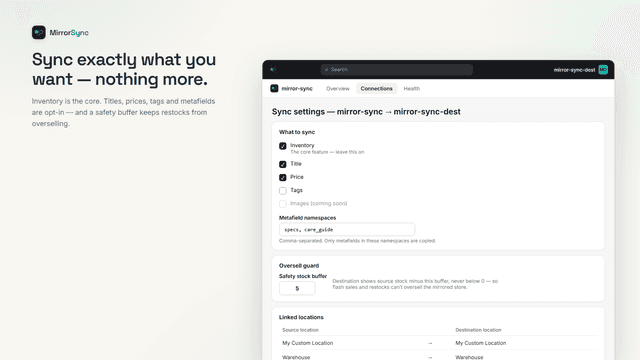
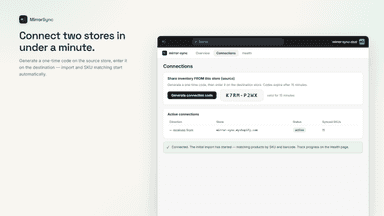
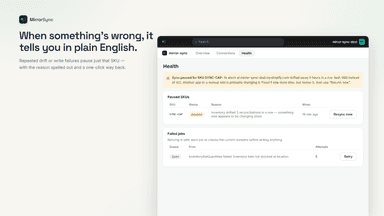
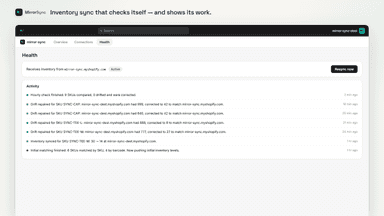
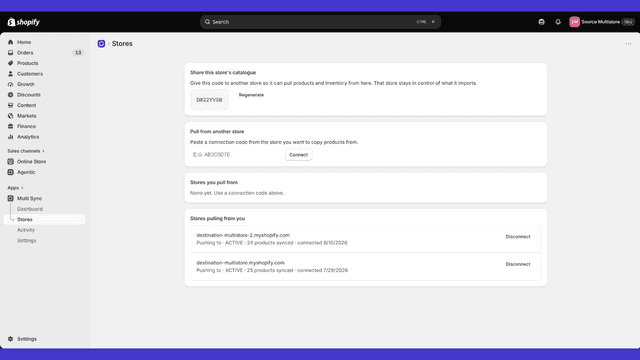
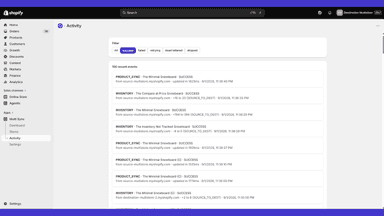
See every featureMirrorSync mirrors inventory and product data from one store to another in near real time — and keeps checking afterwards. Every hour it compares both stores SKU by SKU, repairs any drift it finds, and logs every fix in plain language. If stock keeps drifting or a product breaks, that SKU pauses safely and one click fixes it. A safety stock buffer helps protect you from overselling during restocks.
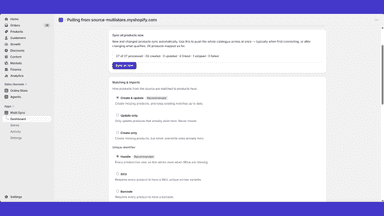
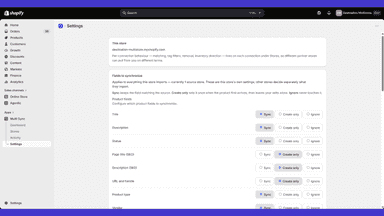
Multi Sync keeps two or more Shopify stores in step, so nobody re-keys a catalogue twice. Edit a product in your source store and the connected stores follow — title, description, images, options, variants and prices. Sell in either store and the other knows: inventory syncs both ways, with loop protection so changes never bounce back and forth.
- Solid inventory sync — updates flow to the mirrored store moments after a change
- Hourly self-check finds and repairs drift, even when webhooks are missed
- Oversell guard: a safety stock buffer keeps a margin between your stores.
- Products sync automatically — title, images, options, variants and prices
- Two-way inventory with loop protection, so stock never drifts
- Variant-level matching by SKU, handle or barcode
- Per-field control: sync it, set it once, or leave it alone
All the numbers
Every figure, side by side
A green dot marks the app ahead on a measured figure. Estimates, gaps and apps that leave no storefront trace never take the lead.
Adoption
| Measure |  MirrorSync |  Syntonic Multi Sync |
|---|---|---|
| Detected stores | Not published | Not published |
| Net store change, 28 days | 0 | 0 |
| Stores added, 28 days | Not enough data | Not enough data |
| Big-brand share | Not enough data | Not enough data |
| Top store categories | Not published | Not published |
| Top store countries | Not published | Not published |
Reviews
| Measure | MirrorSync | Syntonic Multi Sync |
|---|---|---|
| App Store rating | Not published | Not published |
| App Store reviews | Not published | Not published |
| New reviews, 28 days | Not enough data | Not enough data |
| Reviewers a year or more in | Not enough data | Not enough data |
Pricing
| Measure | MirrorSync | Syntonic Multi Sync |
|---|---|---|
| Free plan | Not listed | Yes |
| Lowest paid monthly plan | $19/month | $9/month(ahead) |
| Longest free trial | 7 days | 14 days |
| Plans listed | 3 | 6 |
Listing
| Measure | MirrorSync | Syntonic Multi Sync |
|---|---|---|
| Shopify category rank | #617 | #213(ahead) |
| Shopify App Charts | Not on this week’s charts | Not on this week’s charts |
| Built for Shopify | No | No |
| Launched | Jul 13, 2026 | Sep 28, 2026 |
| Languages | 1 | 1 |
| Developer | MirrorSync | Syntonic |
FAQ
MirrorSync and Syntonic Multi Sync: common questions
- Is MirrorSync or Syntonic Multi Sync cheaper?
- Only Syntonic Multi Sync lists a free plan. Paid plans start at $19/month for MirrorSync and $9/month for Syntonic Multi Sync. Shoplist compares base prices only between monthly plans in the same currency; usage charges and annual plans vary, so check each plan’s limits.
- What features does each app list that the other doesn’t?
- MirrorSync lists 2 the others don’t mention, such as Multi-channel, Scheduled. A feature missing from a listing may still be supported; this compares what each App Store listing says.
- Where does this comparison’s data come from?
- Shoplist crawls Shopify storefronts to detect which apps each store runs, and reads each app’s Shopify App Store listing for reviews, pricing, features and integrations. Store counts are as of Oct 13, 2026; estimated figures are labeled.
How Shoplist compares apps
Store counts come from Shoplist’s crawl of Shopify storefronts, which detects the apps each store runs; they are as of Oct 13, 2026. Reviews, ratings, plans, features and integrations come from each app’s Shopify App Store listing. 28-day figures are labeled when estimated, and a figure that is missing or estimated never decides who leads. Read the methodology.