

MetaClone vs MetaVault
Two Shopify apps, side by side: detected stores, momentum, reviews, plans, listed features and who runs each. Store counts as of Oct 13, 2026 for MetaClone, Oct 14, 2026 for MetaVault.
The short answer
- Both list a free plan. Paid plans start at $29/month for MetaClone and $15/month for MetaVault.
- MetaClone lists 20 features MetaVault’s listing doesn’t mention, including Backups, Blogs, Booleans.
Head to head


Free
- · Create up to 5 clones per month
Pro
- · Unlimited Clones
Free
- · Browse metafields across all owners
- · Delete metafields one at a time
- · Filter by namespace, key or owner
- · Metaobjects viewer
- · View & edit up to 50 metafields/day
Pro
- · Background jobs with history
- · Bulk delete metafields
- · CSV import & export
- · Downloadable error report on import
- · Everything in Free
- · Unlimited metafield edits
Agency
- · Copy metaobjects between stores
- · Everything in Pro
- · Full metafield & metaobject backups
- · Liquid snippet generator
- · Namespace inspector
- · Orphan metafield cleaner
Coverage counts what each App Store listing names. Every feature, checked off app by app, is in Shoplist.
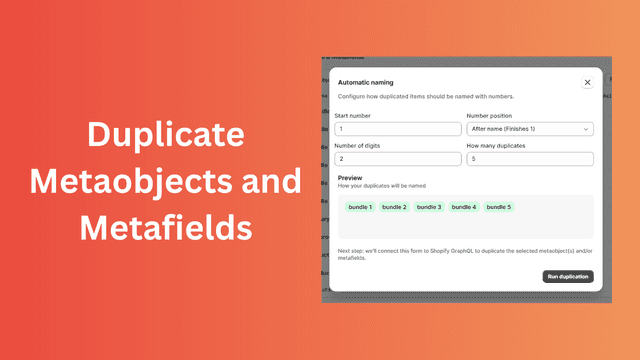
See every featureInstead of manually recreating complex metafield structures, MetaClone lets you duplicate existing metafields and metaobjects in just a few clicks—saving hours of repetitive work and reducing mistakes. By copying existing configurations, merchants can avoid errors caused by manual recreation and keep their store data organized and predictable.
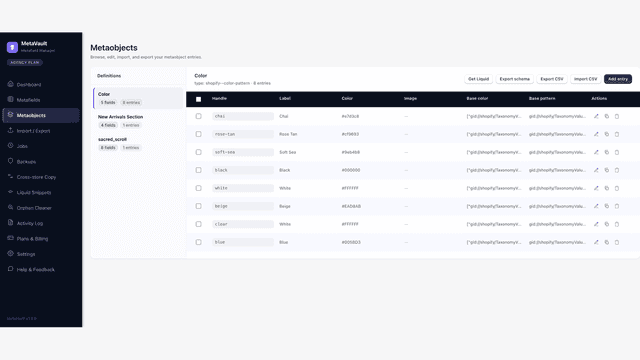
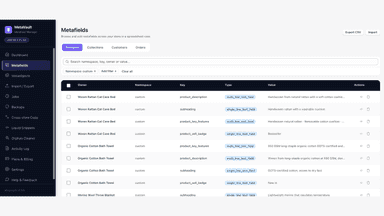
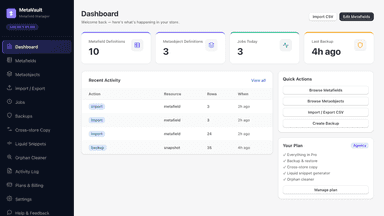
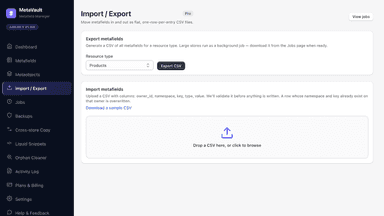
Shopify's admin makes you edit metafields one resource at a time. MetaVault gives you a real workspace for custom data. Browse and bulk edit metafields across products, collections, customers and orders. Manage metaobject definitions and entries in one place. Import and export as CSV to make sweeping changes in a spreadsheet, then push back.
- Duplicate existing metafields with their settings preserved
- Clone metaobjects including all defined fields
- Maintain consistent data structures
- Reduce manual setup when scaling or updating a store
- Bulk edit metafields across products, collections, customers and orders
- Import and export metafields and metaobjects as CSV
- Full backups of your custom data, with preview-then-confirm restore
- Copy metaobjects between stores you manage


All the numbers
Every figure, side by side
A green dot marks the app ahead on a measured figure. Estimates, gaps and apps that leave no storefront trace never take the lead.
Adoption
| Measure |  MetaClone |  MetaVault |
|---|---|---|
| Detected stores | Not published | Not published |
| Net store change, 28 days | 0 | 0 |
| Stores added, 28 days | Not enough data | Not enough data |
| Big-brand share | Not enough data | Not enough data |
| Top store categories | Not published | Not published |
| Top store countries | Not published | Not published |
Reviews
| Measure | MetaClone | MetaVault |
|---|---|---|
| App Store rating | Not published | Not published |
| App Store reviews | Not published | Not published |
| New reviews, 28 days | Not enough data | Not enough data |
| Reviewers a year or more in | Not enough data | Not enough data |
FAQ
MetaClone and MetaVault: common questions
- Is MetaClone or MetaVault cheaper?
- Both list a free plan. Paid plans start at $29/month for MetaClone and $15/month for MetaVault. Shoplist compares base prices only between monthly plans in the same currency; usage charges and annual plans vary, so check each plan’s limits.
- What features does each app list that the other doesn’t?
- MetaClone lists 20 the others don’t mention, such as Backups, Blogs, Booleans, Colors. MetaVault lists 1 the others don’t mention, such as Bulk import and export. A feature missing from a listing may still be supported; this compares what each App Store listing says.
- Where does this comparison’s data come from?
- Shoplist crawls Shopify storefronts to detect which apps each store runs, and reads each app’s Shopify App Store listing for reviews, pricing, features and integrations. Store counts are as of Oct 13, 2026 for MetaClone, Oct 14, 2026 for MetaVault; estimated figures are labeled.
How Shoplist compares apps
Store counts come from Shoplist’s crawl of Shopify storefronts, which detects the apps each store runs; they are as of Oct 13, 2026 for MetaClone, Oct 14, 2026 for MetaVault. Reviews, ratings, plans, features and integrations come from each app’s Shopify App Store listing. 28-day figures are labeled when estimated, and a figure that is missing or estimated never decides who leads. Read the methodology.