
Mergehouse vs Segmently
Two Shopify apps, side by side: detected stores, momentum, reviews, plans, listed features and who runs each. Store counts as of Nov 3, 2026 for Mergehouse, Oct 13, 2026 for Segmently.
The short answer
- Both list a free plan. Paid plans start at $3.99/month for Mergehouse and $9/month for Segmently.
- Segmently lists 3 features Mergehouse’s listing doesn’t mention, including Custom triggers, Custom workflows, Templates.
Head to head

Free
- · See every duplicate group found
- · Weekly email digest, no merging
Pro
- · Covers high-confidence groups
- · One-click and bulk merge
Free
- · 1 backfill per month
- · 2 active rules
- · Real-time tagging on every trigger
- · Tag Manager (read-only)
Starter
- · 10 active rules
- · Email alerts on run failures
- · Tag removal actions
- · Unlimited backfill — never metered
Growth
- · Dynamic tags from order fields
- · Full Tag Manager
- · Scheduled nightly re-evaluation
- · Tag expiry / TTL
- · Unlimited rules
Pro
- · Audit log with CSV export
- · Everything in Growth
- · Rule export / import between stores
Coverage counts what each App Store listing names. Every feature, checked off app by app, is in Shoplist.
See every featureMergehousefinds duplicate customer profiles in your store and lets you merge them safely, without spreadsheets or manual lookups. Every night, it scans your customers and matches on email, phone, and name plus address, scoring each match by confidence. Review every group in your admin, then merge one at a time or in bulk, based on the confidence score.
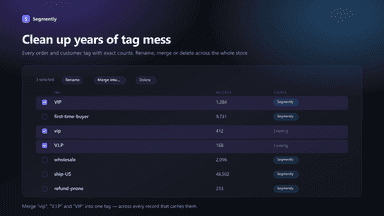
Segmently applies your tagging rules the moment an order or customer event happens, and applies those same rules backwards across your entire history in one run. One rule tags the order and the customer behind it, so you stop maintaining the same logic twice. A built-in tag manager shows every tag with exact counts and lets you rename, merge or bulk delete across the whole store.
- Nightly scan finds duplicate customers automatically
- Confidence score shows which matches are safe to merge
- One-click and bulk merge through the customerMerge API
- Backfill any rule across every order and customer you have ever had
- One rule tags the order and the customer behind it, with no duplicated logic
- Tag manager: every tag with live counts, rename, merge and bulk delete


All the numbers
Every figure, side by side
A green dot marks the app ahead on a measured figure. Estimates, gaps and apps that leave no storefront trace never take the lead.
Adoption
| Measure |  Segmently | |
|---|---|---|
| Detected stores | Not published | Not published |
| Net store change, 28 days | 0 | 0 |
| Stores added, 28 days | Not enough data | Not enough data |
| Big-brand share | Not enough data | Not enough data |
| Top store categories | Not published | Not published |
| Top store countries | Not published | Not published |
Reviews
| Measure | Segmently | |
|---|---|---|
| App Store rating | Not published | Not published |
| App Store reviews | Not published | Not published |
| New reviews, 28 days | Not enough data | Not enough data |
| Reviewers a year or more in | Not enough data | Not enough data |
Pricing
| Measure | Segmently | |
|---|---|---|
| Free plan | Yes | Yes |
| Lowest paid monthly plan | $3.99/month(ahead) | $9/month |
| Longest free trial | 7 days | 14 days |
| Plans listed | 2 | 4 |
Listing
| Measure | Segmently | |
|---|---|---|
| Shopify category rank | Not enough data | #575 |
| Shopify App Charts | Not on this week’s charts | Not on this week’s charts |
| Built for Shopify | No | No |
| Launched | Oct 28, 2026 | Aug 14, 2026 |
| Languages | 1 | 1 |
| Developer | Metigro | TrackWise |
FAQ
Mergehouse and Segmently: common questions
- Is Mergehouse or Segmently cheaper?
- Both list a free plan. Paid plans start at $3.99/month for Mergehouse and $9/month for Segmently. Shoplist compares base prices only between monthly plans in the same currency; usage charges and annual plans vary, so check each plan’s limits.
- What features does each app list that the other doesn’t?
- Segmently lists 3 the others don’t mention, such as Custom triggers, Custom workflows, Templates. A feature missing from a listing may still be supported; this compares what each App Store listing says.
- Where does this comparison’s data come from?
- Shoplist crawls Shopify storefronts to detect which apps each store runs, and reads each app’s Shopify App Store listing for reviews, pricing, features and integrations. Store counts are as of Nov 3, 2026 for Mergehouse, Oct 13, 2026 for Segmently; estimated figures are labeled.
How Shoplist compares apps
Store counts come from Shoplist’s crawl of Shopify storefronts, which detects the apps each store runs; they are as of Nov 3, 2026 for Mergehouse, Oct 13, 2026 for Segmently. Reviews, ratings, plans, features and integrations come from each app’s Shopify App Store listing. 28-day figures are labeled when estimated, and a figure that is missing or estimated never decides who leads. Read the methodology.