

Margly.io vs Margyn: Profit & LTV Analytics
Two Shopify apps, side by side: detected stores, momentum, reviews, plans, listed features and who runs each. Store counts as of Oct 14, 2026.
The short answer
- Paid plans start at $55/month for Margly.io and $32/month for Margyn.
- Margyn lists 6 features Margly.io’s listing doesn’t mention, including Custom dashboards, GDPR compliance, Multi-store reports.
Head to head


Starter
- · 1 user
- · Customer lifetime value
- · Daily data sync
- · Google Ads & Meta tracking
- · Orders and revenue analytics
- · Product margin tracking
Professional
- · 2x daily sync
- · Everything in Starter
- · Up to 20 000 orders
Business
- · 10 users
- · 4x daily sync
- · AI Advisor recommendations
- · Cohort and retention analysis
- · Everything in Professional
- · Google Ads & Meta tracking
All-In-One
- · Automated daily & weekly reports
- · Customer lifetime value cohorts
- · Google PMax breakdowns
- · Meta Ads & Google Ads tracking
- · P&L statements
- · Product-level margin analysis
Coverage counts what each App Store listing names. Every feature, checked off app by app, is in Shoplist.
See every featureMargly is a profit visibility tool for Shopify merchants. It connects your orders, purchase costs, shipping, and ad spend from Google Ads and Meta, then shows your real profit after all costs — per order, per product, per customer. Instead of switching between five tools every morning, you see what made money yesterday and what didn't in one place.
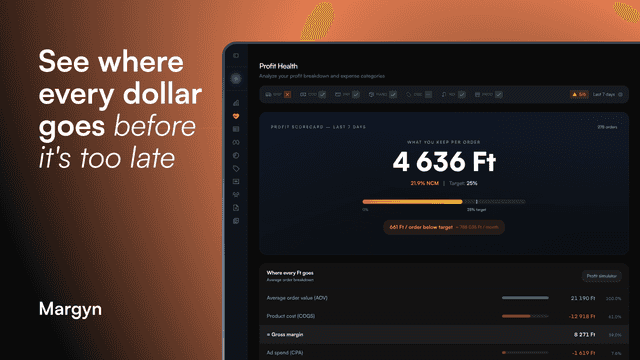
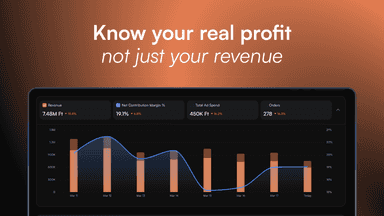
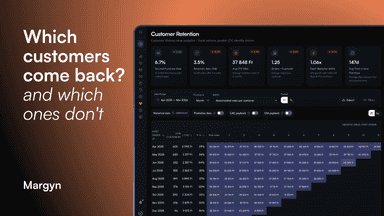
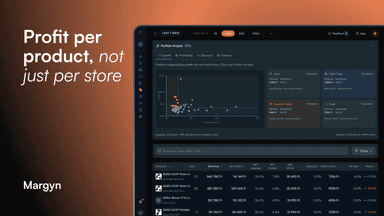
Margyn connects your Shopify store, Meta Ads, Google Ads, and TikTok Ads to show true profit — not just revenue. Every order is broken down by ad spend, shipping, payment fees, returns, and other fees. No CSV uploads, no manual setup. See which customers drive repeat profit with LTV cohort analysis. Track product margins with FIFO inventory tracking — the same method accountants use, but automated.
- Real profit margins per order, product, and customer — not just revenue
- Customer lifetime value, cohort analysis, and repeat purchase tracking
- AI advisor that analyzes your data and suggests next steps in plain language
- Auto-sync ad account data from Meta, Google – including Google PMax insights
- Real-time P&L dashboards with net contribution margin per order and product
- LTV cohort analysis — see which customers actually drive long-term profit
- AI-powered insights that flag margin problems and revenue opportunities


All the numbers
Every figure, side by side
A green dot marks the app ahead on a measured figure. Estimates, gaps and apps that leave no storefront trace never take the lead.
Adoption
| Measure |  Margly.io |  Margyn |
|---|---|---|
| Detected stores | Not published | Not published |
| Net store change, 28 days | 0 | 0 |
| Stores added, 28 days | Not enough data | Not enough data |
| Big-brand share | Not enough data | Not enough data |
| Top store categories | Not published | Not published |
| Top store countries | Not published | Not published |
Reviews
| Measure | Margly.io | Margyn |
|---|---|---|
| App Store rating | Not published | Not published |
| App Store reviews | Not published | Not published |
| New reviews, 28 days | Not enough data | Not enough data |
| Reviewers a year or more in | Not enough data | Not enough data |
FAQ
Margly.io and Margyn: common questions
- Is Margly.io or Margyn cheaper?
- Paid plans start at $55/month for Margly.io and $32/month for Margyn. Shoplist compares base prices only between monthly plans in the same currency; usage charges and annual plans vary, so check each plan’s limits.
- What features does each app list that the other doesn’t?
- Margly.io lists 2 the others don’t mention, such as Page views, Purchase tracking. Margyn lists 6 the others don’t mention, such as Custom dashboards, GDPR compliance, Multi-store reports, Notifications. A feature missing from a listing may still be supported; this compares what each App Store listing says.
- Where does this comparison’s data come from?
- Shoplist crawls Shopify storefronts to detect which apps each store runs, and reads each app’s Shopify App Store listing for reviews, pricing, features and integrations. Store counts are as of Oct 14, 2026; estimated figures are labeled.
How Shoplist compares apps
Store counts come from Shoplist’s crawl of Shopify storefronts, which detects the apps each store runs; they are as of Oct 14, 2026. Reviews, ratings, plans, features and integrations come from each app’s Shopify App Store listing. 28-day figures are labeled when estimated, and a figure that is missing or estimated never decides who leads. Read the methodology.