

marginos vs Profflow: Profit Analytics
Two Shopify apps, side by side: detected stores, momentum, reviews, plans, listed features and who runs each. Store counts as of Oct 14, 2026 for marginos, Oct 22, 2026 for Profflow.
The short answer
- Only Profflow lists a free plan. Paid plans start at $5/month for marginos and $289/month for Profflow.
Head to head


Starter
Free
- · No card needed
- · One store
- · Real net profit for the last 30 days
- · Up to 50 orders a month
Growth
- · Cash-flow forecast
- · Daily P&L and profit calendar
- · Everything in Free, with full history
- · Profflow Pixel
- · ROAS measured on margin, after tax
- · Three decisions a week, priced in money
Pro
- · Everything in Growth
- · Operator: finds the leak, prices three w
- · Owner and team access
- · Scenario planning and period comparison
- · Up to 7,000 orders a month, up to 3 stor
Coverage counts what each App Store listing names. Every feature, checked off app by app, is in Shoplist.
See every featureRevenue doesn't tell you what you keep. Margin OS reveals your true net profit — per order, product, and channel — after COGS, fees, shipping, refunds, and operating expenses. Add product costs inline or by CSV, log expenses, and your real margins update automatically in a clean dashboard with trends, channel and returns breakdowns, and a profit forecast.
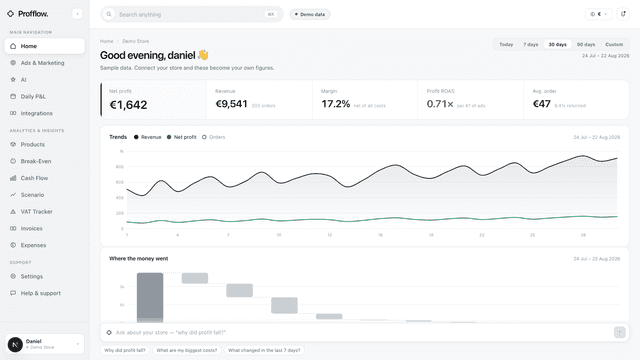
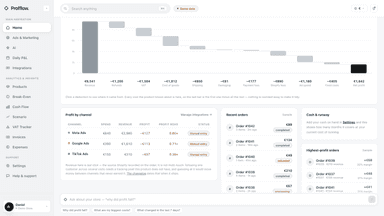
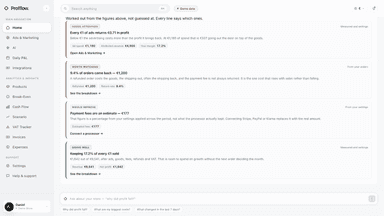
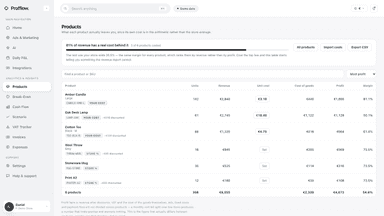
Shopify shows sales. Profflow shows what you keep. Every order is broken down: cost of goods, shipping, payment fees, refunds, discounts, ad spend and tax. You get net profit per day, per order and per product, ROAS measured on margin, and a cash forecast built from your own figures. Each week it names the decisions worth making, priced in money.
- True net profit per order, product & channel — after every cost
- Add product costs inline or import them in bulk by CSV
- Track monthly operating expenses for a true bottom line
- Profit dashboard with trends, channel & returns breakdowns
- Net profit per day, per order and per product — after every cost
- EU VAT stripped at the buyer's rate, with the OSS threshold tracked
- Cost of goods per variant, entered inline or pasted in bulk
- Break-even ROAS from all variable costs, not cost of goods alone


All the numbers
Every figure, side by side
A green dot marks the app ahead on a measured figure. Estimates, gaps and apps that leave no storefront trace never take the lead.
Adoption
| Measure |  marginos |  Profflow |
|---|---|---|
| Detected stores | Not published | Not published |
| Net store change, 28 days | 0 | 0 |
| Stores added, 28 days | Not enough data | Not enough data |
| Big-brand share | Not enough data | Not enough data |
| Top store categories | Not published | Not published |
| Top store countries | Not published | Not published |
Reviews
| Measure | marginos | Profflow |
|---|---|---|
| App Store rating | Not published | Not published |
| App Store reviews | Not published | Not published |
| New reviews, 28 days | Not enough data | Not enough data |
| Reviewers a year or more in | Not enough data | Not enough data |
FAQ
marginos and Profflow: common questions
- Is marginos or Profflow cheaper?
- Only Profflow lists a free plan. Paid plans start at $5/month for marginos and $289/month for Profflow. Shoplist compares base prices only between monthly plans in the same currency; usage charges and annual plans vary, so check each plan’s limits.
- Where does this comparison’s data come from?
- Shoplist crawls Shopify storefronts to detect which apps each store runs, and reads each app’s Shopify App Store listing for reviews, pricing, features and integrations. Store counts are as of Oct 14, 2026 for marginos, Oct 22, 2026 for Profflow; estimated figures are labeled.
How Shoplist compares apps
Store counts come from Shoplist’s crawl of Shopify storefronts, which detects the apps each store runs; they are as of Oct 14, 2026 for marginos, Oct 22, 2026 for Profflow. Reviews, ratings, plans, features and integrations come from each app’s Shopify App Store listing. 28-day figures are labeled when estimated, and a figure that is missing or estimated never decides who leads. Read the methodology.