
MakerStocks vs MakeStock: Raw Materials
Two Shopify apps, side by side: detected stores, momentum, reviews, plans, listed features and who runs each. Store counts as of Nov 3, 2026.
The short answer
- Only MakeStock lists a free plan. Paid plans start at $29/month for MakerStocks and $5.99/month for MakeStock.
- MakerStocks lists 9 features MakeStock’s listing doesn’t mention, including Custom reports, Expiry dates, Inventory sync.
Head to head

Starter
Pro
Business
Free
- · Movement log and Can I make it? included
- · Order deductions, cancellation and refun
- · Up to 10 materials and 5 bills of materi
Pro
- · CSV import and export, cost push to Shop
- · Low-material alerts with optional auto-s
- · Unlimited materials and BOMs
Plus
- · Daily low-stock email digest and selecte
- · Everything in Pro
- · Movement report export
Coverage counts what each App Store listing names. Every feature, checked off app by app, is in Shoplist.
See every featureMakerStocks is for merchants who manufacture what they sell. You record each raw material with what you paid, its alert threshold and expiry date, then build a recipe for every product. Planning a production run reserves the materials, so they cannot be counted twice or sold by mistake. Closing the run deducts them, creates a batch for the finished product and sends the new quantity back to your store.
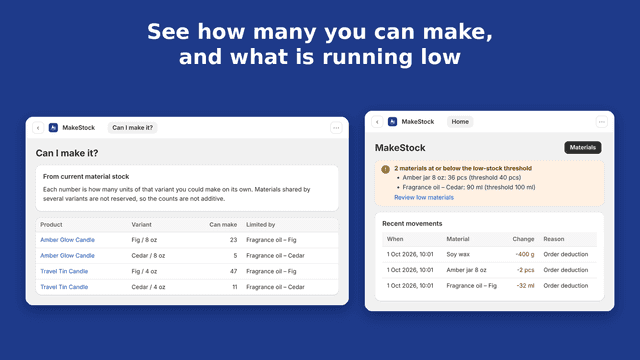
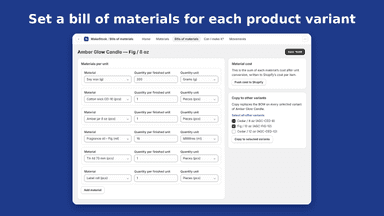
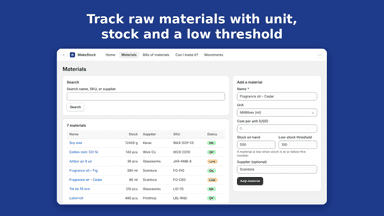
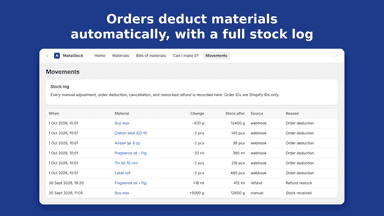
MakeStock tracks the wax, oils, findings, paper and other raw materials your products are made from, which Shopify does not. Add each material with a unit, cost, stock and low threshold, then build a bill of materials (BOM) for each variant. Paid orders deduct the materials once; cancellations and restocked refunds put them back. Can I make it? shows how many units current stock covers and which material limits it.
- Track raw materials, batches and expiry dates alongside finished products
- Build recipes and bills of materials that value every unit you make
- Reserve materials for a production run so stock cannot be sold twice
- Get alerted before a material drops below its threshold or expires
- Materials with unit, cost per unit, stock on hand and a low-stock threshold
- A bill of materials per variant, and copy it to other variants of the product
- Paid orders deduct materials; cancellations and restocked refunds restore them
- Can I make it? shows units makeable from current stock and the limiting material
All the numbers
Every figure, side by side
A green dot marks the app ahead on a measured figure. Estimates, gaps and apps that leave no storefront trace never take the lead.
Adoption
| Measure |  MakeStock | |
|---|---|---|
| Detected stores | Not published | Not published |
| Net store change, 28 days | 0 | 0 |
| Stores added, 28 days | Not enough data | Not enough data |
| Big-brand share | Not enough data | Not enough data |
| Top store categories | Not published | Not published |
| Top store countries | Not published | Not published |
Reviews
| Measure | MakeStock | |
|---|---|---|
| App Store rating | Not published | Not published |
| App Store reviews | Not published | Not published |
| New reviews, 28 days | Not enough data | Not enough data |
| Reviewers a year or more in | Not enough data | Not enough data |
Pricing
| Measure | MakeStock | |
|---|---|---|
| Free plan | Not listed | Yes |
| Lowest paid monthly plan | $29/month | $5.99/month(ahead) |
| Longest free trial | 14 days | 7 days |
| Plans listed | 3 | 3 |
Listing
| Measure | MakeStock | |
|---|---|---|
| Shopify category rank | Not enough data | #533 |
| Shopify App Charts | Not on this week’s charts | Not on this week’s charts |
| Built for Shopify | No | No |
| Launched | Nov 3, 2026 | Oct 7, 2026 |
| Languages | 2 | 1 |
| Developer | MackerStocks | Oskivo |
FAQ
MakerStocks and MakeStock: common questions
- Is MakerStocks or MakeStock cheaper?
- Only MakeStock lists a free plan. Paid plans start at $29/month for MakerStocks and $5.99/month for MakeStock. Shoplist compares base prices only between monthly plans in the same currency; usage charges and annual plans vary, so check each plan’s limits.
- What features does each app list that the other doesn’t?
- MakerStocks lists 9 the others don’t mention, such as Custom reports, Expiry dates, Inventory sync, Multi-location. MakeStock lists 2 the others don’t mention, such as Import and export, Threshold alerts. A feature missing from a listing may still be supported; this compares what each App Store listing says.
- Where does this comparison’s data come from?
- Shoplist crawls Shopify storefronts to detect which apps each store runs, and reads each app’s Shopify App Store listing for reviews, pricing, features and integrations. Store counts are as of Nov 3, 2026; estimated figures are labeled.
How Shoplist compares apps
Store counts come from Shoplist’s crawl of Shopify storefronts, which detects the apps each store runs; they are as of Nov 3, 2026. Reviews, ratings, plans, features and integrations come from each app’s Shopify App Store listing. 28-day figures are labeled when estimated, and a figure that is missing or estimated never decides who leads. Read the methodology.