
Localink vs SEO Link : Internal Linking
Two Shopify apps, side by side: detected stores, momentum, reviews, plans, listed features and who runs each. Store counts as of Oct 13, 2026 for Localink, Oct 15, 2026 for SEO Link.
The short answer
- Localink lists 3 features SEO Link’s listing doesn’t mention, including 404 pages, Bulk editing, JSON-LD.
Head to head


Momentum
New reviews each month
Review pace is the clearest public read on how fast an app is winning new merchants.
Basic
Grow
Advanced
PLUS
Coverage counts what each App Store listing names. Every feature, checked off app by app, is in Shoplist.
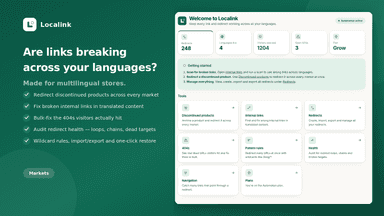
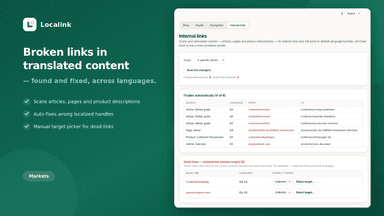
See every featureMultilingual Shopify stores quietly break links: discontinued products leave dead ends on every market, and translated content links to wrong handles — hurting SEO and customers. Localink fixes this automatically across every market. Redirect discontinued products everywhere in one click, and scan translated articles, pages and products for broken internal links — fixing each to the correct localized URL.
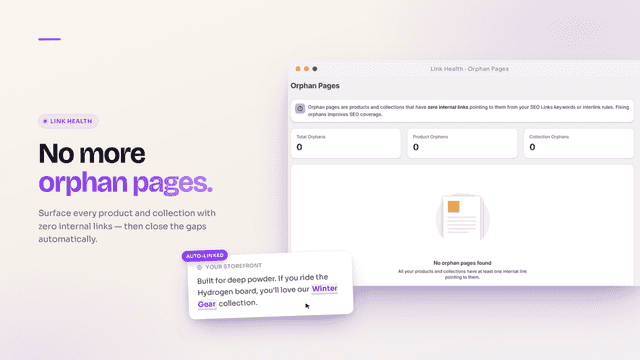
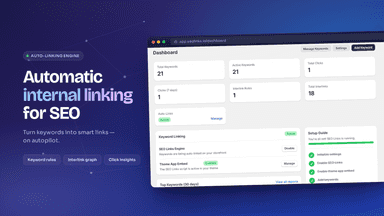
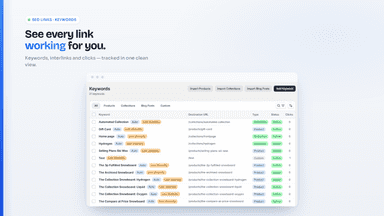
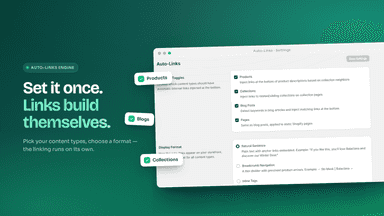
SEO Links improves your store's search performance by automatically building internal links between products, collections, blog posts, and pages. Strong internal linking helps search engines crawl and rank your content while helping shoppers discover related products. Turn keywords into links, generate related product and collection links automatically, and find broken links and pages that have no internal links.
- Redirect discontinued products across all markets at once
- Find and fix broken internal links in translated content
- Manage, import and export URL redirects
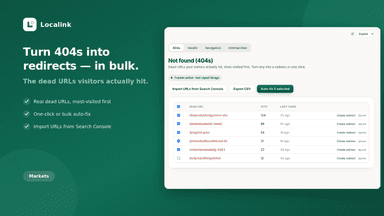
- Detect storefront 404s and fix them in one click
- Turn any word in your content into a link to a product, collection, or page.
- Find links that point to missing, unpublished, or deleted pages and fix them.
- Spot pages that have no internal links so every page can be discovered.
- Track clicks, impressions, and click-through rates for your internal links.

All the numbers
Every figure, side by side
A green dot marks the app ahead on a measured figure. Estimates, gaps and apps that leave no storefront trace never take the lead.
Adoption
| Measure |  Localink |  SEO Link |
|---|---|---|
| Detected stores | Not published | Not published |
| Net store change, 28 days | 0 | 0 |
| Stores added, 28 days | Not enough data | Not enough data |
| Big-brand share | Not enough data | Not enough data |
| Top store categories | Not published | Not published |
| Top store countries | Not published | Not published |
Reviews
| Measure | Localink | SEO Link |
|---|---|---|
| App Store rating | Not published | 5.0 ★ |
| App Store reviews | Not published | 3 |
| New reviews, 28 days | Not enough data | Not enough data |
| Reviewers a year or more in | Not enough data | Not enough data |
FAQ
Localink and SEO Link: common questions
- What features does each app list that the other doesn’t?
- Localink lists 3 the others don’t mention, such as 404 pages, Bulk editing, JSON-LD. SEO Link lists 2 the others don’t mention, such as Link analysis, Reporting. A feature missing from a listing may still be supported; this compares what each App Store listing says.
- Where does this comparison’s data come from?
- Shoplist crawls Shopify storefronts to detect which apps each store runs, and reads each app’s Shopify App Store listing for reviews, pricing, features and integrations. Store counts are as of Oct 13, 2026 for Localink, Oct 15, 2026 for SEO Link; estimated figures are labeled.
How Shoplist compares apps
Store counts come from Shoplist’s crawl of Shopify storefronts, which detects the apps each store runs; they are as of Oct 13, 2026 for Localink, Oct 15, 2026 for SEO Link. Reviews, ratings, plans, features and integrations come from each app’s Shopify App Store listing. 28-day figures are labeled when estimated, and a figure that is missing or estimated never decides who leads. Read the methodology.