

Label Forge vs Lulzasaur: SKU Collision Watch
Two Shopify apps, side by side: detected stores, momentum, reviews, plans, listed features and who runs each. Store counts as of Oct 13, 2026 for Label Forge, Oct 14, 2026 for Lulzasaur.
The short answer
- Only Lulzasaur lists a free plan. Paid plans start at $9.99/month for Label Forge and $29/month for Lulzasaur.
- Label Forge lists 9 features Lulzasaur’s listing doesn’t mention, including Barcode integration, Bulk generation, Bulk printing.
Head to head


Label Forge Pro
Free
- · 3 scans per rolling 30 days
- · Acknowledge intentional duplicates
- · CSV exports and 90-day report history
- · Exact duplicate SKU and barcode checks
- · Up to 1,000 total store variants
Watch
- · Acknowledge intentional duplicates
- · CSV exports and 90-day report history
- · Daily monitoring and manual scans
- · New, changed, and resolved conflicts
- · Up to 25,000 total store variants
Coverage counts what each App Store listing names. Every feature, checked off app by app, is in Shoplist.
See every featureDesign labels in a drag-and-drop editor at true physical size, or start from built-in presets for Avery sheets and Dymo or Zebra rolls. Print the needed quantity based on your on-hand inventory, export a print-ready PDF, and use the calibration setting to align labels precisely on the page. A built-in duplicate finder flags any barcode assigned to more than one variant.
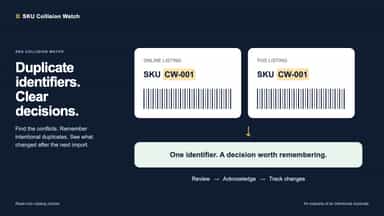
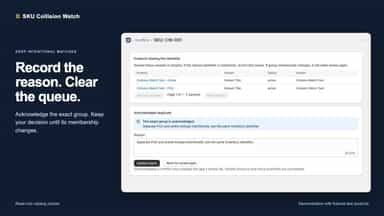
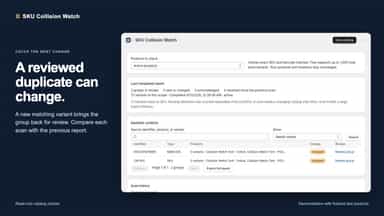
Keep identifier conflicts from getting lost after catalog imports. Scan exact SKU and barcode matches, focus on active products, and record why some duplicates are intentional. Later scans flag new conflicts and changes to acknowledged groups. Review product links, export findings, and compare reports. Watch adds daily checks. The app reads your catalog and never changes products or inventory.
- New barcodes never overwrite existing ones, checked across your whole catalog
- Built-in duplicate finder flags barcodes used on more than one variant
- Vector labels print at true size — 66.675 mm prints as 66.675 mm
- Presets for Avery sheets, Dymo and Zebra rolls, or any custom size
- Find exact duplicate SKUs and barcodes with explicit product-status filters
- Acknowledge intentional duplicates; review again when group membership changes
- Monitor daily on Watch, compare reports, and export identifier conflicts


All the numbers
Every figure, side by side
A green dot marks the app ahead on a measured figure. Estimates, gaps and apps that leave no storefront trace never take the lead.
Adoption
| Measure |  Label Forge |  Lulzasaur |
|---|---|---|
| Detected stores | Not published | Not published |
| Net store change, 28 days | 0 | 0 |
| Stores added, 28 days | Not enough data | Not enough data |
| Big-brand share | Not enough data | Not enough data |
| Top store categories | Not published | Not published |
| Top store countries | Not published | Not published |
Reviews
| Measure | Label Forge | Lulzasaur |
|---|---|---|
| App Store rating | Not published | Not published |
| App Store reviews | Not published | Not published |
| New reviews, 28 days | Not enough data | Not enough data |
| Reviewers a year or more in | Not enough data | Not enough data |
Pricing
| Measure | Label Forge | Lulzasaur |
|---|---|---|
| Free plan | Not listed | Yes |
| Lowest paid monthly plan | $9.99/month(ahead) | $29/month |
| Longest free trial | 7 days | 7 days |
| Plans listed | 1 | 2 |
Listing
| Measure | Label Forge | Lulzasaur |
|---|---|---|
| Shopify category rank | #54(ahead) | #111 |
| Shopify App Charts | Not on this week’s charts | Not on this week’s charts |
| Built for Shopify | No | No |
| Launched | Aug 5, 2026 | Sep 23, 2026 |
| Languages | 1 | 1 |
| Developer | Wolox Technology Inc. | Lulzasaur |
FAQ
Label Forge and Lulzasaur: common questions
- Is Label Forge or Lulzasaur cheaper?
- Only Lulzasaur lists a free plan. Paid plans start at $9.99/month for Label Forge and $29/month for Lulzasaur. Shoplist compares base prices only between monthly plans in the same currency; usage charges and annual plans vary, so check each plan’s limits.
- What features does each app list that the other doesn’t?
- Label Forge lists 9 the others don’t mention, such as Barcode integration, Bulk generation, Bulk printing, Custom elements. A feature missing from a listing may still be supported; this compares what each App Store listing says.
- Where does this comparison’s data come from?
- Shoplist crawls Shopify storefronts to detect which apps each store runs, and reads each app’s Shopify App Store listing for reviews, pricing, features and integrations. Store counts are as of Oct 13, 2026 for Label Forge, Oct 14, 2026 for Lulzasaur; estimated figures are labeled.
How Shoplist compares apps
Store counts come from Shoplist’s crawl of Shopify storefronts, which detects the apps each store runs; they are as of Oct 13, 2026 for Label Forge, Oct 14, 2026 for Lulzasaur. Reviews, ratings, plans, features and integrations come from each app’s Shopify App Store listing. 28-day figures are labeled when estimated, and a figure that is missing or estimated never decides who leads. Read the methodology.