

Kuto vs Kutoku
Two Shopify apps, side by side: detected stores, momentum, reviews, plans, listed features and who runs each. Store counts as of Oct 13, 2026 for Kuto, Nov 9, 2026 for Kutoku.
The short answer
- Kuto lists 7 features Kutoku’s listing doesn’t mention, including Analytics, Bulk payouts, Custom links and discounts.
Head to head


- United States
- Canada
- United Kingdom
Free to install
- · Commission + 10% fee, on sales only
- · No monthly subscription fee
- · Set your own monthly billing cap
Starter
- · 1:1 onboarding
- · By Publisher Report
- · Daily performance report
- · Referring Publisher Name & URL
- · UTM Tracking
Growth
- · 1:1 onboarding
- · By Publisher Report
- · Custom per-publisher rates
- · Daily performance report
- · One sample facilitation per month
- · Referring Publisher Name & URL
Coverage counts what each App Store listing names. Every feature, checked off app by app, is in Shoplist.
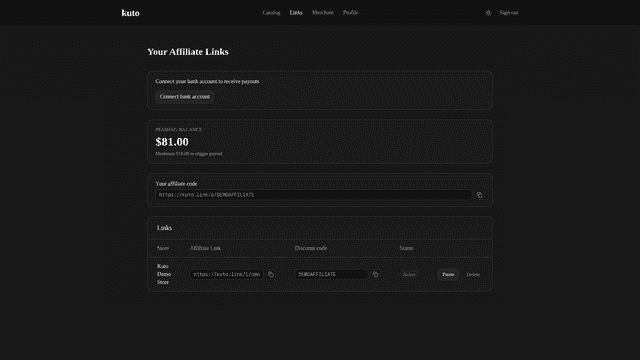
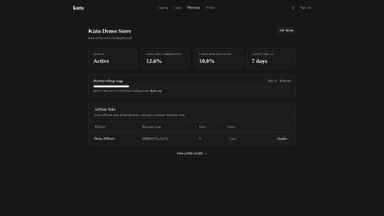
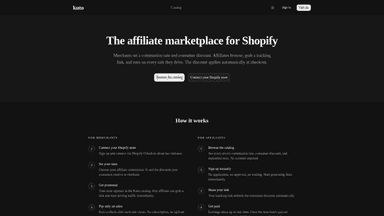
See every featureKuto puts your store in a shared affiliate catalog that promoters actively browse. Set your affiliate commission percentage, the consumer discount your customers receive at checkout, and a billing cap. Affiliates sign up and grab a tracking link with no approval required. The consumer discount applies automatically through the link, no coupon entry needed.
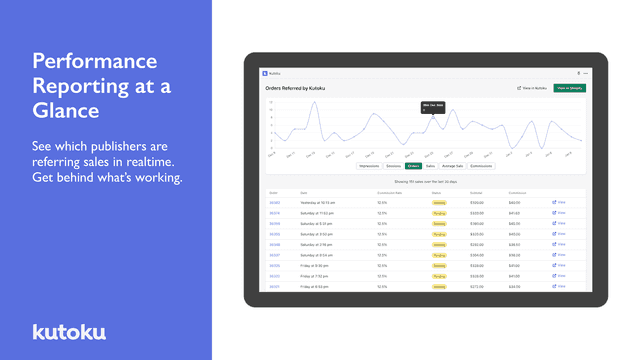
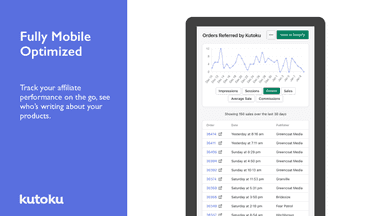
Enable Kutoku's affiliate marketing platform on your store with zero friction and save time by managing your Kutoku referred orders directly in Shopify. Visualize your affiliate performance with beautiful reporting charts. No template editing required. Change themes without needing to reinstall.
- Affiliates discover and link your store without any recruitment
- Consumer discount auto-applies at checkout through the affiliate link
- Affiliate links pause automatically when your billing limit is hit
- Charged via Shopify Billing only when affiliate-driven sales occur
- Easy integration with Kutoku's affiliate technology.
- View your referred sales in realtime directly in Shopify.
- See your current and historical affiliate performance.





All the numbers
Every figure, side by side
A green dot marks the app ahead on a measured figure. Estimates, gaps and apps that leave no storefront trace never take the lead.
Adoption
| Measure |  Kuto |  Kutoku |
|---|---|---|
| Detected stores | Not published | 168 |
| Net store change, 28 days | 0 | +2 |
| Stores added, 28 days | Not enough data | 2 |
| Big-brand share | Not enough data | Not enough data |
| Top store categories | Not published | Apparel & Accessories, Luggage & Bags, Home & Garden |
| Top store countries | Not published | United States, Canada, United Kingdom |
Reviews
| Measure | Kuto | Kutoku |
|---|---|---|
| App Store rating | Not published | Not published |
| App Store reviews | Not published | Not published |
| New reviews, 28 days | Not enough data | Not enough data |
| Reviewers a year or more in | Not enough data | Not enough data |
FAQ
Kuto and Kutoku: common questions
- What features does each app list that the other doesn’t?
- Kuto lists 7 the others don’t mention, such as Analytics, Bulk payouts, Custom links and discounts, Discounts. Kutoku lists 4 the others don’t mention, such as Custom commission, Custom dashboards, Custom domain, Multi-currency. A feature missing from a listing may still be supported; this compares what each App Store listing says.
- Where does this comparison’s data come from?
- Shoplist crawls Shopify storefronts to detect which apps each store runs, and reads each app’s Shopify App Store listing for reviews, pricing, features and integrations. Store counts are as of Oct 13, 2026 for Kuto, Nov 9, 2026 for Kutoku; estimated figures are labeled.
How Shoplist compares apps
Store counts come from Shoplist’s crawl of Shopify storefronts, which detects the apps each store runs; they are as of Oct 13, 2026 for Kuto, Nov 9, 2026 for Kutoku. Reviews, ratings, plans, features and integrations come from each app’s Shopify App Store listing. 28-day figures are labeled when estimated, and a figure that is missing or estimated never decides who leads. Read the methodology.