

Kijun vs Stockyard ‑ Purchase Orders
Two Shopify apps, side by side: detected stores, momentum, reviews, plans, listed features and who runs each. Store counts as of Oct 13, 2026.
The short answer
- Both list a free plan. Paid plans start at $24/month for Kijun and $14.99/month for Stockyard.
- Stockyard lists 6 features Kijun’s listing doesn’t mention, including Auto-restock, Email notifications, Import and export.
Head to head


Free
- · 90-day rolling score history
- · Free for up to 5 vendors
- · Live 0-100 vendor rankings
- · On-time, defect, price, completion
- · Stocky supplier CSV import
Pro
- · 24-month vendor score trends
- · Custom scoring weights
- · Full scorecard CSV export
- · PDF purchase orders
- · Priority email support
Free
- · 3 purchase orders a month, every feature
Standard
- · Create and receive purchase orders
- · Dead stock and cost variance reports
- · Drag-and-drop CSV import
- · Inventory updates written to Shopify
- · Reorder points and low-stock alerts
- · Supplier records and contacts
Coverage counts what each App Store listing names. Every feature, checked off app by app, is in Shoplist.
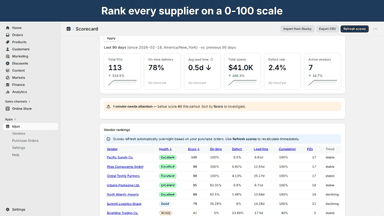
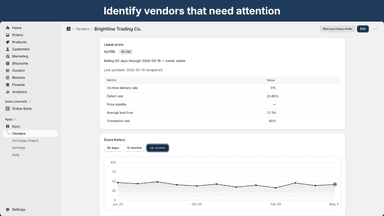
See every featureStocky retires in August 2026. Kijun helps you see which suppliers to keep, watch, or replace. Kijun turns purchase orders into 0-100 vendor scores across on-time delivery, defects, price stability, and completion. Lead time is shown for context but is not part of the score. Kijun is not a full Stocky replacement: it does not forecast demand, rewrite inventory, auto-reorder, or replace POS stocktakes.
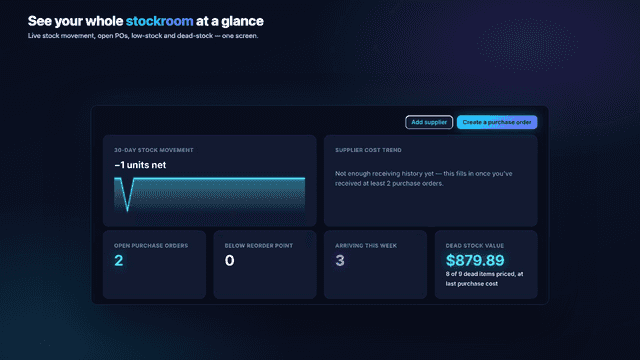
Stockyard covers what your Shopify purchasing setup is missing: reorder suggestions, supplier lead times, and a lasting purchase order history. Set reorder points and get an email before items run out, with a prefilled draft PO. Track what each supplier charges over time and catch quiet increases. Find already-tracked products that haven't sold in the last 60 days. Supplier records and partial receiving included.
- Score every supplier 0-100 from your purchase orders. No spreadsheets.
- Stocky migration guide built-in: 8-part export-import walkthrough
- Tune the weights so a packaging buyer and a textile buyer score differently.
- Trend arrows show which vendors are improving and which are slipping.
- Reorder point alerts by email before items run out
- Prefilled draft purchase orders created from low-stock alerts
- Import suppliers and purchase order history from Stocky CSV files
- Supplier records with payment terms, lead times, and contacts



All the numbers
Every figure, side by side
A green dot marks the app ahead on a measured figure. Estimates, gaps and apps that leave no storefront trace never take the lead.
Adoption
| Measure |  Kijun |  Stockyard |
|---|---|---|
| Detected stores | Not published | Not published |
| Net store change, 28 days | 0 | 0 |
| Stores added, 28 days | Not enough data | Not enough data |
| Big-brand share | Not enough data | Not enough data |
| Top store categories | Not published | Not published |
| Top store countries | Not published | Not published |
Reviews
| Measure | Kijun | Stockyard |
|---|---|---|
| App Store rating | Not published | Not published |
| App Store reviews | Not published | Not published |
| New reviews, 28 days | Not enough data | Not enough data |
| Reviewers a year or more in | Not enough data | Not enough data |
FAQ
Kijun and Stockyard: common questions
- Is Kijun or Stockyard cheaper?
- Both list a free plan. Paid plans start at $24/month for Kijun and $14.99/month for Stockyard. Shoplist compares base prices only between monthly plans in the same currency; usage charges and annual plans vary, so check each plan’s limits.
- What features does each app list that the other doesn’t?
- Kijun lists 2 the others don’t mention, such as Analytics, Custom reports. Stockyard lists 6 the others don’t mention, such as Auto-restock, Email notifications, Import and export, Inventory planning. A feature missing from a listing may still be supported; this compares what each App Store listing says.
- Where does this comparison’s data come from?
- Shoplist crawls Shopify storefronts to detect which apps each store runs, and reads each app’s Shopify App Store listing for reviews, pricing, features and integrations. Store counts are as of Oct 13, 2026; estimated figures are labeled.
How Shoplist compares apps
Store counts come from Shoplist’s crawl of Shopify storefronts, which detects the apps each store runs; they are as of Oct 13, 2026. Reviews, ratings, plans, features and integrations come from each app’s Shopify App Store listing. 28-day figures are labeled when estimated, and a figure that is missing or estimated never decides who leads. Read the methodology.