
Keeply vs Keptly
Two Shopify apps, side by side: detected stores, momentum, reviews, plans, listed features and who runs each. Store counts as of Oct 14, 2026 for Keeply, Oct 13, 2026 for Keptly.
The short answer
- Only Keptly lists a free plan. Paid plans start at $29/month for Keeply and $29/month for Keptly.
- Keptly lists 5 features Keeply’s listing doesn’t mention, including Cohort analysis, Custom reports, Forecasting.
Head to head


Keeply Pro
- · Automated win-back email campaigns
- · Email template builder with live preview
- · Four customer segments with filters
- · Individual purchase rhythm tracking
- · Revenue at Risk dashboard
Free
- · CSV export
- · Dashboard
- · Email templates
- · Health scores
- · Up to 100 customers
Growth
- · CSV export of customer data
- · Industry benchmark
- · Shopify Flow integration
- · Unlimited customers analyzed
- · Weekly email digest with health alerts
Pro
- · Auto-discount rules
- · Cohort retention analysis
- · Customer journey timeline
- · Everything in Growth, plus :
- · Klaviyo integration
- · RFM segmentation
Coverage counts what each App Store listing names. Every feature, checked off app by app, is in Shoplist.
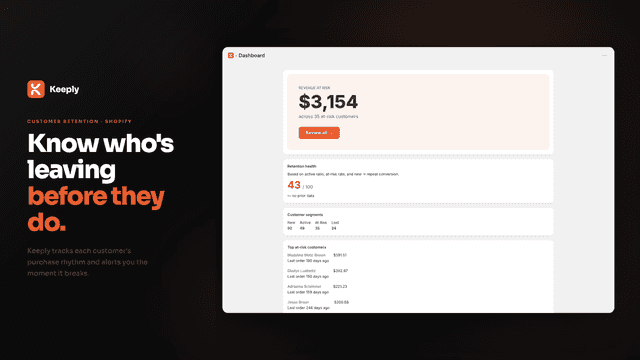
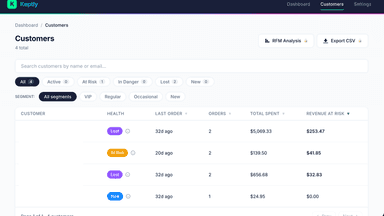
See every featureKeeply predicts customer churn before it happens by tracking each customer's individual purchase rhythm (ADBO). When the rhythm breaks, the customer moves to At Risk — with the exact revenue at stake. Automatically send personalised win-back email campaigns at the right moment. Build branded templates with a live preview, right inside Shopify Admin.
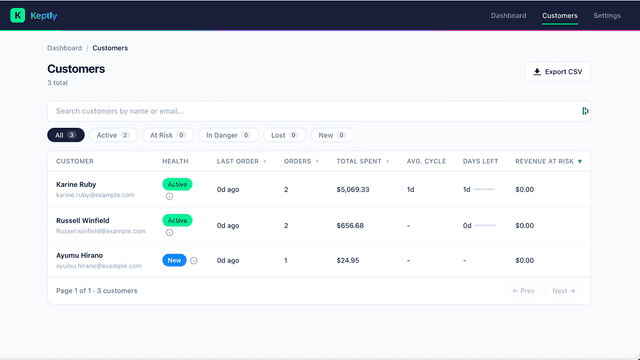
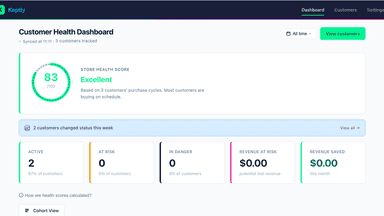
Most merchants don't notice customers leaving until the revenue is gone. Generic retention tools use fixed 30 or 60 day windows that treat every customer the same. Keptly calculates a personal repurchase cycle for each customer based on their actual order history, then assigns a health score: Active, At Risk, In Danger, or Lost.
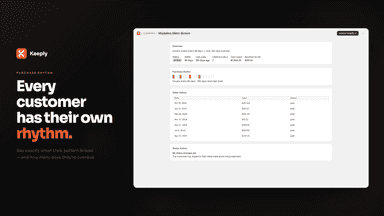
- Individual purchase rhythm per customer, not store-wide stats.
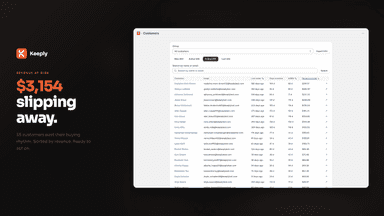
- Revenue at Risk — see churn impact, not just headcount.
- Four segments: New, Active, At Risk, and Lost customers.
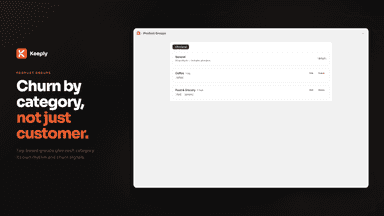
- Product Groups — track churn separately by product category.
- Health scores based on each customer's personal purchase cycle
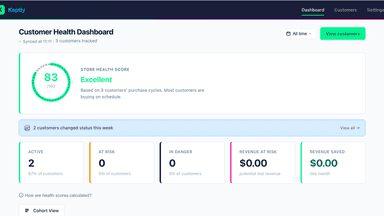
- Dashboard showing revenue at risk, trend charts, and store health score
- One-click discount codes, win-back email templates, and Shopify tagging
- Customer lifetime value estimates, cohort analysis, and CSV export
All the numbers
Every figure, side by side
A green dot marks the app ahead on a measured figure. Estimates, gaps and apps that leave no storefront trace never take the lead.
Adoption
| Measure |  Keeply |  Keptly |
|---|---|---|
| Detected stores | Not published | Not published |
| Net store change, 28 days | 0 | 0 |
| Stores added, 28 days | Not enough data | Not enough data |
| Big-brand share | Not enough data | Not enough data |
| Top store categories | Not published | Not published |
| Top store countries | Not published | Not published |
Reviews
| Measure | Keeply | Keptly |
|---|---|---|
| App Store rating | Not published | Not published |
| App Store reviews | Not published | Not published |
| New reviews, 28 days | Not enough data | Not enough data |
| Reviewers a year or more in | Not enough data | Not enough data |
FAQ
Keeply and Keptly: common questions
- Is Keeply or Keptly cheaper?
- Only Keptly lists a free plan. Paid plans start at $29/month for Keeply and $29/month for Keptly. Shoplist compares base prices only between monthly plans in the same currency; usage charges and annual plans vary, so check each plan’s limits.
- What features does each app list that the other doesn’t?
- Keptly lists 5 the others don’t mention, such as Cohort analysis, Custom reports, Forecasting, Lifetime value (LTV). A feature missing from a listing may still be supported; this compares what each App Store listing says.
- Where does this comparison’s data come from?
- Shoplist crawls Shopify storefronts to detect which apps each store runs, and reads each app’s Shopify App Store listing for reviews, pricing, features and integrations. Store counts are as of Oct 14, 2026 for Keeply, Oct 13, 2026 for Keptly; estimated figures are labeled.
How Shoplist compares apps
Store counts come from Shoplist’s crawl of Shopify storefronts, which detects the apps each store runs; they are as of Oct 14, 2026 for Keeply, Oct 13, 2026 for Keptly. Reviews, ratings, plans, features and integrations come from each app’s Shopify App Store listing. 28-day figures are labeled when estimated, and a figure that is missing or estimated never decides who leads. Read the methodology.