

Karto: Abandoned Cart Recovery vs Pushwoosh
Two Shopify apps, side by side: detected stores, momentum, reviews, plans, listed features and who runs each. Store counts as of Oct 14, 2026 for Karto, Feb 19, 2026 for Pushwoosh.
The short answer
- Only Karto lists a free plan.
- Pushwoosh lists 16 features Karto’s listing doesn’t mention, including APIs and webhooks, Back-in-stock emails, Cross-device carts.
Head to head


Free
- · 100% Automation - Setup once & Forget
- · 30 Abandoned carts/month
- · Conditional offers & cart recovery setup
- · Multi step recovery automation flow
- · Only Email channel
Basic
- · 100 Abandoned carts/month
- · 100% Automation - Setup once & Forget
- · Conditional offers & cart recovery setup
- · Email, Whatsapp
- · Global price shown; discounts in-app
- · Multi step recovery automation flow
Growth
- · 100% Automation - Setup once & Forget
- · 200 Abandoned carts/month
- · Conditional offers & cart recovery setup
- · Email, SMS, Whatsapp
- · Global price shown; discounts in-app
- · Multi step recovery automation flow
Basic
- · 1'000 subscribers
- · 10 projects
- · 1000 emails then
- · 20 user seats
- · SMS depends on the region
- · Unlimited In-App Impressions
Coverage counts what each App Store listing names. Every feature, checked off app by app, is in Shoplist.
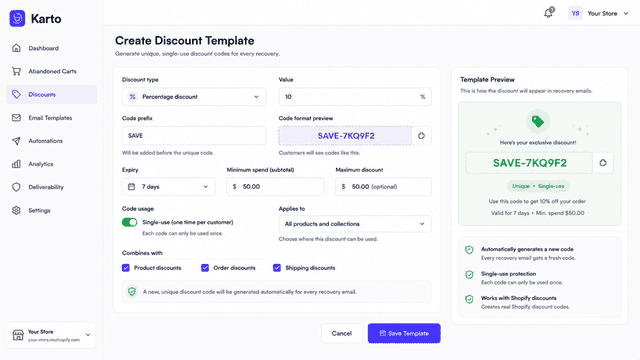
See every featureKARTO helps you recover abandoned carts automatically with intelligent, condition-based workflows across Email, SMS, WhatsApp. Create powerful recovery journeys using customer, cart, and product conditions, then automatically send reminders, discounts, gift cards, Buy X Get Y offers through the right channel at the right time.
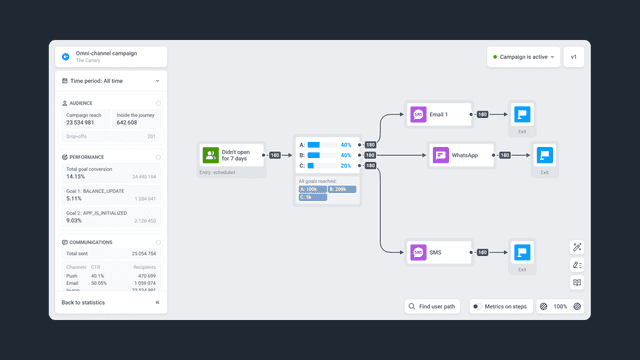
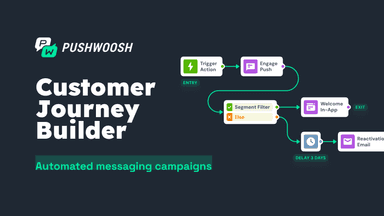
Pushwoosh helps merchants automate email, SMS, and WhatsApp messaging, improving customer engagement and sales. Ideal for e-commerce stores, it streamlines communication for cart recovery, order updates, promotions, and re-engagement. There is no manual work—just set up flows and segments to reach customers at the right time.
- One‑click recovery emails for any abandoned checkout
- Discount types: percentage, fixed amount, shipping discounts, and BxGy
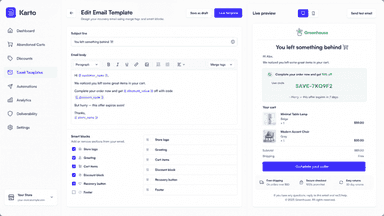
- Reusable email and discount templates with merge tags and preview
- Send from your own verified domain with DKIM, SPF, and DMARC
- Automated Messaging – Send personalized email, SMS, and WhatsApp notifications
- Customer Segmentation – Target customers based on purchase history and behavior
- Flow Integration – Automate messaging by connecting with Shopify Flows easily
- Real-Time Tracking – Monitor message delivery, open rates, and conversions



All the numbers
Every figure, side by side
A green dot marks the app ahead on a measured figure. Estimates, gaps and apps that leave no storefront trace never take the lead.
Adoption
| Measure |  Karto |  Pushwoosh |
|---|---|---|
| Detected stores | Not published | Not published |
| Net store change, 28 days | 0 | 0 |
| Stores added, 28 days | Not enough data | Not enough data |
| Big-brand share | Not enough data | Not enough data |
| Top store categories | Not published | Not published |
| Top store countries | Not published | Not published |
Reviews
| Measure | Karto | Pushwoosh |
|---|---|---|
| App Store rating | Not published | Not published |
| App Store reviews | Not published | Not published |
| New reviews, 28 days | Not enough data | Not enough data |
| Reviewers a year or more in | Not enough data | Not enough data |
FAQ
Karto and Pushwoosh: common questions
- Is Karto or Pushwoosh cheaper?
- Only Karto lists a free plan. Shoplist compares base prices only between monthly plans in the same currency; usage charges and annual plans vary, so check each plan’s limits.
- What features does each app list that the other doesn’t?
- Karto lists 11 the others don’t mention, such as Editor tool, Email domains, Multi-language, Surveys. Pushwoosh lists 16 the others don’t mention, such as APIs and webhooks, Back-in-stock emails, Cross-device carts, Drip campaigns. A feature missing from a listing may still be supported; this compares what each App Store listing says.
- Where does this comparison’s data come from?
- Shoplist crawls Shopify storefronts to detect which apps each store runs, and reads each app’s Shopify App Store listing for reviews, pricing, features and integrations. Store counts are as of Oct 14, 2026 for Karto, Feb 19, 2026 for Pushwoosh; estimated figures are labeled.
How Shoplist compares apps
Store counts come from Shoplist’s crawl of Shopify storefronts, which detects the apps each store runs; they are as of Oct 14, 2026 for Karto, Feb 19, 2026 for Pushwoosh. Reviews, ratings, plans, features and integrations come from each app’s Shopify App Store listing. 28-day figures are labeled when estimated, and a figure that is missing or estimated never decides who leads. Read the methodology.