

InventoryLoop: Reorder & PO vs Stockyard ‑ Purchase Orders
Two Shopify apps, side by side: detected stores, momentum, reviews, plans, listed features and who runs each. Store counts as of Oct 13, 2026.
The short answer
- Only Stockyard lists a free plan. Paid plans start at $29/month for InventoryLoop and $14.99/month for Stockyard.
- InventoryLoop lists 2 features Stockyard’s listing doesn’t mention, including Analytics, Forecasting.
Head to head


Starter
- · Automatic Shopify inventory updates
- · Basic reports and critical alerts
- · Explainable forecasts and reorders
- · Purchase orders, PDF/email, receipts
- · Up to 500 active SKUs and 1 location
Growth
- · Avg. costs, stock value, product margin
- · Everything in Starter
- · Landed costs: freight, duties, other
- · Purchase reports and CSV export
- · Up to 2,500 active SKUs, 5 locations
Pro
- · Everything in Growth
- · Full feature set with higher capacity
- · Up to 10,000 active SKUs, 20 locations
Free
- · 3 purchase orders a month, every feature
Standard
- · Create and receive purchase orders
- · Dead stock and cost variance reports
- · Drag-and-drop CSV import
- · Inventory updates written to Shopify
- · Reorder points and low-stock alerts
- · Supplier records and contacts
Coverage counts what each App Store listing names. Every feature, checked off app by app, is in Shoplist.
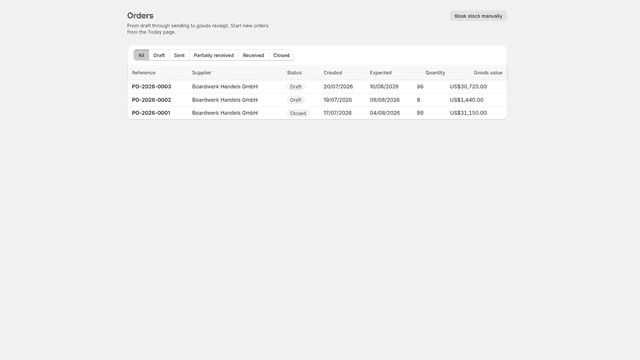
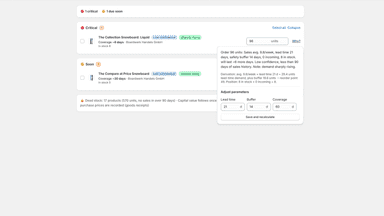
See every featureInventoryLoop turns sales history and current stock into explainable reorder suggestions. Out-of-stock days are excluded from sales velocity, and every recommendation shows its reasoning. Create purchase orders per supplier as PDFs or send them by email. Record partial receipts; landed costs are allocated across items and stock is written back to Shopify.
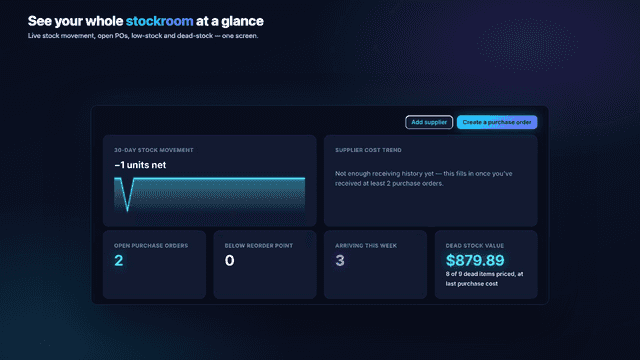
Stockyard covers what your Shopify purchasing setup is missing: reorder suggestions, supplier lead times, and a lasting purchase order history. Set reorder points and get an email before items run out, with a prefilled draft PO. Track what each supplier charges over time and catch quiet increases. Find already-tracked products that haven't sold in the last 60 days. Supplier records and partial receiving included.
- Daily reorder suggestions with visible reasoning and urgency
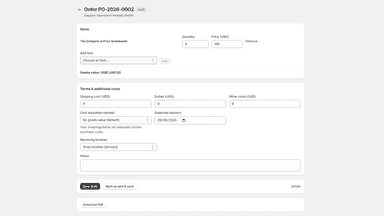
- One-click purchase orders per supplier, as PDF or straight to email
- Goods receipts with partial deliveries, stock written back to Shopify
- Real landed costs: freight and duties fairly allocated across items
- Reorder point alerts by email before items run out
- Prefilled draft purchase orders created from low-stock alerts
- Import suppliers and purchase order history from Stocky CSV files
- Supplier records with payment terms, lead times, and contacts



All the numbers
Every figure, side by side
A green dot marks the app ahead on a measured figure. Estimates, gaps and apps that leave no storefront trace never take the lead.
Adoption
| Measure |  InventoryLoop |  Stockyard |
|---|---|---|
| Detected stores | Not published | Not published |
| Net store change, 28 days | 0 | 0 |
| Stores added, 28 days | Not enough data | Not enough data |
| Big-brand share | Not enough data | Not enough data |
| Top store categories | Not published | Not published |
| Top store countries | Not published | Not published |
Reviews
| Measure | InventoryLoop | Stockyard |
|---|---|---|
| App Store rating | 5.0 ★ | Not published |
| App Store reviews | 1 | Not published |
| New reviews, 28 days | Not enough data | Not enough data |
| Reviewers a year or more in | Not enough data | Not enough data |
Pricing
| Measure | InventoryLoop | Stockyard |
|---|---|---|
| Free plan | Not listed | Yes |
| Lowest paid monthly plan | $29/month | $14.99/month(ahead) |
| Longest free trial | 30 days | 14 days |
| Plans listed | 3 | 2 |
Listing
| Measure | InventoryLoop | Stockyard |
|---|---|---|
| Shopify category rank | #351(ahead) | #568 |
| Shopify App Charts | Not on this week’s charts | Not on this week’s charts |
| Built for Shopify | No | No |
| Launched | Aug 4, 2026 | Aug 14, 2026 |
| Languages | 2 | 1 |
| Developer | Loop-Apps | Stelar Digital LLC |
FAQ
InventoryLoop and Stockyard: common questions
- Is InventoryLoop or Stockyard cheaper?
- Only Stockyard lists a free plan. Paid plans start at $29/month for InventoryLoop and $14.99/month for Stockyard. Shoplist compares base prices only between monthly plans in the same currency; usage charges and annual plans vary, so check each plan’s limits.
- What features does each app list that the other doesn’t?
- InventoryLoop lists 2 the others don’t mention, such as Analytics, Forecasting. Stockyard lists 2 the others don’t mention, such as Auto-restock, Insights. A feature missing from a listing may still be supported; this compares what each App Store listing says.
- Where does this comparison’s data come from?
- Shoplist crawls Shopify storefronts to detect which apps each store runs, and reads each app’s Shopify App Store listing for reviews, pricing, features and integrations. Store counts are as of Oct 13, 2026; estimated figures are labeled.
How Shoplist compares apps
Store counts come from Shoplist’s crawl of Shopify storefronts, which detects the apps each store runs; they are as of Oct 13, 2026. Reviews, ratings, plans, features and integrations come from each app’s Shopify App Store listing. 28-day figures are labeled when estimated, and a figure that is missing or estimated never decides who leads. Read the methodology.