

Inventory Autopilot Dead Stock vs Dead Stock Savers
Two Shopify apps, side by side: detected stores, momentum, reviews, plans, listed features and who runs each. Store counts as of Oct 13, 2026 for Inventory Autopilot Dead Stock, Nov 7, 2026 for Dead Stock Savers.
The short answer
- Both list a free plan. Paid plans start at $9.99/month for Inventory Autopilot Dead Stock and $49/month for Dead Stock Savers.
- Dead Stock Savers lists 8 features Inventory Autopilot Dead Stock’s listing doesn’t mention, including AI optimization, Analytics, Custom reports.
Head to head


Momentum
New reviews each month
Review pace is the clearest public read on how fast an app is winning new merchants.
Free
- · AI discount suggestions
- · Manual sync and basic analytics
- · Up to 50 products monitored
Starter
- · Daily auto-sync and bulk actions
- · Up to 500 products
- · Weekly email digest and clearance widget
Autopilot
- · Dedicated support and advanced analytics
- · Everything in Starter
- · Priority daily scans
Free
- · ABC inventory classification
- · Auto-detect dead stock from Shopify
- · Automatic Shopify sync
- · Top 10 dead SKUs by value
- · Total capital at risk dashboard
Recovery
- · AI Recovery Coach included
- · At-Risk SKUs early warning feed
- · Everything in Free
- · Full dead stock report — all SKUs
- · QuickBooks, Xero & CSV Integration
- · Recovery Value Estimator per SKU
Intelligence
- · Demand Forecasting for future risk
- · Everything in Recovery
- · Prioritised recovery plan by value
- · Recovery performance tracking
- · Unlimited AI recovery coaching
- · Walk-through coaching on top SKUs
Coverage counts what each App Store listing names. Every feature, checked off app by app, is in Shoplist.
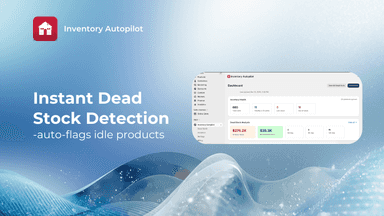
See every featureUnsold products are cash sitting on a shelf. Inventory Autopilot finds dead and slow-moving stock (60/90/120-day thresholds you control), applies tiered clearance discounts you approve in one click, and sells them through an automatic Clearance section that matches your theme. Prices restore when items recover. Works on large catalogs. A weekly digest shows the cash you've recovered.
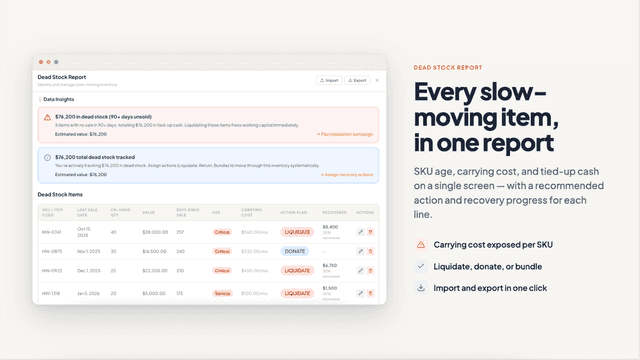
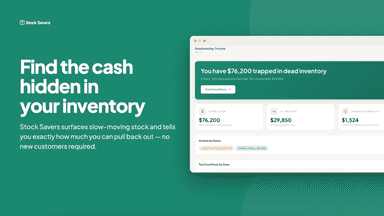
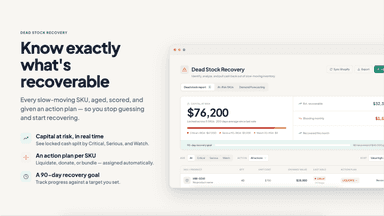
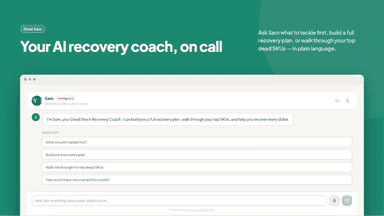
Stock Savers connects to your Shopify store and automatically identifies inventory that hasn't sold in 90+ days — showing you exactly how much cash is trapped and what it's costing you to hold it every month. Set recovery actions per SKU (liquidate, bundle, return, donate), see estimated recovery values at different scenarios, and get AI-powered coaching from Sam — your Dead Stock Recovery Coach — on where to start…
- Dead stock detection with configurable 60/90/120-day thresholds and tier escalat
- Clearance widget Theme App Extension, zero code, matches your store's design
- Weekly AI inventory digest with recovery projections and actionable next steps
- One-click bulk discount approval with tiered rules and full merchant control
- Automatic dead stock detection — flags SKUs with no sales in 90+ days
- Recovery Value Estimator — see liquidation, markdown, and return values per SKU
- AI Recovery Coach — get specific advice on which dead SKUs to tackle first
- At-Risk SKUs feed — catch slow-moving inventory before it becomes dead stock



All the numbers
Every figure, side by side
A green dot marks the app ahead on a measured figure. Estimates, gaps and apps that leave no storefront trace never take the lead.
Adoption
| Measure |  Inventory Autopilot Dead Stock |  Dead Stock Savers |
|---|---|---|
| Detected stores | Not published | Not published |
| Net store change, 28 days | 0 | 0 |
| Stores added, 28 days | Not enough data | Not enough data |
| Big-brand share | Not enough data | Not enough data |
| Top store categories | Not published | Not published |
| Top store countries | Not published | Not published |
Reviews
| Measure | Inventory Autopilot Dead Stock | Dead Stock Savers |
|---|---|---|
| App Store rating | Not published | 5.0 ★ |
| App Store reviews | Not published | 7 |
| New reviews, 28 days | Not enough data | Not enough data |
| Reviewers a year or more in | Not enough data | Not enough data |
Pricing
| Measure | Inventory Autopilot Dead Stock | Dead Stock Savers |
|---|---|---|
| Free plan | Yes | Yes |
| Lowest paid monthly plan | $9.99/month(ahead) | $49/month |
| Longest free trial | 7 days | Not listed |
| Plans listed | 3 | 3 |
Listing
| Measure | Inventory Autopilot Dead Stock | Dead Stock Savers |
|---|---|---|
| Shopify category rank | #328 | #50(ahead) |
| Shopify App Charts | Not on this week’s charts | Not on this week’s charts |
| Built for Shopify | No | No |
| Launched | Apr 28, 2026 | Jul 14, 2026 |
| Languages | 1 | 1 |
| Developer | Inventory Autopilot | Stock Savers |
FAQ
Inventory Autopilot Dead Stock and Dead Stock Savers: common questions
- Is Inventory Autopilot Dead Stock or Dead Stock Savers cheaper?
- Both list a free plan. Paid plans start at $9.99/month for Inventory Autopilot Dead Stock and $49/month for Dead Stock Savers. Shoplist compares base prices only between monthly plans in the same currency; usage charges and annual plans vary, so check each plan’s limits.
- What features does each app list that the other doesn’t?
- Dead Stock Savers lists 8 the others don’t mention, such as AI optimization, Analytics, Custom reports, Forecasting. A feature missing from a listing may still be supported; this compares what each App Store listing says.
- Where does this comparison’s data come from?
- Shoplist crawls Shopify storefronts to detect which apps each store runs, and reads each app’s Shopify App Store listing for reviews, pricing, features and integrations. Store counts are as of Oct 13, 2026 for Inventory Autopilot Dead Stock, Nov 7, 2026 for Dead Stock Savers; estimated figures are labeled.
How Shoplist compares apps
Store counts come from Shoplist’s crawl of Shopify storefronts, which detects the apps each store runs; they are as of Oct 13, 2026 for Inventory Autopilot Dead Stock, Nov 7, 2026 for Dead Stock Savers. Reviews, ratings, plans, features and integrations come from each app’s Shopify App Store listing. 28-day figures are labeled when estimated, and a figure that is missing or estimated never decides who leads. Read the methodology.