

Inventory Aging Pro vs Shelfie — Dead Stock Recovery
Two Shopify apps, side by side: detected stores, momentum, reviews, plans, listed features and who runs each. Store counts as of Oct 13, 2026.
The short answer
- Both list a free plan. Paid plans start at $19/month for Inventory Aging Pro and $9/month for Shelfie.
- Inventory Aging Pro lists 5 features Shelfie’s listing doesn’t mention, including Custom reports, Forecasting, Insights.
Head to head


Free
- · Inventory aging
- · Inventory dashboard
- · Reorder signals
- · Up to 250 tracked variants
Starter
- · CSV / XLSX export
- · Custom variant tracking
- · Inventory aging
- · Inventory analytics
- · Inventory dashboard
- · Reorder signals
Growth
- · Automatic discount engine
- · CSV / XLSX export
- · Custom variant tracking
- · Inventory aging
- · Inventory analytics
- · Inventory dashboard
Scale
- · Automatic discount engine
- · CSV / XLSX export
- · Custom variant tracking
- · Inventory aging
- · Inventory analytics
- · Inventory dashboard
Free
Growth
Pro
Coverage counts what each App Store listing names. Every feature, checked off app by app, is in Shoplist.
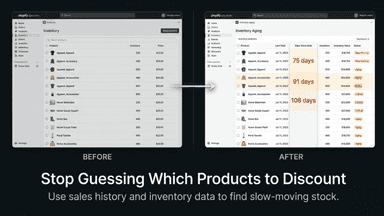
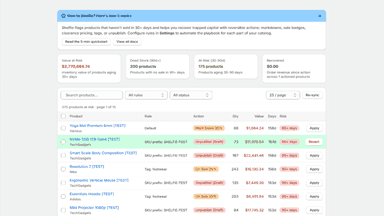
See every featureMerchants often lose valuable capital to products that remain unsold for months without knowing which inventory needs attention. Our app makes aging and slow-moving inventory easy to identify using last sold dates, sales velocity, stock levels, and inventory insights.
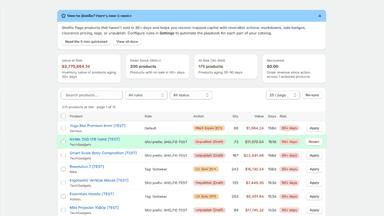
Most Shopify stores have a significant portion of inventory value sitting in products that have not sold in 60+ days. That capital is locked up, taking shelf space, and quietly losing value. Shelfie automatically surfaces this dead stock, suggests one-click recovery actions, and tracks how much each action recovers — so you can clear aging inventory with confidence and measurable ROI.
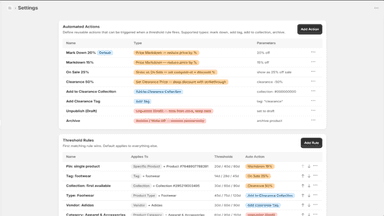
- Automatically apply discounts to aging products based on your rules.
- Find unsold products that tie up capital and reduce inventory efficiency.
- Track how long products have remained unsold and identify aging stock.
- Measure product sales velocity to spot declining and slow-moving products.
- Aging-based risk scoring (Healthy / Warning / Danger / Dead) on every product
- Rules engine — target by vendor, collection, tag, SKU prefix, or product type
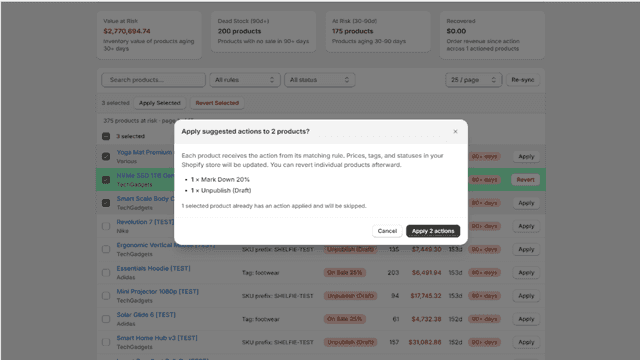
- Bulk apply and revert with confirm breakdown — full action history per product


All the numbers
Every figure, side by side
A green dot marks the app ahead on a measured figure. Estimates, gaps and apps that leave no storefront trace never take the lead.
Adoption
| Measure |  Inventory Aging Pro |  Shelfie |
|---|---|---|
| Detected stores | Not published | Not published |
| Net store change, 28 days | 0 | 0 |
| Stores added, 28 days | Not enough data | Not enough data |
| Big-brand share | Not enough data | Not enough data |
| Top store categories | Not published | Not published |
| Top store countries | Not published | Not published |
Reviews
| Measure | Inventory Aging Pro | Shelfie |
|---|---|---|
| App Store rating | Not published | Not published |
| App Store reviews | Not published | Not published |
| New reviews, 28 days | Not enough data | Not enough data |
| Reviewers a year or more in | Not enough data | Not enough data |
Pricing
| Measure | Inventory Aging Pro | Shelfie |
|---|---|---|
| Free plan | Yes | Yes |
| Lowest paid monthly plan | $19/month | $9/month(ahead) |
| Longest free trial | 7 days | 14 days |
| Plans listed | 4 | 3 |
Listing
| Measure | Inventory Aging Pro | Shelfie |
|---|---|---|
| Shopify category rank | #682 | #668(ahead) |
| Shopify App Charts | Not on this week’s charts | Not on this week’s charts |
| Built for Shopify | No | No |
| Launched | Sep 1, 2026 | Jun 23, 2026 |
| Languages | 2 | 1 |
| Developer | RK The Techist | cooe au |
FAQ
Inventory Aging Pro and Shelfie: common questions
- Is Inventory Aging Pro or Shelfie cheaper?
- Both list a free plan. Paid plans start at $19/month for Inventory Aging Pro and $9/month for Shelfie. Shoplist compares base prices only between monthly plans in the same currency; usage charges and annual plans vary, so check each plan’s limits.
- What features does each app list that the other doesn’t?
- Inventory Aging Pro lists 5 the others don’t mention, such as Custom reports, Forecasting, Insights, Threshold alerts. A feature missing from a listing may still be supported; this compares what each App Store listing says.
- Where does this comparison’s data come from?
- Shoplist crawls Shopify storefronts to detect which apps each store runs, and reads each app’s Shopify App Store listing for reviews, pricing, features and integrations. Store counts are as of Oct 13, 2026; estimated figures are labeled.
How Shoplist compares apps
Store counts come from Shoplist’s crawl of Shopify storefronts, which detects the apps each store runs; they are as of Oct 13, 2026. Reviews, ratings, plans, features and integrations come from each app’s Shopify App Store listing. 28-day figures are labeled when estimated, and a figure that is missing or estimated never decides who leads. Read the methodology.