
GoldSync vs GoldSync: Live Gold Price
Two Shopify apps, side by side: detected stores, momentum, reviews, plans, listed features and who runs each. Store counts as of Feb 19, 2026 for GoldSync, Oct 13, 2026 for GoldSync.
The short answer
- GoldSync lists 7 features GoldSync’s listing doesn’t mention, including Bulk editing, Custom pricing, Fixed discounts.
Head to head


Starter
- · 3-day free trial
- · Customizable pricing formula
- · Email support
- · Live rates + update history
- · One-click price updates
- · Per-variant + stone config
Basic
- · 3-day free trial
- · Bottom-selling-price floor
- · Compare-at price automation
- · Everything in Starter
- · Per-variant + stone config
- · Tax-inclusive pricing
Advanced
- · 3-day free trial
- · Auto-refresh every 12 hours
- · Automated price updates
- · Everything in Basic
- · Spot markup controls
- · Stop-loss floor prices
Coverage counts what each App Store listing names. Every feature, checked off app by app, is in Shoplist.
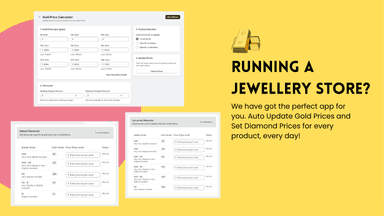
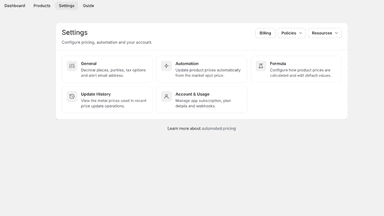
See every featureThe GoldSync App for Shopify is designed for jewelry stores to simplify product or collection updates. Get daily gold rate updates, set diamond charges, and add making charges with flexible options like flat rate, per gram, or percentage. Manage everything from a single dashboard and keep product rates transparent and accurate.
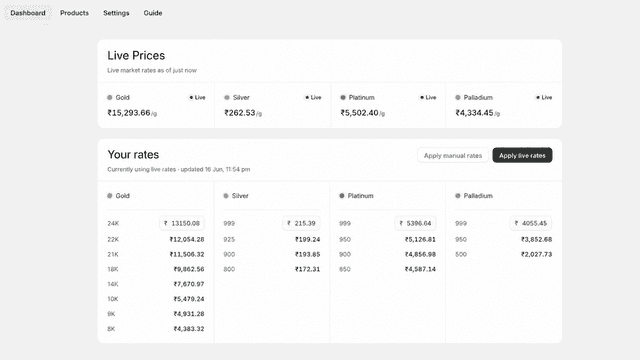
Jewelry prices change with metal rates throughout the day, making manual price updates across hundreds of products, weights, and purities slow and error-prone. GoldSync automatically calculates and updates your Shopify prices using live gold, silver, platinum, and palladium rates. Create pricing formulas based on purity, weight, making charges, wastage, stones, taxes, and more.
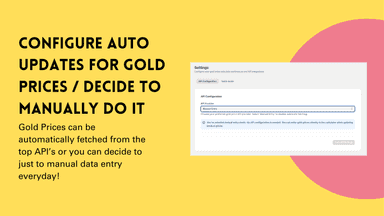
- Auto or Manual Gold Rates Updation
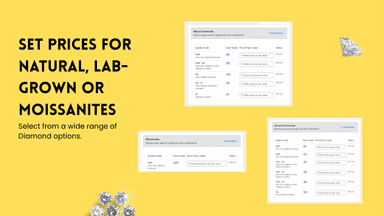
- Set Making and Diamond Charges
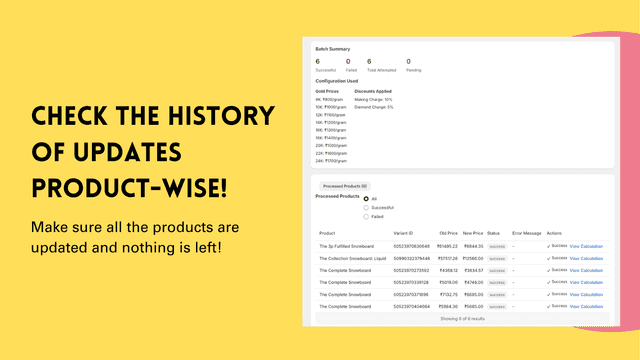
- Take a note of historical data with successful products update
- Seamless Integration with the website
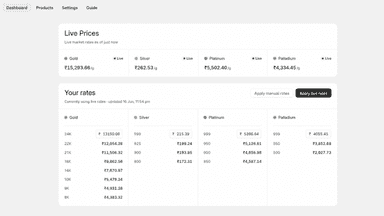
- Price products from live gold, silver, platinum and palladium rates
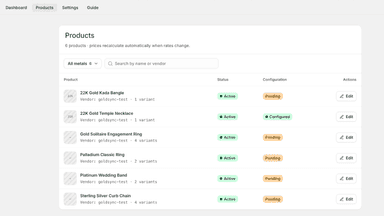
- Reprice your whole catalog in one click, or automatically as rates move
- Set making charges, wastage, purity and stone prices per product
All the numbers
Every figure, side by side
A green dot marks the app ahead on a measured figure. Estimates, gaps and apps that leave no storefront trace never take the lead.
Adoption
| Measure |  GoldSync |  GoldSync |
|---|---|---|
| Detected stores | Not published | Not published |
| Net store change, 28 days | 0 | 0 |
| Stores added, 28 days | Not enough data | Not enough data |
| Big-brand share | Not enough data | Not enough data |
| Top store categories | Not published | Not published |
| Top store countries | Not published | Not published |
Reviews
| Measure | GoldSync | GoldSync |
|---|---|---|
| App Store rating | Not published | 5.0 ★ |
| App Store reviews | Not published | 1 |
| New reviews, 28 days | Not enough data | Not enough data |
| Reviewers a year or more in | Not enough data | Not enough data |
FAQ
GoldSync and GoldSync: common questions
- What features does each app list that the other doesn’t?
- GoldSync lists 7 the others don’t mention, such as Bulk editing, Custom pricing, Fixed discounts, Percentage discounts. GoldSync lists 1 the others don’t mention, such as Auto-repricing. A feature missing from a listing may still be supported; this compares what each App Store listing says.
- Where does this comparison’s data come from?
- Shoplist crawls Shopify storefronts to detect which apps each store runs, and reads each app’s Shopify App Store listing for reviews, pricing, features and integrations. Store counts are as of Feb 19, 2026 for GoldSync, Oct 13, 2026 for GoldSync; estimated figures are labeled.
How Shoplist compares apps
Store counts come from Shoplist’s crawl of Shopify storefronts, which detects the apps each store runs; they are as of Feb 19, 2026 for GoldSync, Oct 13, 2026 for GoldSync. Reviews, ratings, plans, features and integrations come from each app’s Shopify App Store listing. 28-day figures are labeled when estimated, and a figure that is missing or estimated never decides who leads. Read the methodology.