

Glovokai: Address Translation vs Latinizr
Two Shopify apps, side by side: detected stores, momentum, reviews, plans, listed features and who runs each. Store counts as of Oct 13, 2026.
The short answer
- Glovokai lists 6 features Latinizr’s listing doesn’t mention, including Automated workflows, Conditional logic, Custom rules.
Head to head


Momentum
New reviews each month
Review pace is the clearest public read on how fast an app is winning new merchants.
Standard
- · Auto-transliteration
- · Manual/Bulk transliteration
- · Only transliterated orders are billed
- · Undo/Backup transliteration
Unlimited
Coverage counts what each App Store listing names. Every feature, checked off app by app, is in Shoplist.
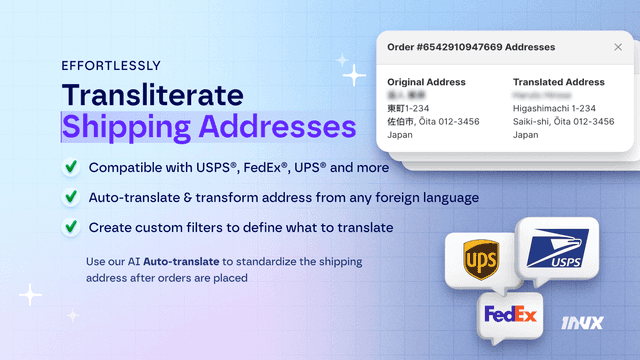
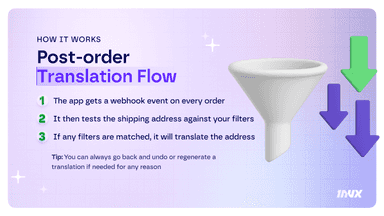
See every featureMany major international shipping carriers don’t support non-latin scripts when printing shipping labels. Glovokai automatically detects unsupported characters, transliterates and updates order shipping address, right after the order is created. Streamline your workflow today and reduce manual work, in just a few clicks.
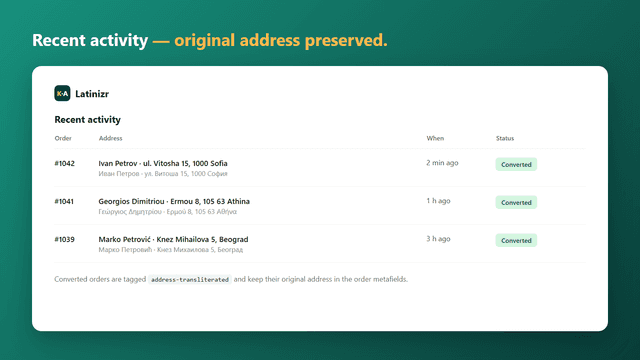
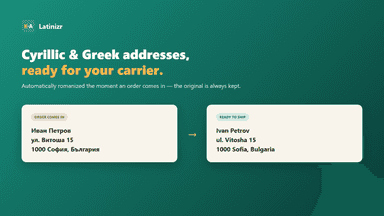
Selling into Bulgaria, Greece, Serbia or the wider Balkans? Carriers like DB Schenker and UPS often can't process Cyrillic or Greek addresses — so orders get delayed or returned. Address Latinizer fixes this automatically. The moment an order arrives, it transliterates the shipping address to Latin using official standards (Bulgarian Streamlined System, Greek ELOT 743, Serbian/Macedonian Latinica).
- Auto-translate & update shipping addresses post-order
- Build & test custom translation filters
- Edit translation prompts for tailored results
- Back up original addresses & undo translations anytime
- Fully automatic — transliterates every order the moment it comes in
- Official romanization for Bulgarian, Greek and Serbian/Macedonian scripts
- Original address preserved on every order — nothing is ever lost
- Zero setup — install and it works, no configuration needed




All the numbers
Every figure, side by side
A green dot marks the app ahead on a measured figure. Estimates, gaps and apps that leave no storefront trace never take the lead.
Adoption
| Measure |  Glovokai |  Latinizr |
|---|---|---|
| Detected stores | Not published | Not published |
| Net store change, 28 days | 0 | 0 |
| Stores added, 28 days | Not enough data | Not enough data |
| Big-brand share | Not enough data | Not enough data |
| Top store categories | Not published | Not published |
| Top store countries | Not published | Not published |
Reviews
| Measure | Glovokai | Latinizr |
|---|---|---|
| App Store rating | 4.0 ★ | Not published |
| App Store reviews | 5 | Not published |
| New reviews, 28 days | Not enough data | Not enough data |
| Reviewers a year or more in | Not enough data | Not enough data |
FAQ
Glovokai and Latinizr: common questions
- What features does each app list that the other doesn’t?
- Glovokai lists 6 the others don’t mention, such as Automated workflows, Conditional logic, Custom rules, Custom triggers. A feature missing from a listing may still be supported; this compares what each App Store listing says.
- Where does this comparison’s data come from?
- Shoplist crawls Shopify storefronts to detect which apps each store runs, and reads each app’s Shopify App Store listing for reviews, pricing, features and integrations. Store counts are as of Oct 13, 2026; estimated figures are labeled.
How Shoplist compares apps
Store counts come from Shoplist’s crawl of Shopify storefronts, which detects the apps each store runs; they are as of Oct 13, 2026. Reviews, ratings, plans, features and integrations come from each app’s Shopify App Store listing. 28-day figures are labeled when estimated, and a figure that is missing or estimated never decides who leads. Read the methodology.