
FraudFlag vs FraudLock
Two Shopify apps, side by side: detected stores, momentum, reviews, plans, listed features and who runs each. Store counts as of Oct 13, 2026.
The short answer
- Paid plans start at $19.99/month for FraudFlag and $19/month for FraudLock.
- FraudFlag lists 4 features FraudLock’s listing doesn’t mention, including Email notifications, Fraud filters, Fraud notifications.
Head to head


basic
- · 7 day free trial
- · Custom risk threshold
- · Domain blocking
- · Full order history dashboard
- · High risk email alerts
- · Order approve, flag, or cancel
Pro
- · 7 day free trial
- · Chargeback evidence package
- · Customer verification emails
- · Everything in Basic
- · Medium risk email alerts
- · Monday fraud digest email
Starter
Growth
Pro
Coverage counts what each App Store listing names. Every feature, checked off app by app, is in Shoplist.
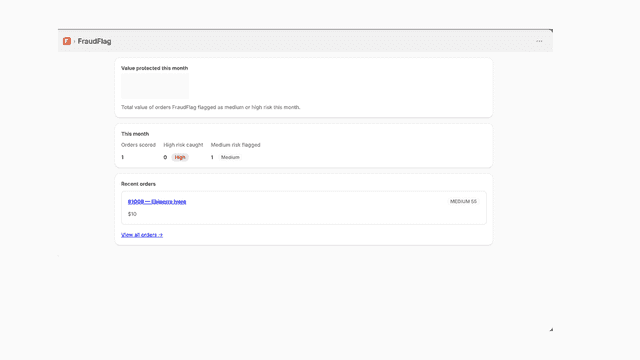
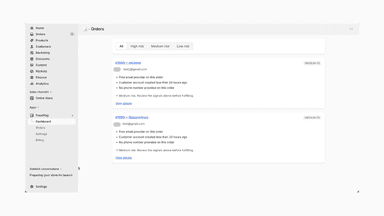
See every featureFraudFlag scores every incoming order for fraud risk before fulfilment. Each order gets a risk level with three plain English bullet points and one recommended action. Detected signals include personal email providers, large orders from first-time customers, mismatched billing and shipping addresses, and forwarding addresses. Merchants receive email alerts on risky orders.
FraudLock flags risky orders and explains exactly why in plain language, then lets you decide whether to clear, watch, verify, hold, or prepare evidence. It never auto-blocks orders or cancels good customers. Deterministic rules, no AI black box.
- Automatic order risk scoring with plain English explanations.
- Instant email alerts when a risky order arrives before shipping.
- Block entire email domains from placing orders.
- Approve, flag, or cancel any order from your dashboard.
- Explainable risk scoring with plain-language reasons
- Human-in-the-loop review — never auto-blocks orders
- Chargeback evidence packets


All the numbers
Every figure, side by side
A green dot marks the app ahead on a measured figure. Estimates, gaps and apps that leave no storefront trace never take the lead.
Adoption
| Measure |  FraudFlag |  FraudLock |
|---|---|---|
| Detected stores | Not published | Not published |
| Net store change, 28 days | 0 | 0 |
| Stores added, 28 days | Not enough data | Not enough data |
| Big-brand share | Not enough data | Not enough data |
| Top store categories | Not published | Not published |
| Top store countries | Not published | Not published |
Reviews
| Measure | FraudFlag | FraudLock |
|---|---|---|
| App Store rating | Not published | Not published |
| App Store reviews | Not published | Not published |
| New reviews, 28 days | Not enough data | Not enough data |
| Reviewers a year or more in | Not enough data | Not enough data |
FAQ
FraudFlag and FraudLock: common questions
- Is FraudFlag or FraudLock cheaper?
- Paid plans start at $19.99/month for FraudFlag and $19/month for FraudLock. Shoplist compares base prices only between monthly plans in the same currency; usage charges and annual plans vary, so check each plan’s limits.
- What features does each app list that the other doesn’t?
- FraudFlag lists 4 the others don’t mention, such as Email notifications, Fraud filters, Fraud notifications, Order validation. FraudLock lists 3 the others don’t mention, such as Chargeback alerts, Custom rules, Delivery. A feature missing from a listing may still be supported; this compares what each App Store listing says.
- Where does this comparison’s data come from?
- Shoplist crawls Shopify storefronts to detect which apps each store runs, and reads each app’s Shopify App Store listing for reviews, pricing, features and integrations. Store counts are as of Oct 13, 2026; estimated figures are labeled.
How Shoplist compares apps
Store counts come from Shoplist’s crawl of Shopify storefronts, which detects the apps each store runs; they are as of Oct 13, 2026. Reviews, ratings, plans, features and integrations come from each app’s Shopify App Store listing. 28-day figures are labeled when estimated, and a figure that is missing or estimated never decides who leads. Read the methodology.