
FormNest – Account Forms vs Singleton | Rich Registration
Two Shopify apps, side by side: detected stores, momentum, reviews, plans, listed features and who runs each. Store counts as of Oct 13, 2026 for FormNest, Nov 8, 2026 for Singleton.
The short answer
- Paid plans start at $7.99/month for FormNest and $9.99/month for Singleton.
- FormNest lists 3 features Singleton’s listing doesn’t mention, including Accounts portal, Profiles, Tagging.
Head to head


Build your own registration form with custom form fields


- United States
- Germany
- Canada
Momentum
New reviews each month
Review pace is the clearest public read on how fast an app is winning new merchants.
Monthly
Base Plan
- · All features included
Coverage counts what each App Store listing names. Every feature, checked off app by app, is in Shoplist.
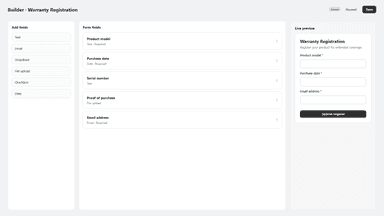
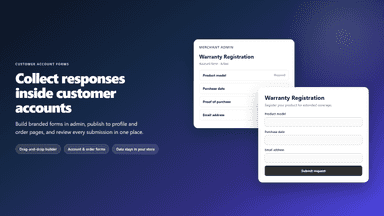
See every featureFormNest lets merchants create custom forms that appear inside the new customer account experience — on the profile page and on order status pages. Perfect for warranty registrations, return requests, wholesale applications, support intake, quote requests, and any post-purchase information you need from logged-in customers.
It's important to know about as much as possible about customers. This app will help with better understanding of the clients habits and needs. That knowledge will allow merchant to improve it's services and finally make more profit of his business. You can create unlimited custom fields in registration form and get all required data about your customers, that cannot be done with standard registration form.
- Build custom forms for customer account and order status pages
- Let customers view their past form submissions in account pages
- Review, update status, and export submissions from one dashboard
- Store all form data in your shop — nothing saved off-platform
- Add unlimited custom fields to your registration form, with own validations
- Send mail notifications for administrators after new customer is registered
- Allow to customers to edit theirs datas in theirs own accounts
- Copy customers data to "Customer Note" field, displayed in customer detail page




All the numbers
Every figure, side by side
A green dot marks the app ahead on a measured figure. Estimates, gaps and apps that leave no storefront trace never take the lead.
Adoption
| Measure |  FormNest |  Singleton |
|---|---|---|
| Detected stores | Not published | 70 |
| Net store change, 28 days | 0 | −3 |
| Stores added, 28 days | Not enough data | 2 |
| Big-brand share | Not enough data | Not enough data |
| Top store categories | Not published | Apparel & Accessories, Health & Beauty, Home & Garden |
| Top store countries | Not published | United States, Germany, Canada |
Reviews
| Measure | FormNest | Singleton |
|---|---|---|
| App Store rating | Not published | 4.7 ★ |
| App Store reviews | Not published | 21 |
| New reviews, 28 days | Not enough data | 0 |
| Reviewers a year or more in | Not enough data | Not enough data |
FAQ
FormNest and Singleton: common questions
- Is FormNest or Singleton cheaper?
- Paid plans start at $7.99/month for FormNest and $9.99/month for Singleton. Shoplist compares base prices only between monthly plans in the same currency; usage charges and annual plans vary, so check each plan’s limits.
- What features does each app list that the other doesn’t?
- FormNest lists 3 the others don’t mention, such as Accounts portal, Profiles, Tagging. A feature missing from a listing may still be supported; this compares what each App Store listing says.
- Where does this comparison’s data come from?
- Shoplist crawls Shopify storefronts to detect which apps each store runs, and reads each app’s Shopify App Store listing for reviews, pricing, features and integrations. Store counts are as of Oct 13, 2026 for FormNest, Nov 8, 2026 for Singleton; estimated figures are labeled.
How Shoplist compares apps
Store counts come from Shoplist’s crawl of Shopify storefronts, which detects the apps each store runs; they are as of Oct 13, 2026 for FormNest, Nov 8, 2026 for Singleton. Reviews, ratings, plans, features and integrations come from each app’s Shopify App Store listing. 28-day figures are labeled when estimated, and a figure that is missing or estimated never decides who leads. Read the methodology.