

Fluxley: AI Make‑an‑Offer vs Noodle ‑ AI Negotiation
Two Shopify apps, side by side: detected stores, momentum, reviews, plans, listed features and who runs each. Store counts as of Oct 14, 2026.
The short answer
- Fluxley lists 3 features Noodle’s listing doesn’t mention, including Automations, Custom discounts, Dynamic pricing.
Head to head


Free w/ Comission
- · 1% only when Fluxley closes a sale
- · Great for furniture, B2B, antiques
- · No monthly fees or minimums
- · Real-time AI chat, not email forms
- · Set min/max discount per product
- · True negotiation, not auto-accept rules
Standard
Coverage counts what each App Store listing names. Every feature, checked off app by app, is in Shoplist.
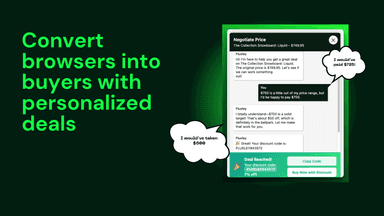
See every featureWhen customers hesitate on price, Fluxley's AI chat negotiates with them directly on your product pages. You set discount boundaries per product. Fluxley finds the minimum discount needed to close each sale. Works around the clock, so you capture deals even after hours. Ideal for high-ticket products, furniture, B2B, antiques, vintage, and clearance inventory.
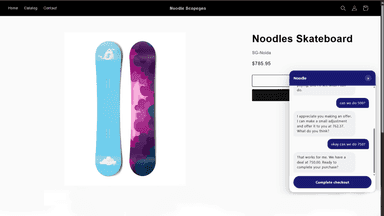
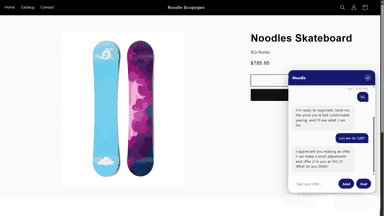
AI Negotiator is a Shopify discount app that lets customers negotiate prices, make an offer, and unlock custom discounts within merchant-set limits. Use AI price negotiation without revealing your lowest price, automatically apply the agreed deal to checkout, and track negotiated orders with tags. Ideal for dynamic pricing, discount offers, AI sales assistance, conversion optimization, and closing more sales.
- AI finds the minimum discount customers need, protecting your profit margins.
- Customers earn their discount, increasing loyalty and retention.
- Spend less on discounts.
- Set per-product min/max thresholds.
- Let customers negotiate prices directly in a live chat widget.
- Set your own maximum discount so prices never go too low.
- Apply rules to all products, a collection, or specific items.
- Exclude specific products from a broader rule automatically.



All the numbers
Every figure, side by side
A green dot marks the app ahead on a measured figure. Estimates, gaps and apps that leave no storefront trace never take the lead.
Adoption
| Measure |  Fluxley |  Noodle |
|---|---|---|
| Detected stores | Not published | Not published |
| Net store change, 28 days | 0 | 0 |
| Stores added, 28 days | Not enough data | Not enough data |
| Big-brand share | Not enough data | Not enough data |
| Top store categories | Not published | Not published |
| Top store countries | Not published | Not published |
Reviews
| Measure | Fluxley | Noodle |
|---|---|---|
| App Store rating | 5.0 ★ | Not published |
| App Store reviews | 5 | Not published |
| New reviews, 28 days | Not enough data | Not enough data |
| Reviewers a year or more in | Not enough data | Not enough data |
FAQ
Fluxley and Noodle: common questions
- What features does each app list that the other doesn’t?
- Fluxley lists 3 the others don’t mention, such as Automations, Custom discounts, Dynamic pricing. Noodle lists 1 the others don’t mention, such as Checkout discounts. A feature missing from a listing may still be supported; this compares what each App Store listing says.
- Where does this comparison’s data come from?
- Shoplist crawls Shopify storefronts to detect which apps each store runs, and reads each app’s Shopify App Store listing for reviews, pricing, features and integrations. Store counts are as of Oct 14, 2026; estimated figures are labeled.
How Shoplist compares apps
Store counts come from Shoplist’s crawl of Shopify storefronts, which detects the apps each store runs; they are as of Oct 14, 2026. Reviews, ratings, plans, features and integrations come from each app’s Shopify App Store listing. 28-day figures are labeled when estimated, and a figure that is missing or estimated never decides who leads. Read the methodology.