

ExIm ‑ Export Import pages vs PagePort ‑ Content Migration
Two Shopify apps, side by side: detected stores, momentum, reviews, plans, listed features and who runs each. Store counts as of Nov 7, 2026 for ExIm, Sep 23, 2026 for PagePort.
The short answer
- Only ExIm lists a free plan.
- ExIm lists 1 features PagePort’s listing doesn’t mention, including Two-way sync.
Head to head


export, import, pages, blogs, blog articles, theme settings
Momentum
New reviews each month
Review pace is the clearest public read on how fast an app is winning new merchants.
Free
- · Blog articles 50
- · Export only
- · Pages 50
- · Settings files 20
Basic
- · Blog articles 50
- · Export and Import
- · Pages 50
- · Settings files 20
Grow
- · Blog articles 250
- · Export and Import
- · Pages 250
- · Settings files 100
Coverage counts what each App Store listing names. Every feature, checked off app by app, is in Shoplist.
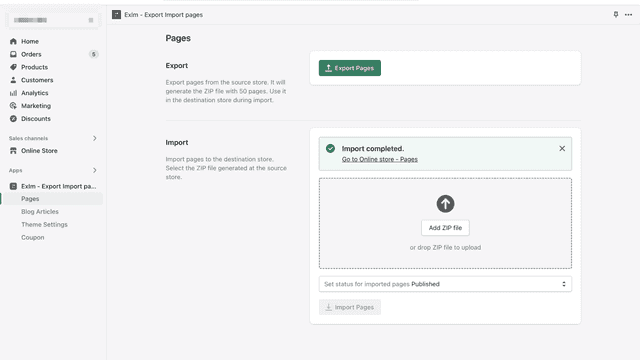
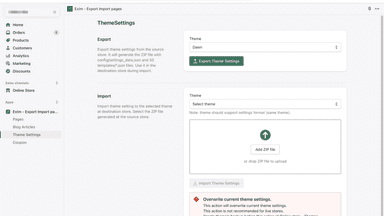
See every featureThe Exim app is designed to simplify store setup. You may copy pages and blog posts from another store. Copy theme settings feature is useful for theme developers. You may build multiple demo stores and easily load theme settings to the customer store.
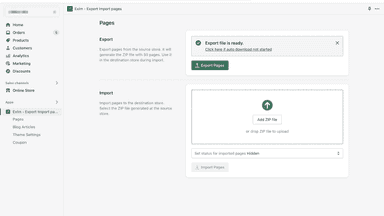
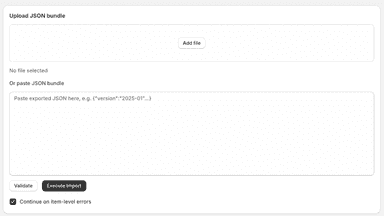
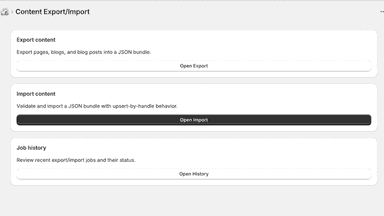
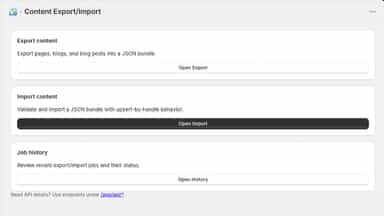
Export and import pages, blogs, and blog articles between Shopify stores. It reduces manual copy/paste work, supports store migrations, and creates structured backups for recovery. Built-in validation catches issues before import, while job tracking shows progress, outcomes, and errors so teams can fix problems quickly and keep publishing workflows reliable.
- One Click. A fast method to bulk export/import pages, blogs, and theme settings.
- Clone Pages and Blogs. Export from the existing store. Import into the new store
- Pre-sets. Generate pre-set configurations for you customers. Useful for web devs
- Export pages, blogs, and articles as JSON
- Validate imports before running to catch issues early
- Track job progress, results, and errors in one history view

All the numbers
Every figure, side by side
A green dot marks the app ahead on a measured figure. Estimates, gaps and apps that leave no storefront trace never take the lead.
Adoption
| Measure |  ExIm |  PagePort |
|---|---|---|
| Detected stores | Not published | Not published |
| Net store change, 28 days | 0 | 0 |
| Stores added, 28 days | Not enough data | Not enough data |
| Big-brand share | Not enough data | Not enough data |
| Top store categories | Not published | Not published |
| Top store countries | Not published | Not published |
Reviews
| Measure | ExIm | PagePort |
|---|---|---|
| App Store rating | 2.7 ★ | Not published |
| App Store reviews | 15 | Not published |
| New reviews, 28 days | 2 | Not enough data |
| Reviewers a year or more in | Not enough data | Not enough data |
FAQ
ExIm and PagePort: common questions
- Is ExIm or PagePort cheaper?
- Only ExIm lists a free plan. Shoplist compares base prices only between monthly plans in the same currency; usage charges and annual plans vary, so check each plan’s limits.
- What features does each app list that the other doesn’t?
- ExIm lists 1 the others don’t mention, such as Two-way sync. A feature missing from a listing may still be supported; this compares what each App Store listing says.
- Where does this comparison’s data come from?
- Shoplist crawls Shopify storefronts to detect which apps each store runs, and reads each app’s Shopify App Store listing for reviews, pricing, features and integrations. Store counts are as of Nov 7, 2026 for ExIm, Sep 23, 2026 for PagePort; estimated figures are labeled.
How Shoplist compares apps
Store counts come from Shoplist’s crawl of Shopify storefronts, which detects the apps each store runs; they are as of Nov 7, 2026 for ExIm, Sep 23, 2026 for PagePort. Reviews, ratings, plans, features and integrations come from each app’s Shopify App Store listing. 28-day figures are labeled when estimated, and a figure that is missing or estimated never decides who leads. Read the methodology.