
EmailOS vs Mailro: Email Marketing
Two Shopify apps, side by side: detected stores, momentum, reviews, plans, listed features and who runs each. Store counts as of Nov 7, 2026 for EmailOS, Nov 6, 2026 for Mailro.
The short answer
- Both list a free plan. Paid plans start at $49/month for EmailOS and $19/month for Mailro.
- EmailOS lists 10 features Mailro’s listing doesn’t mention, including Drip campaigns, Email capture list, Price drop emails.
Head to head


- United States
Free
- · 1,000 emails per UTC month
- · Browse abandonment emails
- · Customer segments with rules
- · Send from shared EmailOS domain
- · Sends pause when limit reached
- · Up to 3 flows (not archived)
Plus
- · 10,000 emails per billing period
- · Custom sending domain (DNS verify)
- · Customer segments with rules
- · Fixed price, no usage overage fees
- · Opens, clicks and revenue dashboard
- · Staff alerts to a fixed inbox
Pro
- · 50,000 emails per billing period
- · Custom sending domain (DNS verify)
- · Customer segments with rules
- · Fixed price, no usage overage fees
- · Opens, clicks and revenue dashboard
- · Staff alerts to a fixed inbox
Free
- · 3,000 emails per month
- · Segment subscribers
- · Send campains and automated Flows
- · Up to 500 subscribers
Standard
- · 1,000 subscribers included
- · 10,000 emails/month at starting tier
- · Segment subscribers
- · Send campains and automated Flows
Coverage counts what each App Store listing names. Every feature, checked off app by app, is in Shoplist.
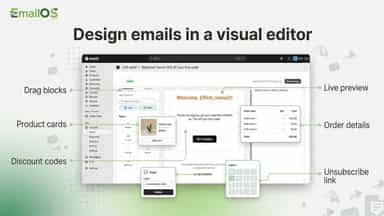
See every featureEmailOS sends automated emails from Shopify events for shoppers and your team. Customer flows include welcome, browse and cart recovery, post-purchase, and win-back. Each step can email the buyer or a fixed address for internal follow-up on purchase orders, invoice, dropship, or backorder. Use templates, segments, delays, and filters on products or order totals. Edit in a visual builder.
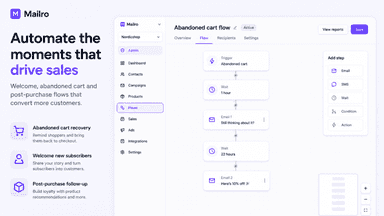
Mailro is an email marketing platform built for Shopify stores that want real results — not just opens and clicks. Connect your store in minutes. Mailro automatically recovers abandoned carts, welcomes new subscribers, and follows up after purchases. Every email is tracked back to actual revenue. Abandoned cart emails include order verification — customers are never emailed after completing a purchase.
- Automated email flows triggered by Shopify customer and order events
- Internal alerts to a fixed email for orders that need team follow-up
- Templates for dropship, backorder, Purchase Order, invoice, and order review
- Browse abandonment and abandoned cart recovery for shoppers
- Abandoned cart recovery with automatic order verification
- Revenue attribution — see exactly which emails drive sales
- Smart segments with flexible AND/OR filter logic



All the numbers
Every figure, side by side
A green dot marks the app ahead on a measured figure. Estimates, gaps and apps that leave no storefront trace never take the lead.
Adoption
| Measure |  EmailOS |  Mailro |
|---|---|---|
| Detected stores | 2 | Not published |
| Net store change, 28 days | 0 | 0 |
| Stores added, 28 days | Not enough data | Not enough data |
| Big-brand share | Not enough data | Not enough data |
| Top store categories | Apparel & Accessories, Home & Garden | Not published |
| Top store countries | United States | Not published |
Reviews
| Measure | EmailOS | Mailro |
|---|---|---|
| App Store rating | Not published | Not published |
| App Store reviews | Not published | Not published |
| New reviews, 28 days | Not enough data | Not enough data |
| Reviewers a year or more in | Not enough data | Not enough data |
FAQ
EmailOS and Mailro: common questions
- Is EmailOS or Mailro cheaper?
- Both list a free plan. Paid plans start at $49/month for EmailOS and $19/month for Mailro. Shoplist compares base prices only between monthly plans in the same currency; usage charges and annual plans vary, so check each plan’s limits.
- What features does each app list that the other doesn’t?
- EmailOS lists 10 the others don’t mention, such as Drip campaigns, Email capture list, Price drop emails, Product recommendations. Mailro lists 10 the others don’t mention, such as Analytics, Automations, Consent collection, Editor tool. A feature missing from a listing may still be supported; this compares what each App Store listing says.
- Where does this comparison’s data come from?
- Shoplist crawls Shopify storefronts to detect which apps each store runs, and reads each app’s Shopify App Store listing for reviews, pricing, features and integrations. Store counts are as of Nov 7, 2026 for EmailOS, Nov 6, 2026 for Mailro; estimated figures are labeled.
How Shoplist compares apps
Store counts come from Shoplist’s crawl of Shopify storefronts, which detects the apps each store runs; they are as of Nov 7, 2026 for EmailOS, Nov 6, 2026 for Mailro. Reviews, ratings, plans, features and integrations come from each app’s Shopify App Store listing. 28-day figures are labeled when estimated, and a figure that is missing or estimated never decides who leads. Read the methodology.